

Researching how AI affects junior hiring and job tasks @KingsCollegeLon and @AIObjectives
London
Joined April 2022
- Tweets1.3K
- Following583
- Followers795
- Likes7.3K




Pinned Tweet
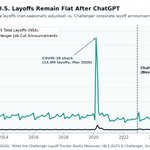
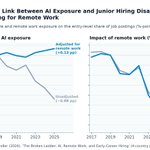
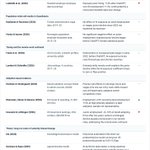
Has AI hit the labor market yet? @alexolegimas and my verdict after ~20 papers: not yet in aggregate. Unemployment and layoffs show almost nothing. But AI may already be cutting junior hiring in exposed white-collar jobs. Remote work may explain part of that decline.
A 🧵

The median of the leading superforecaster group expects US unemployment to peak at 8.5% until 2030. That's roughly what a normal recession produces. Aggregate labor-market disruption from AI has yet to appear in the data, as @alexolegimas and I laid out in this literature review: aleximas.substack.com/p/has-…


A perverse incentive for policymakers to slow the AI race: less data-center investment could ease pressure on sovereign bond yields while improving AI firms’ near-term free cash flow.
Short-term economic incentives might reinforce technological caution.

A morsel of reassurance from me about the recent market moves in @TheEconomist's leader pages:
"Either AI or public debt could crash markets. But probably not both"
And of the risks to fear, a sovereign-debt bust is far more worrying than an AI crash.
economist.com/leaders/2026/1…

These HMRC figures reinforce findings from @BKleinTeeselink’s UK research, which I assisted with: job postings and employment data show particularly sharp declines in junior hiring at AI-exposed firms. AI is probably part of the explanation.
papers.ssrn.com/sol3/papers.…

🚨 New Substack post: Key UK sectors are shedding young workers. Is AI to blame?🚨
I’ve been sceptical that AI is already reshaping the UK labour market. Business adoption is still narrow and shallow. But something odd is going on in the data...
HMRC payroll data: jobs held by 18–24s in info & comms are down 30% in three years vs just 3% for 35–49s. In finance, young people’s jobs fell ~10% while other ages in the sector grew.
On the surface youth payroll numbers haven't shifted massively but this hides some major sector by sector changes. Some of the UK's key sectors are seeing young/entry level payrolls drop rapidly. In my latest post I try to unpack what is going on and whether AI is to blame.
TL;DR is that, even if AI isn't yet to blame, we should still be concerned, not least as AI may well exacerbate these trends in some of the UK's most important sectors 1/


Our new website is live!
At the AI Objectives Institute, we're studying the economics of transformative AI, from its effects on labor markets to the broader economic and policy implications.
Explore our research: ai.objectives.institute/ai-a…

Wildberger will KI fördern und KI-Umsätze besteuern. Werden Nutzungsgebühren dadurch teurer, entsteht ein Zielkonflikt. Eine marktbezogene Umsatzabgabe erscheint mir sinnvoller als eine Tokensteuer. Entscheidend ist, wie stark beide die Nutzung verteuern.
Good to see the Conservatives proposing to halve employer National Insurance for young workers.
In July, I argued for going further: extending the existing exemption for under-25s to support junior hiring, especially as AI makes entry-level work less attractive.
smf.co.uk/opinion-and-analys…
Jacob Schaal retweeted
In the case of Germany, I think right-wing policy environment Ordoliberals, Austrians) doesn't look much different. So there's something to learn from French economic discourse!
These books shaped how I think about ambition, social convention, the consequences of machines, and the fate of Europe


Google, Amazon and OpenAI build their own chips to escape Nvidia. Nvidia’s backs open-weight models as a counterstrategy. Cheap models mean many small buyers who can’t design chips. Classic “commoditize your complement” aimed at its biggest customers.

Jacob Schaal retweeted

2026 saw a lot of smart people wake up to AI risk. I often talk to people who regret being skeptical of AI in the past, who regret not trying earlier. They wish they had paid attention to trend lines earlier, that they had listened to their weird friend who tried to convince them. Now they think it's too late for them to do useful AI safety work.
I wrote a reflection on my own journey into AI safety, to tell those people that this is not a new feeling. For years, I felt that I was too late, and it dissuaded me from joining the field. I was laughably wrong, and so are they. It is only October 2026, and we have a long way to go.
blog.karthiktadepalli.com/p/…

Great piece! In @Int_Politik in May, I argued the same: don't build a parallel stack. Negotiate the terms of joining the US one. internationalepolitik.de/de/…
But the mechanisms of "industrial AI" require more concreteness:
Joint ventures with conditions. Unlike China's car JVs, these pair different industries: labs bring models, factories bring process know-how. Conditions should stop the labs from siphoning off that know-how.
Firms capture value from their process data. Either own a model fine-tuned on it (RL-as-a-service), or sell it to labs as RL environments.
Interoperability rules. Low switching costs force labs to compete on price. That aids the commoditization you want. Switching at contract renewal keeps your exclusive deals stable.
Pull R&D funding. If a goal is quantifiable, pay European teams that achieve certain robotic tasks. The state pays for results and picks no winners.
The details require more careful thinking. I am considering looking more into this; lmk your thoughts!


'Industrial AI' is usually cope. Countries think they don't need frontier AI, and try to get by on industrial data and rampant protectionism instead.
Today's piece argues for a better deal: America makes the tokens, allies turn them into cancer cures, drones and robots.
writing.antonleicht.me/p/all…

Jacob Schaal retweeted

Looking for your feedback
"Help The Unjournal prioritize AI economics and governance research"
uj-prioritization-dashboard.…
lesswrong.com/posts/6fxHMfH7…
With the help of Claude, I updated my website with recent work on Transformers, FAZ, and the AI Labor Market Literature Review. Let me know what you think! Critical feedback is always appreciated. jacobschaal.com

Jacob Schaal retweeted

On the claim that AI is adversely affecting NYC entry level labor market; I had my research agent build on @alexolegimas & @FutureEconJacob 's work to assess the report - links below 1/


To reach my generation, for whom it matters most, I turned the lit review written with @alexolegimas into a music video. Who's to blame for the canaries coughing in the mine?
For those with a longer attention span, here's the full piece: substack.com/home/post/p-217…
Our living review with @alexolegimas, "Has AI impacted the labor market yet?", has its first update: six new papers in three days.
How it fits: exposed grads still find work, but later and in worse jobs. And a hit concentrated in a few majors barely moves average grad unemployment.
Full review, updated: aleximas.substack.com/p/has-…
Have a paper we're missing? Send it our way. We'll keep updating.

Has AI hit the labor market yet? @alexolegimas and my verdict after ~20 papers: not yet in aggregate. Unemployment and layoffs show almost nothing. But AI may already be cutting junior hiring in exposed white-collar jobs. Remote work may explain part of that decline.
A 🧵
Demirev looks at EU job postings from 2021–25. Before and after ChatGPT, postings for the most AI-exposed occupations fell 19–29% relative to the least exposed, with the steepest drop for entry-level roles.
Fairlie & @wu_jane check the class of 2026 in the CPS. Unemployment of recent college grads averaged 7.3% this summer, within the 2022–25 range, and didn't rise relative to older grads or non-grads.