

crypto with gister • ai • web3 • creativity • thought • freelance video editing • graphic design
Joined March 2024
- Tweets65K
- Following5.5K
- Followers5.6K
- Likes79.5K





GISTER OTF 💎 retweeted

I've been trying out Orilo for the past few days, and honestly, I'm quite impressed with the idea.
It's a personal AI voice assistant that lets you stay updated just by talking to it.
I can ask it about AI news, track topics I'm interested in, check my daily schedule, and get a personalized morning briefing without constantly switching between apps.
What I like most is that it's built around voice.
You don't always have to stop what you're doing and look at your screen to catch up.
Still exploring it, but I can already see how useful something like this could be in everyday life.
Pretty interesting stuff from the Orilo team.
🤝 Paid partnership
GISTER OTF 💎 retweeted

Migration series, surface 2: Proofs.
Last time I covered Accounts. This one is the proving layer, which the Quantum Hub labels "STARK proving assumptions."
What the page says is true today: the Starknet proving layer was designed for post-quantum security without relying on elliptic-curve hardness assumptions. That's a choice made at the base, and it ties back to the Foundations page.
The part I appreciated most is "what remains." The advantage is limited to the proving layer, and security still depends on the chosen hashes, parameters and implementation. So this isn't a blanket claim. It's a claim about one layer, and the page tells you where it stops.
Who can change it: StarkWare develops the proving system, and protocol level changes adopted by Starknet are subject to governance.
Under public evidence, the page says no component level evidence record is published for this surface yet. Accounts listed a mainnet demonstration, and this one doesn't have a record yet. I'd rather read a register that says "not yet" than one that fills every box.
Three surfaces left in the series.
Checked Nov 5, 2026.
quantum.starkware.co
@Starknet

GISTER OTF 💎 retweeted

Usually, the race starts when a token begins trading.
With zETH, it's happening before there's even a price chart.
Been following @zerufinance 's latest ActivityFi updates, and the live miner race is probably the part worth paying the most attention to right now.
Registration is done. The race is live. The auction comes next.
Meanwhile, the initial supply keeps shrinking as Ethereum activity burns through it.
And here's what makes this different from simply rewarding whoever shows up first.
Your previous Ethereum activity counts too.
So the race isn't only about who can generate the most transactions after an announcement. It's also about the onchain history people have already built.
The highest-ranked participants earn early access to the auction.
But getting that opportunity and having people willing to buy the token are two very different things.
A falling supply counter looks exciting, but I wouldn't mistake it for proof of demand.
What really matters is how the miner rankings develop, whether genuine contributors earn those seats, and what happens when the auction opens.
That'll tell us a lot more about ActivityFi than another launch announcement ever could.
🤝 Paid partnership
GISTER OTF 💎 retweeted

A network can have 1,543 validators and still face a concentration of power.
Because decentralization isn't just about how many participants exist. It's also about how much influence each participant can accumulate.
That's why one detail in @GenLayer's validator design caught my attention.
To qualify, a validator needs at least 42,000 GEN of its own stake. The active set is limited to the top 1,543 validators by weight.
But voting weight doesn't grow linearly with stake. GenLayer uses a square-root model.
So doubling your stake increases your voting weight by only about 41%, rather than doubling it.
This creates an interesting trade-off.
Stake still gives validators more influence and provides economic commitment to the network. But diminishing returns make each additional increase in influence harder to achieve through capital alone.
It's not a complete solution to concentration. Large stakeholders still have an advantage, and the active set means validator distribution remains important.
Still, I think the principle matters: economic commitment should help secure a decentralized court without allowing voting influence to scale endlessly at the same rate as wealth.
If one validator keeps accumulating more GEN, how much influence should they be allowed to gain before decentralization starts losing its meaning?
That's a question worth watching as the network grows.

GISTER OTF 💎 retweeted

was wondering how Developers pull one specific piece of website Data On Chain without writing Scrapers or exposing the whole session.
with @primus_labs you make a Data Verification Template... point it at the URL and the exact Request that holds the Data.
zkTLS then proves the Request happened and returned what you expected, without leaking the rest...
i opened the Hub and thought it would need a bunch of Config, but it just walks you through finding the Request and saving the Template... stays private unless you publish it.
does @primus_labs still accept Proofs from an old Template if the site changes the Request format later?

GISTER OTF 💎 retweeted

Uploads on @vangrid_io are not available in every region.
The capture docs explain that uploads may be restricted in certain regions.
When this happens, the app displays the message “Uploads are not available in your region.” These restrictions are based on both the capture location and the user's network region.
Captures without location data can still be uploaded, but they will not appear on the map.
Some bounties require location data to verify that the recorded place is accurate.
This means regional restrictions are different from location settings.
One can prevent an upload before the data enters the system.
The other only affects whether a capture appears on the map and whether it qualifies for certain bounties.
The board on data.vangrid.io also displays a PAST DEADLINE status.
When a bounty passes its deadline without being accepted, the escrow is returned to the payer on the original network.
These are two separate mechanisms.
Region restrictions determine whether contributors can submit captures, while deadlines determine whether escrowed funds are returned.
🤝 Paid partnership · 🤖 Made with AI

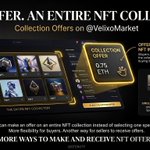
nft liquidity is already fragmented across different chains and marketplaces.
a collection can have active buyers on one platform while another marketplace offers a completely different experience.
@VelixoMarket is addressing part of this problem by bringing nft discovery and trading across fogo and robinhood chain into one marketplace.
but there’s an important distinction.
one interface doesn't mean shared liquidity. collections, listings and activity remain separate on each chain.
the real value is making it easier to discover and trade without constantly switching platforms.
that’s the part of velixo i want to explore further.
velixo.market/

GISTER OTF 💎 retweeted

if $50 is not small money to you, this one is for you!
i received my second reward from the @1win Creator Program a few days ago, and i thought more creators should know about this opportunity.
there's now a $4,000 weekly prize pool, with 60 creators eligible for rewards on the leaderboard.
once approved, you also get access to private creator channels. and if you keep performing consistently, you could work your way towards the Ambassador program.
if you're already creating content on X, why not give it a shot?
join here 👉🏼 1w-ugc.pro
use my invite code NACXAL4 when signing up.


$1,194 FROM JUST 10 FREE SPINS?
bro definitely had a memorable session on @1win.
imagine getting that kind of result before the session is even over.
GISTER OTF 💎 retweeted

Someone in a chat I was in said funding is free money: hold a position and get paid. It looked like income, so I treated it like income.
The funding payments were real. But a position that earns funding still carries the full price risk. Add fees, and together they took back more than the payments. The bill came to months of my income.
A payment you can see makes a bigger risk easy to ignore.
Posting this for @RallyOnChain. What’s the worst “free money” someone in a chat sold you? Reply with yours.
GISTER OTF 💎 retweeted

walk three sides of a statue carefully, rush the fourth, and the 3D model shows exactly where you hurried
that's straight from @vangrid_io's capture docs
a capture that misses a side produces a model with a hole in it
the basics are simple
➛ walk slowly around the subject
➛ keep the phone steady
➛ no quick pans
➛ cover every side you can reach
what surprises people is the upload check
it rejects clips that are too short or unreadable, but a clip with a missing side can still pass
the gap only shows up later, in the model
so the real filter is the contributor, not the upload screen
if one side is hard to reach, submit now or come back for a cleaner pass?
read the capture guide at docs.vangrid.io/contribute/c…

GISTER OTF 💎 retweeted

it's finally mint day for Fungo Genesis!
@FungoLabs is doing things a little differently this time, especially with the sealed-bid auction.
here's the schedule:
→ 12:30 UTC: 500 free mints for whitelist holders and nominees. This window runs for 3 hours.
→ 15:30 UTC: 2,500 Genesis NFTs go up for auction using cZAMA. Bidding stays open for 24 hours.
the part i'm most curious about is how the auction works.
bids stay encrypted while it's running, so nobody can check what others are offering. winners pay the same clearing price, and any excess funds are returned.
the artwork and NFT traits also use Zama's FHE technology to keep them encrypted.
so there's more going on here than just another NFT drop.
let's see how the auction plays out.
@FungoLabs


most NFTs reveal everything as soon as you mint. @FungoLabs is exploring what happens when you don't have to.
using Zama's FHE technology, FungoLabs lets NFT artwork and traits stay encrypted, so holders can choose when to reveal what’s hidden.
think about minting a collectible without seeing all its traits straight away, then discovering them later.
that adds a different kind of excitement to collecting. Rarity, surprises and the timing of a reveal all become part of the experience.
i like the idea because NFTs could be more than just something you mint, display and forget about.
the real test now is seeing what people build with this technology and how it works in practice.
keeping an eye on @FungoLabs

GISTER OTF 💎 retweeted

We voted for whoever made us laugh. Then spent weeks complaining when nothing got done.
Three candidates stood up and explained what they would do. I took notes on each:
- One had a specific plan for communicating lecture changes on time
- One made the promises that got the most laughs
- One had the most friends in the room
The serious candidate finished last. When lecture updates started missing students, the people who had voted on personality remembered what they had picked.
A careless vote is cast before thinking about who lives with the answer.
@GenLayer builds that answer into the network. Before any validator gets a say in a dispute, it locks at least 42,000 GEN of its own. Only the top 1,543 by weight are active.
More stake means more influence, but the relationship is deliberately capped. The network does not let wealth scale control linearly.
A wrong verdict and a corrupt one carry different costs:
- Wrong: the validator loses its fee and covers the same amount from locked GEN
- Corrupt: a percentage of everything locked is taken away, more for the leader than for the others
Locking GEN before voting separates having a say from having a stake in the answer.
If the person judging your dispute had to put their own savings behind the verdict, how differently would they read the evidence?

i've seen nfts used for art, gaming and community access.
but one use case i find interesting is using nft to represent a line of credit.
zeru previously described a credit delegation model where a credit line could be represented by an nft and transferred to another borrower.
think about what that could mean.
a wallet builds reputation through its financial behavior. that reputation helps establish credit capacity, and the credit line could potentially be delegated to someone else.
this raises an interesting question:
what if the value of your onchain reputation wasn't limited to your own wallet?
the idea still raises important questions around risk management, repayment responsibility and how credit delegation would work in practice.
but it introduces an interesting possibility for onchain lending.
@zerufinance is worth watching as it develops its behavioral credit infrastructure.


GISTER OTF 💎 retweeted

Congratulations 🎉 to me I just got @DONJAZZY Tech schoolarship.
Am so super excited and overwhelmed.
Thank you so much @DONJAZZY . God will continue to bless you and enrich you.
Thank you Jesus.


The Don Jazzy Tech Scholarship 2027 is now open!
Apply here: donjazzy.tsacademy.com
Good luck, guys! ❤️🐘


GISTER OTF 💎 retweeted

Retail now makes up about 30% of US equity trading volume, and that’s only the average. In AI, semiconductor and consumer names, its share runs much higher.
@Punk9277 on what’s driving the shift: access to global markets, trading around the clock, and research that now happens on social media and with AI.