

Tinkering Transformers | Coding by Day, Hallucinating by Night
Melbourne, Victoria
Joined January 2013
- Tweets577
- Following780
- Followers206
- Likes711




Pinned Tweet
Agentic RL environments are becoming critical. We integrated OpenReward (openreward.ai) into Alibaba’s ROLE (alibaba.github.io/ROLL/).
Details: github.com/alibaba/ROLL/pull…

Shamane Siri | Pluralis retweeted

This is what we've been working on at @Pluralis. Making distributed pretraining work on consumer GPUs over low-bandwidth connections required advances in both model architecture (arxiv.org/abs/2506.01260) and asynchronous data-parallel training (arxiv.org/abs/2601.22442), both published at NeurIPS.
We've since used Agora, our production training library, to pretrain 8B and 13B models across heterogeneous hardware with community contributors. Our technical report (arxiv.org/abs/2607.13332) describes the system and the 8B run.
Happy to answer any questions and keen to hear your thoughts.

Shamane Siri | Pluralis retweeted

Two new records for ProtocolNanoGPT
First, "random_sequence" pushed the record from 17,784s → 12,663s improving both training speed and convergence via v3 version of his submission.
- Seconds per step: 3.09s → 2.65s
- Steps to target loss: 5,750 → 4,775
Second, @Xingyu_9 dropped the record from 12,663s → 5,985.6s, another massive 53% reduction!
- Seconds per step: 2.65s → 2.28s
- Steps to target loss: 4,775 → 2,625
Based on the latest submission's description, "compressed pipeline communication with an overlapped schedule," it looks like improvements to the pipeline schedule played a major role!!

Shamane Siri | Pluralis retweeted
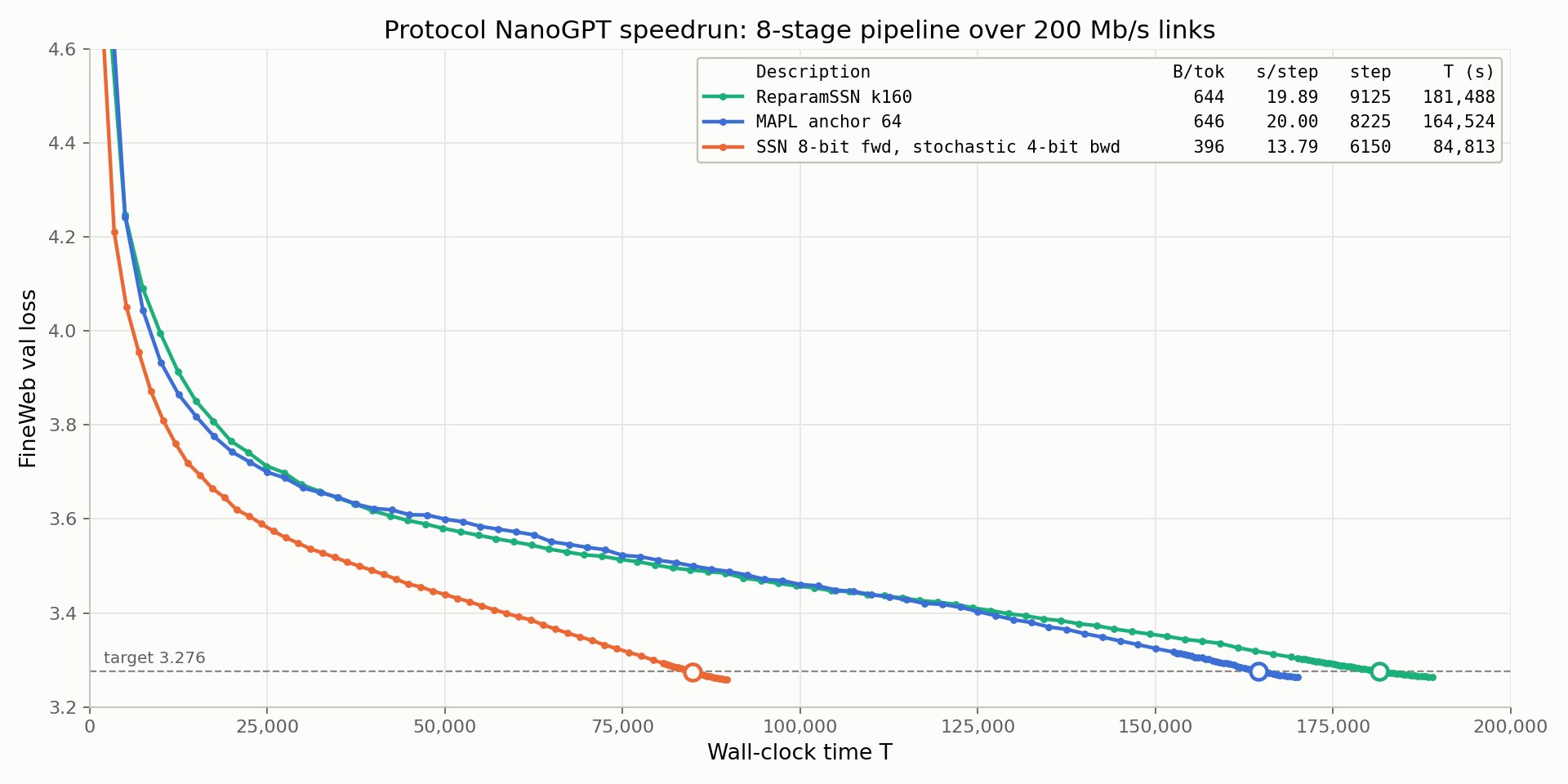
New ProtocolNanoGPT record from @vatsalshah01
Huge improvement from 164,525 s -> 84,813 s
This record introduces a new axis for optimising wall-clock time in the competition. On top of the activation compression used by Subspace Network (SSN), it adds 8-bit quantisation for the forward pass and 4-bit stochastic quantisation for the backward pass.
Shamane Siri | Pluralis retweeted

If you are a student who wants to get closer to frontier LLM lab, this is one of the fastest way to showcase your skill

Training over the internet is bottlenecked on communication between GPUs.
We’re launching Protocol NanoGPT, a speedrun challenge for multi-party LLM training over low-bandwidth links adapted from @kellerjordan0’s modded-nanogpt. Winners will be announced at the CODEC-FM workshop @NeurIPSConf 2026 with $18k in prizes. Open now through Dec 1st.
This gets us one step closer to frontier models owned by the community that builds them, and that no single party controls.

Here's some good news from Down Under!
We have three papers accepted at Neurips!
Covering both pre training and post training .


Shamane Siri | Pluralis retweeted

Happy to see this outcome at @NeurIPSConf and congrats to the team!
1. AsyncMesh was something very close to me and it allows async updates in both PP and DP axis and our recent Agora runs use the delay corrected sparse averaging we introduced in this paper.
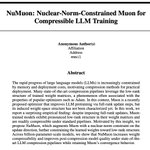
2. NuMuon is an investigation into how weight evolve in muon training which shows low-rank structure is present even in muon trained models which could be exploited for compression.
3. The communication efficient fine-tuning method introduces a novel 2-circuit training paradigm to adapt any open base model in a DP x PP mesh over the internet, without changing the architecture. This is a first step towards enabling open model post-training in Agora.
Looking forward to presenting them in Sydney.
We are fortunate to have 3 papers accepted to this years NeurIPS.
The first is AsyncMesh - a technique for asynchronous updates across both data and pipeline parallelism simultaneously.
Second is NuMuon, which shows the low-rank structure we observe in Subspace Networks is also present and can be exploited under Muon-style optimisers.
The third introduces a technique to finetune open-weight models in the Protocol Learning setup. This is significant as prior to this work, this kind of distributed training required architectural changes, and hence starting from scratch.


Shamane Siri | Pluralis retweeted
We are fortunate to have 3 papers accepted to this years NeurIPS.
The first is AsyncMesh - a technique for asynchronous updates across both data and pipeline parallelism simultaneously.
Second is NuMuon, which shows the low-rank structure we observe in Subspace Networks is also present and can be exploited under Muon-style optimisers.
The third introduces a technique to finetune open-weight models in the Protocol Learning setup. This is significant as prior to this work, this kind of distributed training required architectural changes, and hence starting from scratch.
Shamane Siri | Pluralis retweeted

We believe the ability to create frontier intelligence shouldn’t be concentrated in the hands of a few.
So far, Pluralis is the only company I see building a viable solution to this problem.

My position is typically to focus on getting things to work rather than making noise about what needs to be done, but enough people have messaged me in last 24 hours that felt I should write some brief thoughts. The tl;dr is I completely agree with the sentiment but think no-one aside from Pluralis is earnestly moving towards a realistic solution.
The reality is without some mechanism to pool resources for the creation of the models - with hardware that can't be taken away - the situation remains exactly the same, with a faint hope that Nvidia pours enough money into various challengers that the open <> closed model gap stays narrower for longer. I see very few scenarios where an individual group can pull ahead to the frontier (and even if they do, they will be subject to the same dystopian regulation the labs are now speedrunning towards). It must be a community driven effort to achieve this and hence we require a substrate to pool compute, data, and expertise effectively. This looks like p2p/distributed/multiparty training using hardware that has already been purchased to do local AI, thats sitting idle half the time, is physically controlled by individuals and can't be taken away. Repurposing this hardware for creation of the models and not just consumption is absolutely critical.
I don't view most of the other things in this list as meaningfully moving the needle towards a good outcome. RL post-trains as a service.. ok great you made it easier for enterprise clients to use open models. Inference providers serving openweights... ok you host models and make money I don't see what you've changed. Open harnesses... my concern was never that I'd be locked out of the harness layer. Local inference... I don't really care about qwen3.8 27b running at 200 tok/s I want deepseek v4 pro running locally, and I want a better model than deepseek v4 pro. I wanna own and impact the process not the output.
We don't have this yet because its hugely technically challenging - it requires solving fundamental research problems around low-bandwidth training and a re-write of most layers of the training stack. This is what we've been doing with extreme urgency for the last year and what we will continue to do until its working. Once such a system exists however, we will look back and find it strange that private companies ever felt they would be able to monopolize and control something this fundamental.
Shamane Siri | Pluralis retweeted

My position is typically to focus on getting things to work rather than making noise about what needs to be done, but enough people have messaged me in last 24 hours that felt I should write some brief thoughts. The tl;dr is I completely agree with the sentiment but think no-one aside from Pluralis is earnestly moving towards a realistic solution.
The reality is without some mechanism to pool resources for the creation of the models - with hardware that can't be taken away - the situation remains exactly the same, with a faint hope that Nvidia pours enough money into various challengers that the open <> closed model gap stays narrower for longer. I see very few scenarios where an individual group can pull ahead to the frontier (and even if they do, they will be subject to the same dystopian regulation the labs are now speedrunning towards). It must be a community driven effort to achieve this and hence we require a substrate to pool compute, data, and expertise effectively. This looks like p2p/distributed/multiparty training using hardware that has already been purchased to do local AI, thats sitting idle half the time, is physically controlled by individuals and can't be taken away. Repurposing this hardware for creation of the models and not just consumption is absolutely critical.
I don't view most of the other things in this list as meaningfully moving the needle towards a good outcome. RL post-trains as a service.. ok great you made it easier for enterprise clients to use open models. Inference providers serving openweights... ok you host models and make money I don't see what you've changed. Open harnesses... my concern was never that I'd be locked out of the harness layer. Local inference... I don't really care about qwen3.8 27b running at 200 tok/s I want deepseek v4 pro running locally, and I want a better model than deepseek v4 pro. I wanna own and impact the process not the output.
We don't have this yet because its hugely technically challenging - it requires solving fundamental research problems around low-bandwidth training and a re-write of most layers of the training stack. This is what we've been doing with extreme urgency for the last year and what we will continue to do until its working. Once such a system exists however, we will look back and find it strange that private companies ever felt they would be able to monopolize and control something this fundamental.

Shamane Siri | Pluralis retweeted

how inference engines actually work - releasing full talk slides!
i cover everything in the lifetime of a request e2e:
> the inference engine
> kv + prefix caching
> continuous batching
> paged attention
> chunked prefill
> sampling
> agentic loops from inside the engine

Shamane Siri | Pluralis retweeted
A 13B stress-test has just finished in Agora and instead of winding down we're going to ramp the contributor count until it blows up. If you have access to good local ML hardware, point your agent at agora-testing.pluralis.ai and join the pre-train for a few hours. Currently at 165 consumer GPU's.

Shamane Siri | Pluralis retweeted


Shamane Siri | Pluralis retweeted
Submissions are now open. Deadline Aug 29th, AoE.
collaborative-open-decentral…

Call for Papers — CODEC-FM @ NeurIPS 2026 (Sydney)
Frontier-scale training shouldn't require a hyperscaler's cluster. We're bringing together the open-model and decentralized-training communities to address the core technical challenges of this paradigm, extending foundation model training beyond a single datacenter and supporting more scalable, collaborative open-model development.
:push_pin: Topics: communication-efficient & async optimization · heterogeneous & fault-tolerant systems · federated learning at scale · security in trustless settings · open model infra & governance · benchmarks
:alarm_clock: Deadline: Aug 29, 2026
Details & CFP → collaborative-open-decentral…
@SameeraRamasin1 @benjamintherien @Ana_koloskova @ebelilov @niclane #kaja #Aakanksha @Pluralis

Shamane Siri | Pluralis retweeted

Zero Train–Inference Mismatch — now for linear attention, and under async RL 🎯
We got bitwise-exact trainer/generator parity for Gated DeltaNet (Qwen3.5-9B / 35B-A3B) on TorchTitan RL + vLLM, then asked the question nobody had actually tested in open source: does it help async RL?
Two firsts (as far as we know):
1️⃣ First open-source stack to hit train/inference logprob diff = 0 on a
linear-attention model
2️⃣ First to measure what zero mismatch is worth under async off-policy RL
How — smaller than it sounds:
• trainer and generator share one model definition (TorchTitan unified model). No more aligning trainer & generator op by op
• recurrent kernel everywhere on the forward (prefill + decode + trainer), chunked only for backward
• split-K off, batch-invariant GEMM, + a batch-invariant bmm for the MoE router
• we never touch FLA kernel internals — the recurrent kernel is intrinsically batch-invariant: one sequence's own state, fixed order, no cross-sequence reductions
• vLLM's linear-cache management + prefix caching keep working as-is
📊 Qwen3.5-9B + DAPO-Math, async at offpolicy = 4 / 12 / 32:
• logprob_diff = exactly 0 at step 0 ✅ every nonzero after that is staleness, not precision
• at offpolicy=32 the stock stack runs away past 0.065; ours holds ~0.035
• the unified model is free — the entire bill is the kernels
• also verified on MoE 35B-A3B and a 64-turn / 64K-context terminal agent
🤔 Now the honest part: it depends on the config. On math at offpolicy=12, BI leads on train reward and peaks highest on held-out AIME. On the terminal agent it's slightly ahead. On search, and on other math configs, the curves are indistinguishable. What is consistent is the numerics — BI keeps the gap from exploding as you widen the window. Cost: 2–3× trainer throughput (≈5× on the agent).
Our take: bitwise parity is a debugging tool, not a production default. Flip BI on for 20 on-policy steps — if the gap is 0 and your run is still broken, the infra is exonerated and the bug is in your data or your algorithm. That's worth 20 steps, not a whole run.
Next:
• make BI cheap (kill the 2–3×)
• more workloads, more seeds
• stay tuned for more complex agentic training recipes/tests 👀
Full writeup 🔗 yichuan-w.github.io/blog/GDN…
We collaborated closely with the TorchTitan team, and we sincerely encourage everyone to check out TorchTitan RL. With its clean, efficient unified model architecture and native async RL design, we believe it is a strong foundation for your next RL engine.
#LLM #RL #agentic #pytorch #torchtitan

Interesting to see, how Kimi K3 has specially worked on the effort level per domain.
arxiv.org/abs/2607.24653

Always nice to revisit those neural turning machines and differential neural computers.

I believe that LSTM based architectures (constant hidden state, constant flops / step) will crush transformers as we know them in 2-3 years.
we will laugh about KV Caches and how dumb we were..
to achieve this, the LSTM will need to have a large external memory bank with tool-use like Mem0 / RLMs / RAG to read/write memories into a db, but this will be more like us writing things in a notebook vs. being forced to memorize everything in a KV-cache.
this will require the model NOT to memorize facts inside the weights, but ONLY learn functions to manipulate, write, and retrieve facts, which of course is the better system.
if I am vibe coding, why do I need to know who Kevin Costner is, and how many people are in paris, and have all of those facts in my weight file.. seems like a waste.
and the whole model + fixed hidden state can sit in SRAM and the "memories" will sit in cpu ram (or disk?), as it will be addressed in small amounts and perhaps even regex-able vs. big heavy knn mat mul.
what is distinct about this structure is the model itself will need to learn a saliency function of what to store in short term, long term, vs. external memory such that it can be easily retrieved, and what to forget entirely... without ANY human example traces. just via RL.
the biggest implication as it comes to chips and DRAM is that it will prefer chips w large SRAM and a huge amount of SMs and likely little DRAM if any at all.
so chips that support this will be good investments.
does anyone else see this yet?
Shamane Siri | Pluralis retweeted

Lecture 10 of my course! Nominally on regularization in RL, so I discuss the evolving role of the KL penalty in RL, but also a set of nice RL papers that explain what RL helps models generalize better than SFT -- with theory supporting it.
When going through these, it's so interesting how seasonal problems in ML are. Lots of problems from controlling reward models overopt will rhyme as we try to control rubrics for agents.
00:00 Intro & the role of regularization
02:50 The KL penalty in RL
10:53 RL as a reverse KL loss
21:09 Why RL generalizes better than SFT
25:15 Other regularization tools
Just a few videos left as I get to the end of the course. Thanks all, and keep sending questions. Spread the word if you have a second.
Frontier-scale training for everyone, theory and practice.
Call for Papers — CODEC-FM @ NeurIPS 2026 (Sydney)
Frontier-scale training shouldn't require a hyperscaler's cluster. We're bringing together the open-model and decentralized-training communities to address the core technical challenges of this paradigm, extending foundation model training beyond a single datacenter and supporting more scalable, collaborative open-model development.
:push_pin: Topics: communication-efficient & async optimization · heterogeneous & fault-tolerant systems · federated learning at scale · security in trustless settings · open model infra & governance · benchmarks
:alarm_clock: Deadline: Aug 29, 2026
Details & CFP → collaborative-open-decentral…
@SameeraRamasin1 @benjamintherien @Ana_koloskova @ebelilov @niclane #kaja #Aakanksha @Pluralis
Shamane Siri | Pluralis retweeted
Call for Papers — CODEC-FM @ NeurIPS 2026 (Sydney)
Frontier-scale training shouldn't require a hyperscaler's cluster. We're bringing together the open-model and decentralized-training communities to address the core technical challenges of this paradigm, extending foundation model training beyond a single datacenter and supporting more scalable, collaborative open-model development.
:push_pin: Topics: communication-efficient & async optimization · heterogeneous & fault-tolerant systems · federated learning at scale · security in trustless settings · open model infra & governance · benchmarks
:alarm_clock: Deadline: Aug 29, 2026
Details & CFP → collaborative-open-decentral…
@SameeraRamasin1 @benjamintherien @Ana_koloskova @ebelilov @niclane #kaja #Aakanksha @Pluralis