
MTS @ stealth | PhD @CseHuji, Ex - Meta (FAIR)
Israel
Joined October 2022
- Tweets142
- Following832
- Followers389
- Likes1.3K




Gallil Maimon retweeted

the alpha in reading RL data model trajectories goes a lot further than just understanding model failures.
stuff like tooling issues that cost turns, data that a model might see that's unexpected, eval awareness, reward hacking, etc are all found in the trajectories. whether it's training or evalling, the first step to solidifying should be running out the task hundreds of times before feeling comfortable enough to ship it. the problem with assuming a task is good in the absence of rollouts is you can never know what you don't know. maybe you're leaving signal that would be valuable, a failure you didn't think to account, maybe your verifier is too brittle, maybe a certain tool doesn't work because you vibe-coded it. you never know till you read.
Gallil Maimon retweeted

New preprint: 🔥 Latent Information Feedback Transformers (LIFT) 🔥
Information in LM generation propagates downward (high to low layers) only through the decoded token, creating a bottleneck. Removing it via state propagation makes the model recurrent, which is not scalable for training.
Can we teach LMs to propagate state while keeping pretraining fully parallel? YES!
LIFT is a Transformer-based architecture + teacher-supervised training approach that enables Transformer LMs to exploit deep-to-shallow feedback, while keeping training parallel.
LIFT models consistently outperform standard Transformers and baselines on language modeling, downstream reasoning tasks, and procedural tasks under a token-matched budget, while being on par with or ahead of compute-matched Transformers. LIFT also outperforms Transformers trained on 8x more data on a state-tracking task, even when trained with the states of a Transformer that fails it!
Work by the amazing @TiroshDor and @AmosaurusRex
Paper: arxiv.org/abs/2609.38149
Detailed post + visualizations + code + models coming soon!

Gallil Maimon retweeted

🥳 Happy to share that our work on implicit transcription in SpeechLMs is heading to #EMNLP2026 Findings!
The updated version includes:
🎙️ Evaluation on natural speech
🧠 Additional decoding methods
🧪 New controls
Thanks to my great collaborators! @GallilMaimon @adiyossLC


Gallil Maimon retweeted
9/ This work was done in collaboration with @GallilMaimon and @adiyossLC .
Links:
📄 Paper:
arxiv.org/abs/2606.22473
🌐 Project page (with transcription examples):
pages.cs.huji.ac.il/adiyoss-…
🤗 Dataset:
huggingface.co/datasets/slpr…

Gallil Maimon retweeted

Talia Sternberg, Gallil Maimon, Yossi Adi, "Interleaved Speech Language Models Latently Work In Text" arxiv.org/abs/2606.22473
Gallil Maimon retweeted

Have LLMs become supervised learners (once again)?!
In our new paper, we argue that current LLMs’ post-training methods have effectively reverted to the "pre-train then fine-tune" era, explicitly tailoring models to desired behaviors.
1/n
🤖 Made with AI

Gallil Maimon retweeted

[1/5] Is Text Enough for Control? 🐇
Text-driven video editing lets you describe *what* to change. But what about *how much*?
We introduce Adaptive-Origin Guidance (AdaOr).
A joint work with @DecartAI and @TelAvivUni 🧪
accepted to #SIGGRAPH2026.
Gallil Maimon retweeted

StressTest is heading to #ACL2026! ✌️
Updates include:
☕️ StressPresso, new benchmark for stress tasks generalization.
🧠 More models and more complex reasoning tasks!
Thanks to the GREAT collaborators @GallilMaimon @adiyossLC !
Project and paper: 🔗 pages.cs.huji.ac.il/adiyoss-…

Gallil Maimon retweeted

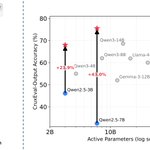
Coding models still have a weird blind spot: they can write code, but often can't faithfully predict what that code will do.
"Self-Execution Simulation Improves Coding Models" attacks that gap by training models to mentally execute programs, then using that skill to rank and repair solutions.

Gallil Maimon retweeted

[CL] Self-Execution Simulation Improves Coding Models
G Maimon, O Yoran, F Kreuk, M Hassid… [FAIR team, Meta] (2026)
arxiv.org/abs/2604.03253


Gallil Maimon retweeted

🚨 New Paper Alert 🚨
We assume the "Wisdom of the Crowd" surfaces the best models, but are we actually finding the right ones? 🤔
Surprisingly, popularity is a poor proxy for performance and better options exist! 📉
Project: jonkahana.github.io/hidden_g…
👇 Here's what we found:
Gallil Maimon retweeted

Can LLMs reliably predict program termination?
We evaluate frontier LLMs in the International Competition on Software Verification (SV-COMP) 2025, directly competing with state-of-the-art verification systems.
@AIatMeta @HebrewU @Bloomberg @imperialcollege @ucl
@jordiae @pascalkesseli @jvanegue @HyadataLab @adiyossLC @PeterOHearn12
Paper: arxiv.org/pdf/2601.18987
Website: orensultan.com/llms_halting_…
🧵👇
1/n

Gallil Maimon retweeted

🆕 Code World Models: Building World Models for Computation
youtube.com/watch?v=sYgE4ppD…
One of the biggest ideas in codegen this year was the CWM from @AIatMeta. @jacob_d_kahn joins us to discuss the intuition, results, and RL work behind building such a highly capable research model!
thanks to @syhw for helping to set this up!
Gallil Maimon retweeted

I'm immensely proud of the work done by my cracked CodeGen team at Meta, with PhD students and veterans, for which nothing is someone else's problem.
The broader Meta AI community all pulled together for this.
I'm very thankful for the unwavering support of our whole leadership.
Gallil Maimon retweeted

New from Meta FAIR: Code World Model (CWM), a 32B-parameter research model designed to explore how world models can transform code generation and reasoning about code.
We believe in advancing research in world modeling and are sharing CWM under a research license to help empower the community to build upon our work.
➡️ Read the technical report: ai.meta.com/research/publica…
➡️Download the open weights: huggingface.co/facebook/cwm
➡️Download the code: github.com/facebookresearch/…
Gallil Maimon retweeted

Code World Model: producing code by imagining the effect of executing instructions and planning instructions that produce the desired effect.

(🧵) Today, we release Meta Code World Model (CWM), a 32-billion-parameter dense LLM that enables novel research on improving code generation through agentic reasoning and planning with world models.
ai.meta.com/research/publica…
Gallil Maimon retweeted

new research from Meta FAIR: Code World Model (CWM), a 32B research model
we encourage the research community to research this open-weight model!
pass@1 evals, for the curious:
65.8 % on SWE-bench Verified
68.6 % on LiveCodeBench
96.6 % on Math-500
76.0 % on AIME 2024
🧵

Gallil Maimon retweeted

Interesting! Weights on HF of course: huggingface.co/collections/f…

(🧵) Today, we release Meta Code World Model (CWM), a 32-billion-parameter dense LLM that enables novel research on improving code generation through agentic reasoning and planning with world models.
ai.meta.com/research/publica…
Gallil Maimon retweeted

📢 Our Conversational AI Reading Group is back!
Join the first Fall 2025 session! 🤖
📅 Thursday, Sept 18 | 11 AM–12 PM EST
🎙 Speaker: Pooneh Mousavi (Mila) @MousaviPooneh
📖 Topic: “Discrete Audio Tokens: More Than a Survey!”
🌐 Details: poonehmousavi.github.io/rg
Gallil Maimon retweeted

I’ll be presenting our survey paper “Discrete Audio Tokens: More Than a Survey!” at the first Fall 2025 session of the Conversational AI Reading Group.
Looking forward to seeing you there and discussing ideas!

📢 Our Conversational AI Reading Group is back!
Join the first Fall 2025 session! 🤖
📅 Thursday, Sept 18 | 11 AM–12 PM EST
🎙 Speaker: Pooneh Mousavi (Mila) @MousaviPooneh
📖 Topic: “Discrete Audio Tokens: More Than a Survey!”
🌐 Details: poonehmousavi.github.io/rg