

Two thousand years of the Germanic-speaking world, one entry a day. Battles, paintings and old photographs, from the Rhine to the Cape.
- Tweets476
- Following39
- Followers155
- Likes261




ALT Varusschlacht (The Battle of the Teutoburg Forest), painted by Otto Albert Koch in 1909. Germanic warriors overrun Roman legionaries in a forest battle.

ALT The Holstentor in Lübeck, photochrom print from the 1890s. The twin-towered brick city gate with tram lines running past.

ALT Ribe seen from the cathedral's Borgertårnet, photographed by Kristian Hude around 1900. Tiled roofs run out to the flat marsh and river.

ALT Kerkbuurt harbour on Marken, photochrom print from the 1890s. Wooden houses on mounds, a canal and fishermen in the foreground.

ALT Schaffhausen with the Munot fortress on the hill, photochrom print from the 1890s. The old town above the Rhine.

ALT The Battle of the Lechfeld, painted by Michael Echter in 1860. Otto the Great's horsemen ride into the Magyar army under raised banners.

ALT The Nine Sovereigns at Windsor, photographed by W. & D. Downey on 20 May 1910. Nine kings in dress uniform, six standing and three seated, on the day of Edward VII's funeral.

ALT Alfred Nobel, photographed by Gösta Florman before 1896. He sits in profile in a carved chair, chin resting on his hand.

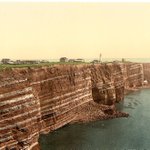
ALT West coast and Oberland, Heligoland, photochrom from the 1890s. Red sandstone cliffs with the church and lighthouse on top.

ALT Heligoland in 1648, map by Franz Geerz, 1886. The island and its reefs as they were in 1648, with the land lost to the sea since then marked in yellow.

ALT Embarkation of the Pilgrims, painted by Robert W. Weir in 1843. The Pilgrims pray on the deck of the Speedwell before leaving Delfshaven in Holland in July 1620.

ALT The Royal Charles brought in as a prize, painted by Jeronymus van Diest in 1667. The captured English flagship under Dutch flags, with other ships around her.

ALT Salzburg from the Kapuzinerberg, photochrom from the 1890s. The old town and cathedral domes under the Hohensalzburg fortress, with snowy mountains behind.

ALT Der König überall, painted by Robert Warthmüller in 1886. Frederick the Great inspects the potato harvest while peasants show him their crop.


ALT Edystone Light-house, engraved by Henry Winstanley around 1700. His own print of the lighthouse he built on the Eddystone rocks off Plymouth, with notes on how it was built.

ALT Canal and Belfry, Bruges, photochrom print from the 1890s. A still canal with the Belfry rising behind the old houses.

ALT The Rozenhoedkaai and the Belfry of Bruges today, photographed by Ank Kumar (CC BY-SA 4.0). The same canal view, with the tower still behind the houses.

ALT The Groenerei, Bruges, photochrom print from the 1890s. A stone bridge crosses the canal, with boats moored below and the Belfry behind.

ALT The Groenerei in Bruges at night, photographed by Rainer Halama (CC BY-SA 4.0). The canal and its stone bridge, lit up under the trees.

ALT Gustavus Adolphus at the Battle of Breitenfeld, painted by Johann Jakob Walter in 1632. The Swedish king rides a rearing horse above the battlefield.

ALT The Plönlein in Rothenburg ob der Tauber, photochrom print from the 1890s. A half-timbered house stands where two cobbled streets fork towards two medieval gate towers.

ALT The Loss of the White Ship in 1120, drawn by Cecil King around 1922. The ship breaks up in a storm while a small boat is swamped beside it.

ALT Burg Eltz in the Moselle valley, Germany, photochrom print, 1890s. The castle's towers and half-timbered upper storeys rise above the forest.

ALT The Pfalz toll castle on its island in the Rhine at Kaub, Germany, with Gutenfels Castle on the vineyard hill behind, photochrom print, 1890s.

ALT Reichsburg Cochem on its vineyard hill above the town of Cochem on the Moselle, Germany, photochrom print, 1890s.

ALT The Marksburg on its steep wooded hill above Braubach on the Rhine, Germany, photochrom print, 1890s.

ALT The Battle of Stamford Bridge, painted by Peter Nicolai Arbo in 1870. Harald Hardrada, in blue, is struck in the throat by an arrow in the middle of the fighting.

ALT Lauterbrunnen valley with the Staubbach falls, Bernese Oberland, Switzerland, photochrom print, 1890s. A woman stands on a green slope above the village, with cliffs and the snowy Jungfrau behind.

ALT Portrait of Abel Tasman with his wife and daughter, painted by Jacob Gerritsz Cuyp in 1637. Tasman stands by a globe in black with a white ruff.

ALT Breakfast under the Big Birch, painted by Carl Larsson in 1896. His family eat at a long table in the garden of the house at Sundborn.

ALT The Lazy Nook (Lathörnet), painted by Carl Larsson in 1894. A striped daybed and a sleeping dog in a room of the house at Sundborn.

ALT Crayfishing, watercolour by Carl Larsson from his Ett hem series, published 1899. Children fish by the river at Sundborn while a crayfish meal is laid out on the grass.

ALT The Veranda, watercolour by Carl Larsson from his Ett hem series, published 1899. A dog lies on the steps by the yellow front door of the house at Sundborn.