

Web3 without switching apps. TG: https://xitter.cf/t.co/d3O329xJJH
Global Unity
Joined January 2025
- Tweets485
- Following519
- Followers5.4K
- Likes11.1K




Pinned Tweet
Most people still don't know what Glunity actually is.
So here's the full picture: one thread, everything you need.
What we're building, why, and where we are right now. 👇

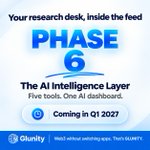
Think of Phase 6 as a research desk built into your feed.
Targeted for Q1 2027, the AI Intelligence Layer brings five things to Glunity:
1. AI project discovery, to surface projects worth a look.
2. An AI research assistant, to help you dig into a token.
3. Risk intelligence, to flag warning signs early.
4. Personalized recommendations, based on what you follow.
5. A unified AI dashboard, with it all in one view.
Today, the Research tab in the app says exactly what it is: coming in Phase 6. Nothing here is live yet, and we are not pretending otherwise.
One boundary stays fixed. AI supports your research. It does not trade for you, and it is not investment advice. The decision is always yours.
Web3 without switching apps. That’s GLUNITY.

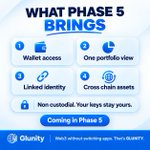
Phase 5 is where Glunity’s wallet section arrives. Here is what it covers, in plain words.
Wallet access inside the app, provided through an established non custodial partner. Your keys stay yours, and Glunity does not custody funds.
One portfolio view. A unified dashboard so you can see your holdings in one place.
Wallet linked identity. Your wallet connects to your Glunity profile, so your on chain activity can count toward your reputation.
Cross chain visibility. See assets across the chains Glunity supports, without hopping between apps.
Phase 5 is targeted for Q4 2026. Until then, the wallet tab in the app says exactly that: coming in Phase 5, with the phase attached.
Web3 without switching apps. That’s GLUNITY.

Trust in a token launch should come from something you can read, not something you are told.
That is why Glunity has committed to an independent audit of the smart contracts that control governance and treasury. A named third party firm performs it, and the work is completed before TGE.
Then you get to see it. The full report will be published publicly in advance of TGE, and the firm’s name will be announced through our official channels ahead of time.
Not a summary. Not a badge. The report itself.
Anyone can read it, question it, and check our work.
That is how we want every important step to feel: documented, public, and open to scrutiny.
Web3 without switching apps. That’s GLUNITY.

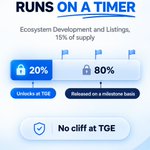
Not every token unlock runs on a timer. Here is how the Ecosystem Development and Listings allocation actually works, in real numbers.
The allocation is 15% of supply, which is 150,000,000 GLUN.
At TGE, 20% of it unlocks with no cliff. That is 30,000,000 GLUN, and it makes up 3% of the 10.25% circulating supply at launch.
The remaining 80%, or 120,000,000 GLUN, is released on a milestone basis, not on a fixed calendar.
Compare that with the team allocation, which has a 6 month cliff and then 24 monthly unlocks. Different purposes get different schedules. This bucket exists to fund development and listings, so its release follows progress instead of the clock.
Every unlock schedule is published in our whitepaper, so anyone can check the math.
Web3 without switching apps. That’s GLUNITY.

30% of GLUN’s supply is the Community Growth and User Incentives allocation, the largest single bucket in our tokenomics.
It exists to reward participation:
1. Participation rewards: referrals, community contribution, and research engagement.
2. Programs governance may establish to reward ecosystem development, education, bug reports, developer contributions, and ambassadors.
That is double the size of the presale, and double the ecosystem development and listings allocation.
At TGE, only 4.1667% of it unlocks. The remaining 95.83% is released progressively.
Web3 without switching apps. That’s GLUNITY.

Three things people assume about Glunity, and what is actually true.
Myth: the AI trades for you.
Fact: Glunity AI surfaces research and recommendations. It does not execute trades, hold funds, or make governance decisions on its own.
Myth: the Foundation controls Glunity forever.
Fact: the Foundation is a steward, not a permanent owner. Its job is to enable a gradual handover to community led governance, ending in binding on chain votes.
Myth: GLUN is a share in Glunity.
Fact: GLUN is a utility token. It is not equity, not a claim on revenue or profits, and not a guarantee of returns.
Better to know the real picture than to guess.
Web3 without switching apps. That’s GLUNITY.

Most ecosystems list features. Ours is built as a loop.
Glunity AI surfaces credible projects. Discover and Connect bring community attention to them. From Phase 7 onward, those projects can launch through the integrated launchpad. Launchpad activity then feeds back into the AI research data, and the AI gets better.
Each layer feeds the next, so the platform improves with use instead of just growing larger.
One honest note: the loop completes in stages. The social layer comes first, AI arrives in Phase 6, and the launchpad follows in Phase 7. We are building the loop in order, not claiming it is running today.
$GLUN is the token.
Web3 without switching apps. That’s GLUNITY.

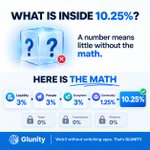
At TGE, 10.25% of GLUN will be in circulation. Here is exactly where it comes from.
Liquidity: 8% of supply, 37.5% unlocked at TGE. That is 3%.
Presale: 15% of supply, 20% unlocked at TGE. That is 3%.
Ecosystem Development and Listings: 15% of supply, 20% unlocked at TGE. That is 3%.
Community Growth and User Incentives: 30% of supply, 4.1667% unlocked at TGE. That is 1.25%.
3% + 3% + 3% + 1.25% = 10.25%, or 102,500,000 GLUN.
Team, Foundation, and Reserve start at 0% and stay locked at TGE.
Every number here can be checked with a calculator.
$GLUN is the token.
Web3 without switching apps. That’s GLUNITY.

Privacy in Web3 isn’t one thing. Here is how we handle it at Glunity.
Your assets stay yours. Glunity does not take custody of user funds at any layer. Wallets, private keys, and on chain identities remain under your control.
Your data stays minimal. We follow data minimization, collecting only what is necessary to operate and improve the service.
Your Trust Score is public on purpose. It is a visible reputation signal, not private data, and its inputs and calculation are disclosed to users in plain terms.
No custody. Minimal data. A score you can see and understand.
$GLUN is the token.
Web3 without switching apps. That’s GLUNITY.

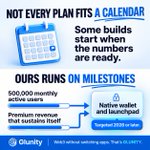
Most roadmaps run on a calendar. One part of ours runs on a milestone.
Glunity’s wallet and launchpad will launch through established non custodial partners. We plan to bring both in house, with that move targeted for 2028 or later.
But the date is not the trigger. Two conditions are. Glunity Connect needs to reach 500,000 monthly active users, and Glunity AI premium subscriptions need to reach a self sustaining revenue run rate that covers the cost of building native infrastructure. Whichever comes later decides when work begins.
Building a wallet and launchpad to institutional security standards is a multi year, audit heavy job. It should be funded by real usage, not by hope.
Earn the next phase before starting it.
$GLUN is the token.
Web3 without switching apps. That’s GLUNITY.

Every Glunity update, in one place.
Everything we publish on X is also posted in our official Telegram channel: product news, roadmap progress, and announcements.
Join the channel to follow along without digging through a timeline. It’s the quickest way to stay current as the app moves toward public launch.
t.me/glunityofficial
$GLUN is the token.
Web3 without switching apps. That’s GLUNITY.

Four tabs. Four logins. One token to check.
That’s the Web3 routine most of us run every day: a screener, X, a governance portal, and a wallet.
Glunity is building the fix. One app where you see a signal, discuss it with the community, vote on it, and act on it.
No tab switching. No lost context. Just one flow.
What’s the most tabs you’ve ever had open to research a single token? Tell us below.
$GLUN is the token.
Web3 without switching apps. That’s GLUNITY.

Every proposal that changes Glunity follows the same five steps, no shortcuts, no backroom approvals skipping the line.
Submission. An eligible participant submits a proposal, meeting the 0.1% circulating supply requirement we've already covered.
Review. The proposal gets evaluated for completeness and compliance before it ever reaches the community, filtering out anything half formed or non compliant early.
Community discussion. Stakeholders weigh in, surface risks, challenge assumptions. This step exists specifically so problems get caught before a vote locks anything in.
Voting. Eligible GLUN holders vote during the defined 5 day window, against the 4% quorum threshold.
Execution. Approved proposals get implemented, through Foundation multisig at Stage 2, shifting to on chain execution at Stage 3.
Five steps, in order, every time. Not a vote that magically becomes reality, a process with a review stage and a discussion stage built in before anyone's tokens decide anything.
Governance isn't just casting a vote. It's everything that happens before the vote too.
$GLUN is the token.
Web3 without switching apps. That's GLUNITY.

"Community first" is easy to say. Here's a simple way to actually prove it.
Drop a reply below with one thing you'd want to see built into Glunity next. Not a wishlist for later, actual ideas we'll genuinely read.
Best part about building in public, the good ideas don't have to come from inside the team.
What would you add?
$GLUN is the token.
Web3 without switching apps. That's GLUNITY.

A token doesn't gain value just because a roadmap says so. Here's the actual mechanism, tied to real activation dates, not vague future promises.
Right now, at TGE, GLUN's only active utility is incentive rewards. That's it. We're not pretending the other three are live before the infrastructure they depend on even exists.
Premium AI subscriptions activate in Phase 6, alongside the AI Intelligence Layer. The moment deeper research access goes live, GLUN demand gets a direct driver, people spending GLUN monthly or annually to unlock it, not holding and hoping it goes up.
DAO participation and launchpad activity go live together in Phase 7. Once governance voting becomes binding and the launchpad opens, two more concrete demand sources activate at the same time, GLUN required to submit proposals and vote, plus launchpad related activity feeding back into the ecosystem.
Here's the part that connects all of it. As each utility turns on, demand for GLUN is expected to grow with it, not from a single launch day spike, but from four separate activation points spread across the roadmap, each one tied to a real feature actually shipping.
Value accrual here isn't a chart going up and to the right by default. It's a sequence, incentive rewards now, premium access in Phase 6, governance and launchpad in Phase 7, each one adding a reason to hold or spend GLUN that didn't exist the phase before.
No utility is claimed before its dependency ships.
$GLUN is the token.
Web3 without switching apps. That's GLUNITY.

A fixed supply alone doesn't make a token sustainable. Here's the actual mechanism behind how Glunity stays funded without relying on inflation.
Zero inflation is the floor, not the whole plan. 1,000,000,000 GLUN, minted once, nothing more ever created. That rules out the easy fix most projects lean on when treasury runs low, printing more tokens.
So the real question is what replaces that safety net. Four things, stated plainly.
Transparent allocation and vesting. Every bucket, every cliff, every unlock schedule, published and checkable on chain, nothing discretionary hiding in the structure itself.
Utility driven demand. GLUN moves because premium subscriptions, governance participation, and platform payments actually require it, not because holders are told to expect appreciation.
Diversified protocol revenue. Platform fees, premium subscriptions, launchpad fees once Phase 7 ships, sponsored placements, multiple income lines, not one single point of failure.
Treasury oversight through governance. Spending isn't a founder decision made quietly, it runs through multi signature custody and DAO accountable process.
Here's the part that ties it together. As platform revenue grows, reliance on token emissions to fund development is designed to shrink. Not eliminated by magic, replaced deliberately, with usage based income doing more of the work over time.
A fixed supply tells you what can't happen. This is what's actually supposed to happen instead.
$GLUN is the token.
Web3 without switching apps. That's GLUNITY.

Smart contract audits get all the attention. Here's the layer most projects never mention, how the platform itself stays secure day to day.
Role based access control. Not every team member can touch everything. Access is scoped to what a role actually needs, nothing more.
Multi factor authentication. A password alone never grants access to sensitive systems, a second verification step is required every time.
Infrastructure redundancy. No single server, no single point of failure, taking down the platform if something breaks.
Encrypted data transmission. Data moving between systems is encrypted in transit, not sent in the open.
Secure key management. Sensitive keys are handled through dedicated secure practices, not sitting in a config file somewhere.
Continuous logging and monitoring. Activity across the platform is tracked in real time, so unusual behavior gets caught as it happens, not discovered weeks later.
Business continuity planning. A stated plan for keeping the platform running through disruptions, not something figured out after the fact.
None of this is the flashy part of security. It is the unglamorous, constant work that determines whether everything else, the audits, the governance, the trust score, actually holds up in practice.
A secure contract running on an insecure platform is still a security problem.
$GLUN is the token.
Web3 without switching apps. That's GLUNITY.

Anyone can list a project. Deciding which ones deserve your attention is the hard part. Here's how Discover, a native feature of Glunity AI, actually decides.
"Verified" isn't a badge you can buy. It's a combination of two things.
On chain checks. Contract source code verification, liquidity lock status, and holder distribution concentration. Is the code public, is the liquidity actually locked, and does a handful of wallets control most of the supply? These are questions the data can answer.
Community flagging. Users can report projects, but every report is weighted by the reporter's Trust Score. A brand new account and an established, credible one don't carry the same weight, which makes flag spamming a losing strategy.
Then comes the strictest layer. Before any project receives featured or promoted placement, manual review is required. Automation surfaces candidates. A human signs off before anything gets promoted.
Now the part that protects all of it. Sponsored content is always visibly labeled "Sponsored" with a distinct background. It can appear in the feed, but it can never appear inside an AI research card, and it can never influence AI generated signals, sentiment scores, or Discover rankings. Paying for placement does not buy credibility.
The result is a discovery layer where reputation, data, and human review decide what rises, and money can't shortcut any of them.
Scam clones win when nobody can tell real from fake. We're building the layer that makes it visible.
$GLUN is the token.
Web3 without switching apps. That's GLUNITY.

A DAO vote decides where treasury money goes. That's the easy part everyone talks about. Here's the part nobody explains, what stops the money from disappearing between the vote and the spend.
Multi signature custody. No single wallet, no single person, can move treasury funds alone. Every critical transaction requires multiple signers, so one compromised key or one bad actor can't drain anything.
Controlled capital deployment. Funds don't get released all at once just because a proposal passed. Deployment is staged and monitored, not dumped in a single transaction the moment a vote closes.
Diversified allocation, where appropriate. Treasury resources aren't concentrated into a single asset or a single bet, reducing the damage any one market move can do to the protocol's runway.
Periodic financial reporting. Not a promise to report someday, a stated commitment to regular disclosure, so the community isn't left guessing what the treasury actually holds between votes.
And layered on top of all of it, governance oversight itself, meaning even the process for spending is subject to the same transparent, community accountable system as everything else we've published.
Here's the distinction that matters. Governance decides what should happen. Treasury controls decide how safely it actually happens. Most projects only ever talk about the first one.
A vote is only as good as the custody behind it.
$GLUN is the token.
Web3 without switching apps. That's GLUNITY

Most token utilities just say "pay for premium access" and stop there. We actually explain why we built it the way we did.
Premium subscription access unlocks deeper Glunity AI research, more detailed sentiment breakdowns, extended whale tracking history. Structured like a tiered account subscription, comparable to X Premium. Billed monthly or annually, at a fixed $GLUN amount.
Here's the part most projects skip. We could have built this as stake to unlock, lock $GLUN, get permanent access. We didn't. We chose spend based instead, and there's a specific reason why.
Stake to unlock creates a one time lockup, then nothing. No recurring demand, no ongoing token velocity, just tokens sitting idle after the initial stake. Spend based means the subscription fee actually moves through the system every single billing cycle, creating recurring demand instead of a single spike.
We also ruled out a hold threshold model, where simply holding a certain amount of $GLUN grants premium access automatically. That approach rewards large holders with premium features regardless of whether they're actually using the platform. Spend based ties access to real usage, not just wallet size.
Two competing designs, ruled out on purpose, for stated reasons, not because we didn't think of them.
Activation timing, stated plainly too. This utility goes live in Phase 6, alongside the AI Intelligence Layer, not at TGE. We're not claiming it's active before the infrastructure it depends on actually exists.
One utility. Two rejected designs. A reason for every choice we did make.
$GLUN is the token.
Web3 without switching apps. That's GLUNITY.
