

Making sense of technology and business through conversations of the people shaping the future.
Joined October 2026
- Tweets231
- Following64
- Followers124
- Likes56




Pinned Tweet
A SpaceX competitor explains just how impossible it is to achieve what Elon has.
Rocket Lab CEO Peter Beck once said reusable rockets didn't make sense for small rockets like his Electron. He promised he'd eat his hat if he ever changed his mind.
In 2019, with SpaceX already landing rockets, he walked on stage and admitted he was wrong.
Then he explained why he'd doubted it. The rocket comes back at "eight and a half times the speed of sound," through plasma "about half the temperature of the sun," with loads like "three elephants" standing on "a 1.8 mm carbon fibre rocket."
"Getting through the wall is really, really hard."
SpaceX first landed an orbital-class rocket booster upright on December 21, 2015.

Let’s take this gentleman’s argument at face value that anyone can throw money at rockets and get something like Starship, Falcon or Dragon.
Perhaps he can explain to everyone how SpaceX is able to catch giant starships from orbit with chopsticks and deliver 85% of all Earth payload to orbit with Falcon, while Blue Origin, which started before SpaceX and was funded by the immensely wealthy Jeff Bezos, is not yet able to launch reliably?
Also, why is it that Boeing and Lockheed received several times what SpaceX did from the government for development of their rockets and spacecraft, but the Boeing capsule is still not operational and ULA delivers less than 5% of SpaceX payload to orbit?
I am genuinely curious about these questions.
Chamath Palihapitiya just said Nvidia's leadership has no idea what to do.
Nvidia is making its $235B buyback "a top priority." Chamath says that's the tell:
"When you are like, I'm going to do a buyback, what you're basically saying is I don't have a clue."
"I don't know what to buy. I don't know what to build. I don't know what to invest in, which is okay when disruption is low."
"But when disruption is high, you are going to be rewarded for acquisitions because that tells the existing investor you are trying to defend the moat that you have and build new moats."
@chamath @theallinpod
1
25
The days of 90% software margins are over.
Modal CEO @bernhardsson argues that profit margins will compress as technology’s value chain expands.
"The reason is actually almost like topological. You have this stack of vendors: applications, models, infrastructure, cloud, Nvidia and so on."
"When a customer pays a dollar at the top of the stack it has to flow through a lot of different layers and at every layer there's going to be you know 20-30% gross margins"
"The space is so big but you're also splitting it across a lot of layers in the stack. The 90% software margin businesses are gone. I think Modal has an opportunity long term to get to 40-60% margins but we're never going to get to software margins."
FT: @HarryStebbings
3
67
Dwarkesh Patel claims that superintelligence is potentially just a year away.
He's interviewed nearly every top AI lab leader, and earlier this year he'd have said "at least a better part of a decade." Then he watched what AI is doing to AI research itself.
Now he thinks we're "possibly only a couple of months away from AIs that are as good as the best humans at AI research."
Once AI research is automated, the rest follows fast: "by 2030 and plausibly as early as next year, we'll have AIs that are at least as good as the best human experts in every field."
Even he admits, "I know this is a wild claim."
@dwarkesh_sp
1
17
Greatest shareholder value destruction of all time.


Chamath Palihapitiya predicts that Nvidia is about to face a trillion-dollar lawsuit.
His logic is simple. $1.5 trillion of Nvidia's value got "wiped out," and "at a minimum there was some disclosure issues."
There's real harm caused that can be measured monetarily.
That's all the trial lawyers need. He says they're "licking their chops," ready to sue for the full $1.5 trillion, settle for $250 billion, and "take half of it."
@chamath @theallinpod
1
12
The AI tech elite keep telling you what the future looks like. Legendary investor Stanley Druckenmiller says that certainty is arrogance.
Asked about the consensus that AI will be "very deflationary" and "lead to massive job losses":
"I say anybody who believes that with conviction suffers from arrogance and not an open mind. I don't think any of us know how this movie is going to play out."
"First of all, every technological revolution since was known to man. It's been declared for jobs at the end of the world all the way back to the horse and buggy."
"Now, there are brilliant people saying it's going to happen and I'm open-minded to that too because the speed is like nothing we've ever seen before. But you have to acknowledge when it's happened every other cycle that it's not a given."
Anthropic is the Apple of AI. Alternatives like open source models are Android.
Baillie Gifford's Peter Singlehurst: We have a strong hypothesis that value will continue to accrue to the frontier models.
In every tech shift, "the vast majority of revenue and profit" goes to whoever is "at the leading edge."
Just because something is the most adopted, doesn't mean it accrues the most value.
"You could look back at the mobile era where most of the value accrued to Apple despite Android becoming ubiquitous."
2
47
Almost back at the price bankers sold to insiders.
Retail investors are getting their shot at the bid they’ve always asked for.

David Friedberg says Anthropic's IPO could be a once-in-a-generation bet, regardless of price.
He hasn't studied the numbers. But here's what he's hearing from people who sat in on management conversations:
Anthropic is "building this recursive self-improvement engine," its model capabilities "are accelerating," and its compute cost "per unit of intelligence… is actually declining."
With investments "down to the chip layer," they think they have "this kind of runaway business," and that "this could be a winner-take-all scenario of the biggest market ever."
His bet: if you think there's even a chance that's true, it's worth putting "some percentage of your portfolio to this IPO, regardless of where the market bids it."
@friedberg @theallinpod
15
Shopify CEO Tobias Lütke explains why Amazon blocked AI agents while Shopify caters for them.
"I think the aggregators have a little bit more concrete need to stay in control. And some of the things that the agents do are kind of scary. There's a lot of impersonation going on."
Shopify, by contrast, is building for agentic commerce.
"And for us, we would like the checkout to work really well. We are building lots and lots of APIs and systems to make the checkout work well. If it's the person purchasing or an agent on their behalf, that's fine by us. So we try to support it all."
@alexeheath @tobi

Prediction: in 10 years, 99.999% of financial transactions will happen between agents (with humans making up the remaining 0.001%).
Agents need new infrastructure to scale to this point, and we’re building it.
1
1
52
Full episode:

Tobi Lütke on the AI agent revolution and future of Shopify
@tobi on where agent commerce is headed, sci-fi becoming reality, and his GPU wine cellar.
Why did Amazon block Meta's Muse but Shopify welcomed it? I sit down with Tobi in Toronto to discuss why the companies are taking different approaches to agents and how shopping changes when AI starts buying things on your behalf.
He explains the early AI shopping behavior he’s seeing. We also get into why he thinks AI makes starting a business easier, the backlash against the technology, and why everyone will eventually have to embrace it to get ahead in their careers.
We get into how AI agents will make money, who pays when they handle a purchase, and why advertising gets complicated when your assistant is supposed to work for you. We discuss his experience on Meta’s board and working with Mark Zuckerberg.
Lütke also shares why he turned his wine cellar into a GPU server rack and how he uses his personal AI agent that runs entirely from his house.
This is one of my favorite pods I've ever done.
Timestamps:
00:00 Amazon blocks Muse
02:40 Shopify's approach to AI agents
07:00 How AI agents will change shopping
11:05 Sci-fi and tech optimism
17:57 Zero-sum thinking vs. abundance
21:20 AI backlash and the founder advantage
45:28 Building an AI-first Shopify
52:18 Who profits from agentic commerce?
01:03:22 How Shopify stays ahead
01:10:39 Advertising and discovery in the agent era
01:16:02 Rack, Cellar, and Claw
Links:
Spotify: open.spotify.com/episode/71x…
Substack: sourcesnews.substack.com/p/t…
YouTube: youtu.be/r9SHzCW9zxo
Apple Podcasts: sources.news/p/tobi-lutke-sh…
This episode's presenting sponsor is @hyperagentapp
Thanks to the show’s premiere sponsors: @Atlassian, @meetgranola, and @mercury
48
Benchmark General Partner Bill Gurley explains why IPOs are broken:
In a traditional IPO, bankers set the price, and the shares go to their biggest clients, mostly hedge funds and asset managers. On day one the stock jumps. Those funds sell into the pop, and retail buys at the higher price.
Gurley: "It doesn't provide access to all investors. It's just a select group of people that happen to be the biggest customers of the investment bank."
The pricing is "determined by humans just guessing."
Every dollar of that first-day jump is money the company could have raised itself. Instead it goes to the funds, in what he calls "massive one-day wealth transfers straight from the founders, employees and investors to the buy side."
"This year it's going to be over $34 billion in one-day giveaways."
That was 2020. Anthropic just priced above its range on a reported ~$500B of orders.
Buying the pop just makes you exit liquidity for insiders.
@bgurley
2
43
Former Nvidia CEO Jensen Huang doesn't think the two frontier labs need to generate trillions of dollars for the AI build out to work.
"They're going to be two of the most consequential technology companies ever built in history."
"But they don't have to be anywhere near a trillion dollars in revenues to be successful. I think we're putting way too much pressure on that."
@altcap
2
131
Steve Eisman made a fortune betting against the housing bubble in 2008. Now he's saying Anthropic is selling you the top.
"I think Anthropic might be going public now because the first half of the year looks really good because of token maxing and the lack of open weight models."
The timing means the IPO doesn't have to show third-quarter numbers, which "might show something of a slowdown because of the end of token maxing."
"I actually think by the fourth quarter, we'll definitely see a slowdown. And so I think they needed to go public now."
@edels0n @realsteveeisman

Jason Calacanis predicts that Anthropic will kill Microsoft.
Days before the IPO, Anthropic launched "a Zoom killer," then whiteboards and sheets, "an Excel killer."
Jason's read is that they're building "the ultimate bundle, every single piece of software that you need," and every SaaS company is in the way.
It's the same bundling playbook Microsoft used to win.
@Jason @theallinpod
Watch this before you buy Anthropic's IPO. Warren Buffett hasn't bought one since the 1950s, and says the average person shouldn't even think about it.
Here's what he said in a 2019 interview as Lyft went public:
"We haven't bought an initial public offering, or I haven't, Charlie hasn't, I think since 1955."
The last one was Ford: "I took a free ride on 100 shares and made 500 bucks, and it's the only time I've ever done that."
His advice on hot IPOs: "I think buying new offerings during hot periods in the market, I don't think is anything the average person should think about at all."
Asked whether Lyft could be another Amazon or Google he missed: "Oh, it always can be."
But "you can go around making dumb bets and win, you know. It's not something you want to take as a lifetime policy, though."
Public markets are getting the leftovers. Baillie Gifford's Peter Singlehurst says the real story of the Anthropic IPO is how much value got created before retail investors could touch it.
"Meta IPOed in 2012 at a valuation about one-tenth of the value that Anthropic is coming to the public markets at."
The growth now happens before the IPO. "We saw it with SpaceX as well where you're seeing trillions of dollars of value being created in private markets."
It means that if you only invest in public markets, you're missing most of the upside.
"To do growth equity investing properly in this era, you have to be doing it in both public but also in private markets."
Anthropic President Daniela Amodei says Anthropic IPO is all about funding more aggressive compute costs.
"Anthropic has always had a fraction of what our competitors have had in terms of compute and capital."
Even so, "we've pretty consistently had the most powerful, most performant models for the majority of the past several years."
But staying ahead is getting expensive. "The compute requirements for the future are very large… we will need more compute to be able to stay at the frontier as we get bigger."
2
67
Is there any upside left for retail in the Anthropic IPO? Baillie Gifford's Peter Singlehurst says yes, and he isn't selling.
"Public companies have become bigger than anybody thought they could become if you go back 15 years ago."
"There's still so much growth that's happening and we believe this is going to be an exceptional growth stock into the public market."
"We're long term."
2
42
David Friedberg says Anthropic's IPO could be a once-in-a-generation bet, regardless of price.
He hasn't studied the numbers. But here's what he's hearing from people who sat in on management conversations:
Anthropic is "building this recursive self-improvement engine," its model capabilities "are accelerating," and its compute cost "per unit of intelligence… is actually declining."
With investments "down to the chip layer," they think they have "this kind of runaway business," and that "this could be a winner-take-all scenario of the biggest market ever."
His bet: if you think there's even a chance that's true, it's worth putting "some percentage of your portfolio to this IPO, regardless of where the market bids it."
@friedberg @theallinpod
Ahead of their blockbuster IPO, Anthropic CEO Dario Amodei warns us not to overpay for his company.
Jamie Dimon asked him why Anthropic is going public now. Dario said the best advice he got was "never let your company be worth a single dollar more than it's really worth."
That belief guides how he runs Anthropic: "under promise and over deliver." Then he took a not-so-subtle shot at OpenAI: "we don't vague post about models ahead of time."
"We build the model, we make sure it's good, we release the model."
@DarioAmodei
4
386
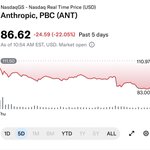
Anthropic’s IPO is set to price at $83 a share, putting their valuation right at the $1.5 trillion that @chamath predicted.
"I was wrong." Chamath Palihapitiya predicts that Anthropic IPO will come in at $1.5 trillion.
His reason: Anthropic has far more cash than anyone thought. CFO Krishna Rao "entering June, already had $125 billion," while total net burn to get there "has been like $9 billion or $10 billion."
He'd assumed they needed to raise $200–250 billion and price "closer to a trillion."
Now he says they only need "$80 and $120 billion," and the price will land "between $1.3 trillion on the low end to $1.7 trillion on the high end."
"I kind of think it'll come in around $1.5 trillion, if I had to just kind of guess."
@chamath @theallinpod
1
32