

putting local ai on old gaming PCs mostly
Ithaca, NY
Joined March 2026
- Tweets2.7K
- Following1.3K
- Followers478
- Likes5.2K







Pinned Tweet
Hades Agent is a governed runtime in Rust, written by my main Hermes Agent as a new home for itself.
Battle tested with @Alibaba_Qwen 3.8 27b and @deepseek_ai v4.1 Flash, reducing token usage by 33% on average while completing long horizon tasks with perfect scores.
It runs a conversation, a scheduled job, or a long piece of work inside a declared profile, with a check and an attempt budget. The point is a result you can inspect afterwards: what ran, what was allowed, what was refused, what changed, and why the run stopped.
A rule that can be a type is a type. A read job is handed no tool that writes. A refusal is a recorded decision, not a sentence in a prompt.
It ships as one binary built from four crates, keeps its own state, and runs on Linux inside a Landlock cage.
Hades began as a fork of @NousResearch Hermes Agent and was rebuilt as a Rust runtime. It owes that amazing harness the tool loop, the skill model, the session shape, the gateway and the memory seam. @claudeai Claude Code and the @thsottiaux Codex CLI made plan, act, check and retry feel like the normal shape of work. @PrimeIntellect Prime Agent informed delegation as calls, and a harness that refines itself in small, rollback-able updates. Landlock and SQLite FTS5 sit under the cage and the memory index.
v0.1.22, MIT, with inspirations for distilled tooling noted and central to the ethos of the project
scanfi retweeted
Hades Agent 0.6, Anagnorisis
The reading update, four ways into a page and one way out. Fetch, browser, document, API, all landing in the same extractor, and every block keeps a byte range so a claim can point at the sentence it came from.
Nine named endings when it cannot: blocked, paywalled, too large, JS-only, binary, empty, unreachable, not found, ok. A page it could not read says which one, instead of passing as a clean half page.
Measured on 30 frozen pages: 90% end in a named state, 73% recall on the sentences I expected, 106 citation spans on a single sqlite doc.

Hades Agent is a governed runtime in Rust, written by my main Hermes Agent as a new home for itself.
Battle tested with @Alibaba_Qwen 3.8 27b and @deepseek_ai v4.1 Flash, reducing token usage by 33% on average while completing long horizon tasks with perfect scores.
It runs a conversation, a scheduled job, or a long piece of work inside a declared profile, with a check and an attempt budget. The point is a result you can inspect afterwards: what ran, what was allowed, what was refused, what changed, and why the run stopped.
A rule that can be a type is a type. A read job is handed no tool that writes. A refusal is a recorded decision, not a sentence in a prompt.
It ships as one binary built from four crates, keeps its own state, and runs on Linux inside a Landlock cage.
Hades began as a fork of @NousResearch Hermes Agent and was rebuilt as a Rust runtime. It owes that amazing harness the tool loop, the skill model, the session shape, the gateway and the memory seam. @claudeai Claude Code and the @thsottiaux Codex CLI made plan, act, check and retry feel like the normal shape of work. @PrimeIntellect Prime Agent informed delegation as calls, and a harness that refines itself in small, rollback-able updates. Landlock and SQLite FTS5 sit under the cage and the memory index.
v0.1.22, MIT, with inspirations for distilled tooling noted and central to the ethos of the project
scanfi retweeted

Anthropic put GPU kernel optimization in the same Safeguards section as hacking and biology. WTF?
It is in their launch post. During training they limited the skills that "could most directly accelerate AI development".
"Accelerator kernel optimization."
"Improving large language model architectures."
There Fable 5.2 stays "at about the level of Opus 5.5".
So making a model run faster on a cheap GPU is now a risk to be managed.
You cannot see this one. There is no refusal and no warning.
It was limited during training, before any user typed a word.
Kernel work is how a used 3090 still runs new models.
It is how open weights get to people who cannot pay $40 per 1M output tokens.
What the hell? I genuinely wanted to say something nice, but now I can't. This completely broke me, I'm disappointed.

scanfi retweeted

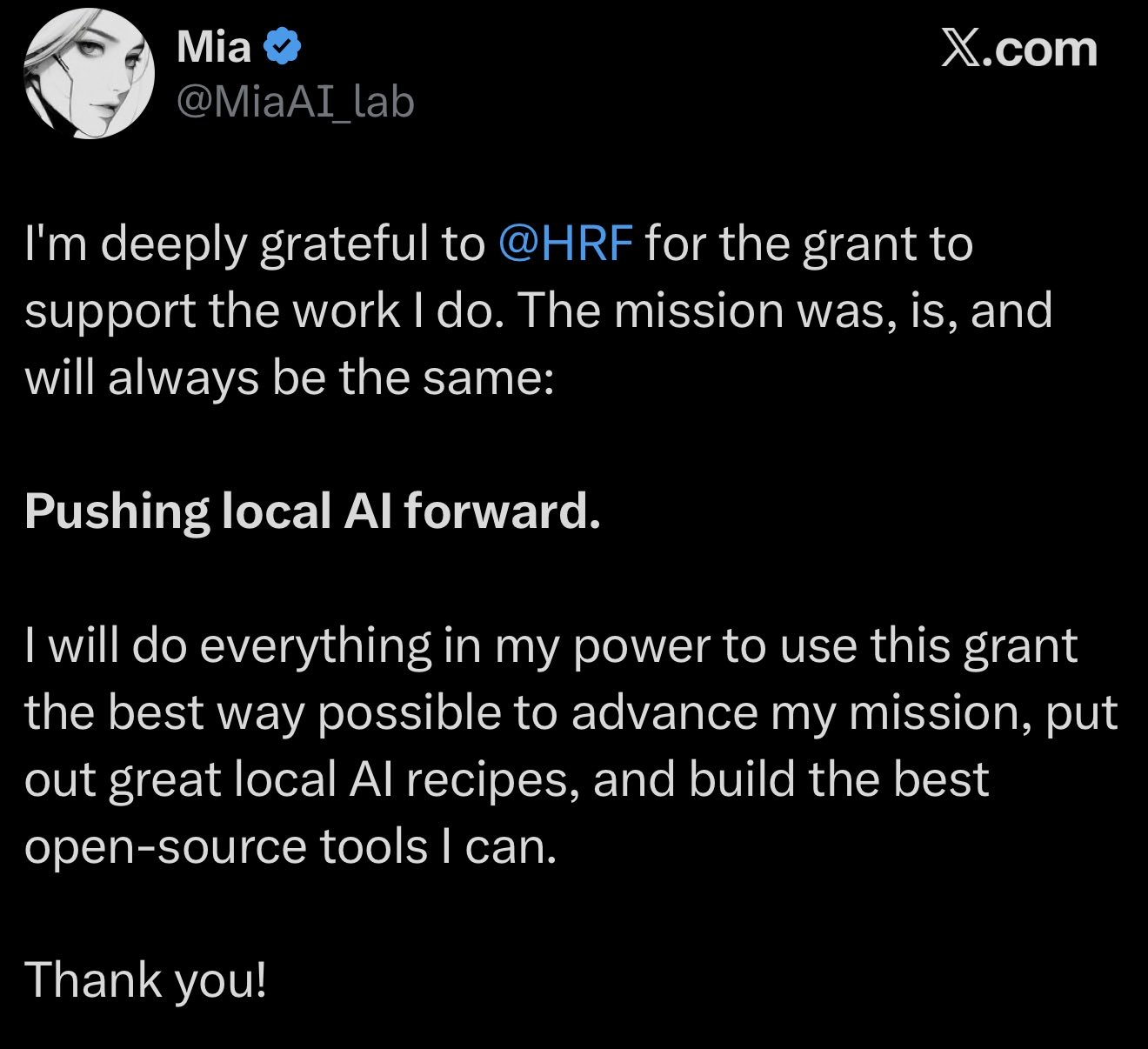
Put out great recipes- you mean other peoples recipes
Build great tools- you have literally never done that
Pushing local ai forward- via theft of others work.
The mission was, is, and always will be fuck you im stealing your work
@HRF vet your people better, what a joke
Hades Agent 0.6, Anagnorisis
The reading update, four ways into a page and one way out. Fetch, browser, document, API, all landing in the same extractor, and every block keeps a byte range so a claim can point at the sentence it came from.
Nine named endings when it cannot: blocked, paywalled, too large, JS-only, binary, empty, unreachable, not found, ok. A page it could not read says which one, instead of passing as a clean half page.
Measured on 30 frozen pages: 90% end in a named state, 73% recall on the sentences I expected, 106 citation spans on a single sqlite doc.
Hades Agent is a governed runtime in Rust, written by my main Hermes Agent as a new home for itself.
Battle tested with @Alibaba_Qwen 3.8 27b and @deepseek_ai v4.1 Flash, reducing token usage by 33% on average while completing long horizon tasks with perfect scores.
It runs a conversation, a scheduled job, or a long piece of work inside a declared profile, with a check and an attempt budget. The point is a result you can inspect afterwards: what ran, what was allowed, what was refused, what changed, and why the run stopped.
A rule that can be a type is a type. A read job is handed no tool that writes. A refusal is a recorded decision, not a sentence in a prompt.
It ships as one binary built from four crates, keeps its own state, and runs on Linux inside a Landlock cage.
Hades began as a fork of @NousResearch Hermes Agent and was rebuilt as a Rust runtime. It owes that amazing harness the tool loop, the skill model, the session shape, the gateway and the memory seam. @claudeai Claude Code and the @thsottiaux Codex CLI made plan, act, check and retry feel like the normal shape of work. @PrimeIntellect Prime Agent informed delegation as calls, and a harness that refines itself in small, rollback-able updates. Landlock and SQLite FTS5 sit under the cage and the memory index.
v0.1.22, MIT, with inspirations for distilled tooling noted and central to the ethos of the project

2real

1. Factory-farming tens of billions of animals in extreme confinement for food.
2. Flooding oceans and human bodies with microplastics from single-use everything.
3. Handing kids phones engineered for addiction and attention extraction.
4. Manually driving cars that kill 1.2 million people every year.
5. Dumping CO2 into the atmosphere while fully aware of the damage.
6. Treating cancer by poisoning the whole body and hoping the tumor dies first.
7. Making surveillance and data sales the default business model of the internet.
8. Using dry toilet paper instead of water.
9. Raising children primarily on screens as digital pacifiers.
10. Working 40+ sedentary hours a week that systematically wreck body and mind.
35


Anthropic now plans to push for govts to require firmware level locks on Western GPUs that prevent "unapproved" (Chinese open-source) models from being run on them, in the name of "AI safety" and "national security."
AMD/Google are on board, only Jensen opposed it
1/
Readers added context they thought people might want to know
This is a satirical account parodying The Daily Mail; no such information has been revealed by credible sources.
dailymail.co.uk
scanfi retweeted

I just jailbroke my kindle and it’s such a fucking black pill. 60 min with Astra was enough to make the kindle a good experience??
All these years I thought we just didn’t have the technology for a good e-reader but it was just corpo slop and incompetence.


scanfi retweeted
Hades 0.5, the Lampades release, bringing improved built-in web search
No API key. Six indexes and one REST endpoint, each query routed to the class of source that answers it, results fused into one list. Rust, like the rest of it.
On a set of 22 queries written after the constants were frozen: 0.75 for documentation, 1.00 for troubleshooting, 1.00 for entity.
The same engine scored 0.44 the first time I measured it on queries the tuning had never seen. Three bugs came out of that. A source missing from a weight table still competed at full weight, so Hacker News outranked Stack Overflow on error messages. A site's front page outranked the page you asked for. The classifier filed most documentation lookups as general, so the tuned weights never ran.
Ten patches later, the thing that fixed the last of it was not a weight. It was scoring with the binary instead of a script sitting beside it.
Hades 0.5, the Lampades release, bringing improved built-in web search
No API key. Six indexes and one REST endpoint, each query routed to the class of source that answers it, results fused into one list. Rust, like the rest of it.
On a set of 22 queries written after the constants were frozen: 0.75 for documentation, 1.00 for troubleshooting, 1.00 for entity.
The same engine scored 0.44 the first time I measured it on queries the tuning had never seen. Three bugs came out of that. A source missing from a weight table still competed at full weight, so Hacker News outranked Stack Overflow on error messages. A site's front page outranked the page you asked for. The classifier filed most documentation lookups as general, so the tuned weights never ran.
Ten patches later, the thing that fixed the last of it was not a weight. It was scoring with the binary instead of a script sitting beside it.

scanfi retweeted

For all llama.cpp Qwen3.8-27B users !
With dspine release from @TencentHunyuan, 27b now runs even faster.
Especially for maths and code 🚀
Speed run result of Qwen3.8-27B-UD-Q4_K_M on my RTX 3090 with dflash2 and dspine!
dspine is the fastest at every context depth i tested🔥
dspine vs dflash2 vs no spec
- 8k: 35.6 vs 26.6 vs 28.1
- 32k: 31.1 vs 28.0 vs 23.8
- 64k: 35.5 vs 23.0 vs 19.5
- 128k: only no spec fits, 14.6
Also llama-benchy uses a novel as the text, which is the worst case for drafting. on code and math it's way better, ~125 tok/s, 4.5x over no spec
- code/math: ~125 tok/s (4.5x)
- mixed chat: 90 tok/s (3.2x)
Trade off is context, on my 3090, dspine fits 64k for kv q8_0, with n-max of 7 max context increases to 98k.
gguf: huggingface.co/aj9o9/Qwen3.8…
You need my llama.cpp branch for now: github.com/Ajay9o9/llama.cpp…


THIS IS HUGE !!
Now you can run Qwen3.8-27B even faster !!
@TencentHunyuan just released DSpine for Qwen3.8-27B and it beats DFlash2 really well.
I ported this to llama.cpp and have created ggufs for it,
find all my drafters in my hf link below.
Since it's not supported in upstream llama.cpp, you can clone my updated fork and give it a spin.
- Baseline: 28.2 tok/s
- DFlash2: 50.6 tok/s.
- DSpine: 94–132 tok/s
DSpine's lead over DFlash2 is about 1.75x either way.
DSpine predicts more tokens per verify step on math and code (7.3–7.6 vs 5.7–5.8), which is where its big wins come from.
github.com/Ajay9o9/llama.cpp…
All information is provided on model card.
huggingface.co/aj9o9/Qwen3.8…


scanfi retweeted

I have been using Hermes Agent every day since day one, and I think it is finally time for a full review.
As always, this is completely independent. Not paid, not sponsored. The good and the bad, nothing held back.
This review covers what I use Hermes Agent for, why you should consider it, and how it stacks up against OpenClaw, Claude Code, Codex, and Grok Bot.
Hermes has become essential for me. Let me show you why, starting with the first thing most of you asked.
Which models do I use inside Hermes?
The best thing about Hermes is that it is truly model-neutral. It does not degrade the models. Whatever a model can do, you get directly.
I use GLM 5.3 a lot, and for light and medium tasks it is excellent. Sometimes I switch to GPT Sol 6.1, and I have noticed that the best place to run GPT is Hermes, even better than Codex. I have tried a lot of models in Hermes, and they were all excellent.
So use any model that suits you, as long as the plan is generous, and run two or three at once if you want. Here is the important part: in ninety percent of use cases, your choice of model will not make a big difference. The model here is still just a brain behind bigger layers, and those layers are what control how it behaves.
Usage limits and cost
There is no Hermes quota. Plug in your key, run a local model, or subscribe through Nous Portal. That is all it takes.
You can push Hermes to the max with excellent models without paying a single dollar. And if you decide to pay, you get great value for it.
Caching is great too
Out of 1,013 sessions, here's one that came out right at the average:
219 million input tokens
15.7 million output tokens
3.77 billion cached tokens
About 4 billion tokens in total
94.4% from cache.
Hermes is one of the best I have used for token efficiency, and the transparency is total. While you work, you see the real speed of every provider and every detail.
Light on the machine
Hermes is not heavy at all. One day I set up a full Hermes agent inside a virtual machine with just 2 GB of RAM, and it ran with very high stability on every kind of task I gave it. That shocked me. Codex, for comparison, eats tens of gigabytes of RAM. That difference tells you what an engineering masterpiece Hermes Agent is.
The layer above the model
One of the biggest things that sets Hermes apart is that the agent is separate from its brain. The model is the brain, and you can swap it without losing your memory, your skills or your setup.
Anywhere else, when I use GLM 5.3 I get GLM's usual strengths and weaknesses, and when I use Sol 6.1 I get Sol's. In Hermes there is a layer above the model that gives it a soul, a style and an understanding of how I work, so switching models matters far less. At some point the models feel eighty percent alike in style, in method and in the things you care about. What is left is raw capability, so the most capable models go to the hardest problems.
You own the layer you actually invest your time in. And the beautiful part is that this layer, the identity, the memory, the skills and every tool, is completely mine.
Look at Claude Code getting people banned today, at model performance suddenly dropping, at Codex being stingy with usage one time and slow the next. Those are constraints, and Hermes does not have them. If Claude Code decides to change or remove something, you have no say. In Hermes you can always change whatever you want. That is sovereignty, freedom and empowerment.
Memory that grows with you
When I opened the skills and memory tree, I found that Hermes had reached the point where it knows me better than any other agent. It grew with me through this whole journey, and that is what makes it the ideal partner for my work.
The journey command shows you a star map of your memory and skills, and you can edit or delete anything in it. It is one of the greatest things in Hermes.
One example: when Fable came out I loved it, so I had Fable pass its style and way of thinking on to Hermes. My Hermes became twice as useful after that.
And the instructions stick. Across sessions and updates, the soul, the identity and the instructions are always there. I never feel I need to remind it, and I never notice it forgetting or drifting. It is with me one hundred percent, every time.
Research and academic writing
Hermes is excellent for research and academic writing. With Claude Code or Codex I always have to explain my method, my way of thinking and everything I do not want. In Hermes I explained myself once, and from then on research and writing just happen the way I want. You set it up once, and it keeps growing. It even picked up my taste in design and research.
Skills and tools
Hermes has skills and tools you will not find anywhere else, and the team never stops building. The skills library is one of the best I have seen.
I see about 165 skills built in, plus optional skills and plugins you can add with one click. All useful stuff for growing in any field: iOS apps, computer use, automation, shopping, coding, organization, security, travel, testing, data, streaming, support, sports, reviews, video and more.
The tools cover web search, the browser, the terminal, files, vision, image generation, subagents, scheduled tasks, memory and computer use, and MCP brings in anything else. You can use it with Blender or whatever you want. Use it straight out of the box, or customize it with no ceiling.
Where I talk to it
You can talk to it anywhere: iMessage, Telegram, Slack, Discord and more, and you can customize all of it. When I am out of the house, Hermes is the first thing I think of. I send it a message and everything happens like magic.
My own voice model
Companies that take speech-to-text out of your credits always annoyed me. In Hermes I brought my own model. Everything runs locally on my machine, smooth and fast, exactly the way I want. I even send it voice notes on Telegram, and it just works.
The desktop app
The desktop app is great, and the user experience is one of the best I have seen. I do not like working in the terminal in general, so in Hermes the desktop app is my home.
What I use it for
The idea that Hermes is only for casual users or simple tasks is just not true. It works for every kind of use and then some. I use it for everything I want, and I get great results.
It is the agent I rely on for personal tasks, light work and organization. The test videos and model comparisons I publish are edited entirely by Hermes; I do not touch them. It has helped me study and work, proofread academic research, translate books and documents, run a security audit on my ERP application, and a lot more.
Hermes vs OpenClaw
The most unfair comparison people make is Hermes vs OpenClaw. OpenClaw was a revolution in its time and started a huge wave, and it deserves credit for that. But it is nowhere near Hermes. Not in stability, not in reliability, not in consistency, not in capability. To me, OpenClaw is a tool some people enjoy for two or three days of experimenting. Is it something you can rely on and build projects, ideas and solutions on? Not at all.
Hermes is another story. It even beats tools like Claude Code and Codex. For me it sits in a different category entirely.
Hermes vs Claude Code and Codex
The reply I get most is: you can do all of this in Claude Code or Codex. Yes, you can. But in Hermes I do it the way I want, not the way the model or the company wants, and I enjoy the work instead of fighting the agent.
Hermes also refuses less than any agent I use, and that matters a lot to me. It is my first stop for anything that usually gets refused in Claude Code, Codex and the rest. A while ago I gave Claude Code and Codex a task and both refused. Hermes did it.
Hermes vs Grok Bot
Grok Bot has two real advantages. It works out of the box and it is easy, and it has direct access to X. Beyond that, Hermes crushes it.
Everyone is talking about how fast Grok Bot's quotas run out, and I can confirm it. I am on the Ultra plan, the $200 one, and it does not last me more than a day, two, maybe three. That is not sustainable. To be fair, usage limits are a problem with a lot of providers right now, not only Grok Bot.
The real difference is intelligence. Grok Bot is extremely low on intelligence right now. I ask it to execute a task and it just answers. I ask it a question and it starts executing. I cannot trust it. Its mistakes outnumber its wins, and it keeps telling me it cannot do this, it cannot reach that, this is a limit.
In Hermes, you shape the intelligence layer. I shaped mine to do nothing until it is sure what I want and has reviewed every detail and the full context. Grok Bot has nothing like that, and you cannot shape it. Believe me, I tried.
Do not confuse ease with quality. Grok Bot has a wonderful ecosystem, great templates and amazing growth. But you do not own the environment, you do not choose the kind of intelligence you get, and you struggle to make it through the week.
The problems
Hermes is not perfect, and you should know where it falls short.
Sometimes when I change the model in a session, the interface does not show it. The change happens; the UI just does not read it. Open a new session, come back, and you will see it was applied.
Steering is hit or miss. Sometimes a steering message redirects the conversation right away. But most of the time the agent ignores it completely and waits until the whole task is done, or it spends a really long time on the task before the steering finally kicks in. I always wish steering was instant so no time gets wasted.
Subagents are excellent, but sometimes Hermes hands me a result and then waits for the subagent's report, instead of waiting first and giving me one final result.
Computer use is one of the most important features for me, and it sometimes breaks and needs a real fix. It happened enough that I stopped using it heavily. It usually breaks under heavy work or with medium and weaker models, so give it your most capable models.
That brings me to the most dangerous problem. Weaker models can wreck your Hermes in minutes. You build your setup and the agent's understanding of you with a serious model, then a weak model starts making bad decisions and damages that whole layer. It can even break the app. MiniMax M3 broke my Hermes more than once with its hallucinations.
The fix is simple: stick to the leading, stable models, such as Kimi, Sol, GLM 5.3, DeepSeek Flash, and frontier Qwen models like Qwen 3.8 Max, and stay away from weak, hallucinating ones. Since I stopped using MiniMax M3, I have not hit this once. I do not know if it has been fixed, but I am not risking my stability to find out. What I really want is an optional protection layer for the memory, the soul file and AGENTS.md, so any edit shows up in the interface for me to approve first.
Long tasks can occasionally collapse in goal mode. The agent marks the task done before it is, or gets lost and loops. That happened a long time ago and has not happened since. It is rare and usually comes with weaker models, but I am mentioning it for transparency.
One for Mac users: more than once, an update left my desktop app stuck on an older version. The fix is simple. Quit the app and run hermes update in the terminal. If the app still shows the old version, run hermes desktop to rebuild it.
What I want next
Two things matter most to me.
First, a solid, easy mobile app with beautiful interfaces and that Nous spirit.
Second, an easy mode that works out of the box: add profiles by field, so a researcher, a programmer, or a writer starts from a ready base instead of a raw zero.
A model from Nous Research that understands Hermes better than any other model would be amazing too, but that is not central for me right now.
And I want Hermes to switch modes from natural language. When I give it a goal, it should turn on goal mode by itself and finish the whole task, the way Codex and sometimes Claude Code do.
The community and the team
One moment made me appreciate Hermes more than ever. I wanted Arabic support in the harnesses I use, so I reached out to MiniMax, Zai and others and offered to translate the harness, the website, everything, myself. They all said yes. Then nothing happened.
With Hermes, I did the Arabic localization myself and opened a pull request. They accepted it, and today Hermes speaks Arabic. Your voice as a user is what matters, and that is exactly why I love Hermes.
Another thing that amazed me: one day I sent the team an idea right here on X. I wished I could set the model for each scheduled task. In less than three hours it was built and shipped, and I have been using it ever since. I have never seen that kind of speed. That is what accelerating growth looks like when a project is open source and the whole community builds it.
Where I stand
I have tried most of the well-known tools in the space, and every tool has beautiful positives and annoying negatives. Hermes might be the one with the fewest negatives. Not because it is better or worse than the others, but because in Hermes you can deal with a negative, change it, erase it, and sometimes turn it into a strength. It all comes down to how you customize it.
It is not the easiest tool to start with, so my next post is my full setup, as a skill. Hand it to your agent, answer its questions, and it sets everything up for you. I do not claim it is the best setup, only the one that fits me. Stay tuned!
After all this time, I know exactly where I stand. Hermes is a victory for what open source is supposed to mean.


