

“No one should ever suffer or die because of failures in healthcare delivery systems or processes of care.”
Red Wing, MN
Joined May 2015
- Tweets437
- Following228
- Followers131
- Likes125
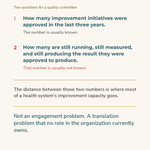





Ask a quality committee how many improvement initiatives it approved in the last three years. The number is usually known.
Ask how many are still running, still measured, and still producing the result they were approved to produce. That number is usually not known.
The distance between those two numbers is where most of a health system's improvement capacity goes.
The standard explanations are engagement and staffing. Staff did not adopt it. The unit was short. The sponsor changed roles.
Each of those is true often enough to be believable. Each also places the cause inside the people who were asked to do the work.
The cause sits earlier than that.
An initiative is approved with an aim, a sponsor, a timeline, and a measurement plan.
What it is almost never approved with is a translation function: a named person accountable for converting leadership intent into something a charge nurse can execute on a Tuesday, and for converting what that charge nurse already knows into something a Quality Director can prioritize.
Without that function, the initiative does not fail loudly. It thins out.
Compliance drifts. Measurement lapses. The sponsor's attention moves to the next approved item, and the problem the initiative was meant to solve returns to the list.
Then it is approved again, under a different name.
Not an engagement problem. A translation problem that no role in the organization currently owns.
At scale this is expensive in a way no single project's budget shows. Quality office capacity is finite.
Every initiative that thins out consumes that capacity twice: once to run it, and once to run its successor.
The design decision in front of health system leaders: keep approving improvement work at the current rate and absorb the attrition, or build the translation capability that lets fewer initiatives finish.
No one should ever suffer or die due to process of care or system failures.
#HealthcareQuality #PatientSafety

A systematic review and meta-analysis published in Nursing Reports in September 2026 examined the association between the nursing work environment and missed nursing care.
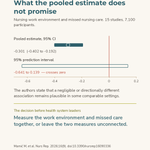
The primary analysis pooled 15 studies and 7,100 participants. A more favorable work environment was associated, on average, with less missed nursing care (pooled Pearson correlation -0.301, 95% CI -0.402 to -0.192).
Fourteen of the 15 studies reported an inverse association.
The authors suggest that missed care is not simply a consequence of a shortage of nurses, and that it reflects a broader organizational system that includes professional standards, leadership, participation, teamwork, communication, and decision-making. They also state that adequacy of staffing and resources remains central.
The authors state several limits of the evidence. Most of the primary studies were cross-sectional, and exposure and outcome were most often measured by self-report questionnaires completed by the same participants. The 95% prediction interval, -0.641 to 0.139, crossed zero, which the authors interpret as indicating that a negligible or directionally different association remains plausible in some comparable settings. The authors state that the present review does not demonstrate that changing any one of the organizational factors will necessarily reduce missed care.
The authors also note that regular, simultaneous measurement of the nursing work environment and missed care could serve as an organizational early warning system, and that deteriorating work environment scores with concomitant increases in missed care could help identify units where quality and patient safety are compromised before more serious adverse outcomes occur.
HB Healthcare Safety frames the decision before health system leaders as binary: measure the nursing work environment and missed care together, as the authors suggest could serve as an early warning system, or leave the two measures unconnected.
Mamić M, Farčić N, Barać I, Mudri Ž, Barišić M, Mamić I, Puharić Z, Pomper GK, Vukoja I. The association between the nursing work environment and missed nursing care: a systematic review and meta-analysis. Nurs Rep. 2026;16(9). doi.org/10.3390/nursrep16090…
#HealthcareQuality #PatientSafety

Two decades. Billions of dollars. National surveillance, payment penalties, and bundle compliance across nearly every hospital in the country.
On central line infections, it worked.
ICU central line bloodstream infections fell from roughly 43,000 in 2001 to 18,000 in 2009, and kept falling. CDC credited that work with 3,000 to 6,000 lives in 2009 alone. Modeled across the full period, the defensible range is 25,000 to 70,000 lives.
That is real. Every hospital that ran those bundles earned it. It is the clearest return the patient safety movement has produced, and it deserves to be named more often than it is.
But the same effort, aimed at a different device, returned almost nothing on mortality.
Catheter-associated urinary tract infections received the same surveillance, the same penalties, the same bundle discipline. The strongest evidence, a meta-analysis in Critical Care Medicine, found no statistically significant attributable mortality for CAUTI.
The widely quoted 13,000 deaths a year counts patients who had a hospital urinary tract infection. Not patients who died of one.
CAUTI reduction returned genuine value: shorter stays, lower cost, less antibiotic exposure and less resistance. It did not return lives, because the harm was rarely lethal to begin with.
Two harms. Same tools. Same rigor. Same people. Opposite returns.
The variable was never effort. It was the shape of the target.
The return arrived where the harm was countable, protocol-izable, and genuinely fatal. Where the target was fuzzier, in the omissions of care, the delayed diagnosis, the nursing care that went missing, there was no bundle to run, and the field still has almost no measurement of what those omissions are costing patients.
The Inspector General findings show what that produced at the system level.
27% of Medicare inpatients harmed in 2008.
25% in 2022.
The tools worked on the problems shaped like the tools.
The design decision in front of health system leaders: keep concentrating improvement capacity on the harms that already have a bundle, or build the capability to find the harms that do not.
No one should ever suffer or die due to process of care or system failures.
#HealthcareQuality #PatientSafety

A systematic review published in the International Journal for Quality in Health Care in November 2025 examined how well trigger tools identify adverse events when applied to medical record review.
Gutierrez-Mendoza and colleagues included 100 studies from 37 countries, covering 932 hospitals and 552,623 medical records reviewed with a trigger tool.
Two methods account for most of that literature. The Institute for Healthcare Improvement Global Trigger Tool was used in 75% of the studies, and the Harvard Medical Practice Study method in 15%.
For the IHI Global Trigger Tool, the authors report an average positive predictive value of 54.5%, a negative predictive value of 80.9%, a sensitivity of 86.6%, and a specificity of 68.2%.
For the Harvard Medical Practice Study method, the reported average positive predictive value was 43.9% and the negative predictive value 37.8%.
The authors state that 66% of the 100 studies reported no predictive value at all, and that predictive values are reported in about one in seven studies.
Among the studies that did report them, predictive values for individual triggers ranged from 0 to 100%.
The authors state the limits of their own synthesis. No meta-analysis was conducted; the averages are arithmetic means across the studies that supplied values, and the synthesis is narrative. Only articles published in English and Spanish were included. Heterogeneity across studies limited the ability to synthesize findings meaningfully.
Two of their findings bear directly on how review capacity is designed.
Every included study used a two-stage review process. Two or more reviewers were involved in 86% of studies, and in 72% a physician validated the adverse events independently of the first reviewer.
On automation, the authors write that digital trigger tools have the potential to reduce the time spent identifying triggers in hospitals equipped with electronic medical records, but that this approach requires the supervision of healthcare professionals to validate the findings effectively. They state that validation of adverse events will remain dependent on the expertise of physicians or other experienced healthcare professionals.
HB Healthcare Safety frames the decision before health system leaders as binary: treat trigger-based detection as a screen whose output a qualified reviewer validates, or treat its output as a count and report it as found.
Gutierrez-Mendoza LM, Manias E, Nicholson P. Predictive values of trigger tools for identifying adverse events in hospitalized patients using a medical record review: a systematic review. Int J Qual Health Care. 2025;37(4):mzaf119. doi.org/10.1093/intqhc/mzaf1…
#HealthcareQuality #PatientSafety

A patient who recovers fully can still have received care that failed at three separate points.
Most review processes will never examine that case.
Selection is usually driven by outcome. A death. A readmission. A complaint. A claim.
Something happened, so someone looks.
That logic is reasonable, and it is incomplete, because it makes the outcome the trigger for examining the process. When the outcome is good, the process is not examined, whatever occurred inside it.
The result is a systematic gap with a predictable shape. Process failures that end badly are studied. Identical process failures that end well are never seen, and they are far more numerous.
The difference between the two is often a nurse who noticed in time, a pharmacist who caught the order, or a patient with the physiologic reserve to absorb a delay.
None of those are controls. They are fortunate, and good fortune is not a safety mechanism.
This determines what a health system is able to learn. A review process that examines only bad outcomes produces a catalog of bad outcomes. It does not show where the care process breaks, because it has sampled only the breaks that happened to be fatal.
The design decision in front of health system leaders: continue selecting cases for review by outcome, or build the capacity to examine the process independent of how the patient fared.
No one should ever suffer or die due to process of care or system failures.
#HealthcareQuality #PatientSafety
Six questions a health system can answer about its own patient safety data, or discover that it cannot.
Each is answerable from systems a hospital already has. The value is not in any single answer. It is in finding out which of the six have no answer at all.
1. How many cases did the organization review last year, as a share of discharges?
2. Of the opportunities for improvement identified in those reviews, how many were omissions of care rather than errors of commission?
3. How were the reviewed cases selected, and who made that selection?
4. When two reviewers examined the same case, how often did they agree?
5. Of the findings produced, how many were assigned a named owner and a date?
6. Of those, how many were verified as changed rather than closed?
An organization that can answer all six has a measurement system. One that can answer only the first two has a reporting obligation.
The distance between those two positions is not a question of effort. Every health system built the measurement infrastructure that regulators and accreditors asked it to build, and built it in good faith. The question is whether the review process was ever designed to produce findings that could be tracked, or only to satisfy a requirement.
Most were designed for the requirement. That is what was asked for.
The design decision in front of health system leaders: continue reporting what is required, or build a review process whose findings can be traced to a verified change.
No one should ever suffer or die due to process of care or system failures.
#HealthcareQuality #PatientSafety
Case review is funded as a project and consumed as a standing need.
That mismatch is structural, and most health systems have it.
A mortality review committee is sized to a calendar. It meets monthly, or quarterly. It is staffed by clinicians whose review hours are taken from clinical time, and the number of cases it can take up is set by how many will fit in the meeting.
The cases themselves do not arrive on that schedule.
They arrive continuously, at whatever rate the organization discharges patients.
So the committee reviews what fits.
Not what matters most. What fits.
None of this is a failure of the committee, and none of it is a failure of rigor. The design was inherited. Review capacity was built on the expectation that a small number of flagged cases would need expert judgment, and that the flagging would come from voluntary reports.
The expectation changed. The capacity did not.
A review function sized to a meeting will always report a number that describes the meeting. It cannot describe the care.
The design decision in front of health system leaders: continue sizing review capacity to the committee calendar, or size it to the volume of care actually delivered.
No one should ever suffer or die due to process of care or system failures.
#HealthcareQuality #PatientSafety
Missed nursing care is most often attributed to capacity.
That attribution is well supported. In a study of 4,258 direct-care nurses in adult intensive care units, Connell and colleagues found that a more favorable work environment was associated with lower burnout, and that part of this association was explained by missed care and moral distress.
Investment in the work environment is therefore justified on the evidence.
It is also incomplete.
A randomized study published this summer tested a second lever. Vexler, Drach-Zahavy, and Srulovici paired ten hospital wards by type and size and randomly assigned them to structured proactive huddles or to usual practice.
On the huddle wards, nurse-reported missed care fell from before to after the intervention, even as workload rose. On the control wards, it did not, and the difference between groups was statistically significant (180 nurses; 85 intervention, 95 control).
The authors report that safety climate partially mediated the reduction, a finding they describe as consistent with a mediating role rather than proof of a causal pathway.
The study has limits that leaders should weigh. The outcome is nurse-reported rather than observed. The study was conducted on ten wards in a single hospital, a small number of clusters, and a single study warrants replication in more diverse settings.
Within those limits, the finding suggests that omissions of care are partly a coordination problem, and coordination can be structured.
Where unit huddles are already in use, whether they occur, what they cover, and whether anyone acts on the concerns raised can depend on the charge nurse on duty and the pressures of that shift.
A practice that depends on individual discretion is likely to be performed inconsistently. A practice that is specified, scheduled, and measured can be held to a standard.
The decision facing health system leaders is not staffing versus communication. It is whether structured communication will be managed with the same rigor as staffing: a defined standard, a measure of adherence, and clear accountability for acting on what is raised.
Sources
Vexler M, Drach-Zahavy A, Srulovici E. Appl Nurs Res. 2026;90:152117. doi.org/10.1016/j.apnr.2026.…
Connell KA, Bocchese S, Lake ET, McHugh MD, Yu H. Intensive Crit Care Nurs. 2026;97:104516. doi.org/10.1016/j.iccn.2026.…
#HealthcareQuality #PatientSafety
American hospitals spend roughly $39 billion a year administering regulatory compliance. In an average 161-bed hospital, about $709,000 of that, plus 4.6 full-time employees, goes to quality reporting alone.
That figure comes from an American Hospital Association analysis. It is a proxy.
It is not the number. The number does not exist.
No federal agency, no accreditor, and no health system can produce the total American healthcare has invested in quality improvement and patient safety over the last three decades.
The other side of the equation is in worse condition.
The harm-cost figures still quoted in board presentations trace back to incidence studies conducted in 2007 and 2008.
$28 to $45 billion a year for hospital-acquired infections.
$17.1 billion for measurable medical errors, in 2008 dollars.
Both rest on data now approaching two decades old.
None of this is negligence. Health systems built precisely the measurement infrastructure that regulators and accreditors asked them to build. Every dollar of it was spent in good faith. And the investment produced real, documented results. AHRQ credits the 2010 to 2014 hospital-acquired condition work with roughly 87,000 deaths averted and $19.8 billion saved.
But a field that cannot state its own investment, and cannot state the harm it reduced, cannot compute a return on either.
That is not a gap in the argument. That is the argument.
And the size of the gap is measurable the moment anyone looks.
In a multicentre collaborative review of 19,181 cases, 66.3% carried at least one opportunity for improvement. Of 46,444 opportunities found, 41,439 were omissions of care.
Roughly seven times what voluntary reporting had captured.
doi.org/10.1136/bmjoq-2024-0…
Seven times is not a rounding error. It is a different denominator.
Every return-on-investment figure the field has published rests on the smaller one.
The design decision in front of health system leaders: keep reporting the metrics you are required to report, or build the review capacity that produces a denominator you can defend in front of your board.
No one should ever suffer or die due to process of care or system failures.
#HealthcareQuality #PatientSafety

One hour from now: Industry Symposia sunrise session, 7:00 AM MST
Sixty minutes on what the last twenty years of adverse-event definitions leave out, and what frontline teams, patients, and families report that traditional safety data does not capture.
Structured case review, done in the session rather than described.
Before It Becomes a Claim: Structured Case Review as a Risk Instrument- Room 121, 7-8 AM MST
The AI Does Not Decide. You Do.- 8:40 to 9:00 AM MST, Bite Size Learning Theater (Solution Center)
Booth 121 the rest of the day. Honey Badger Balloons.
#ASHRM26 #PatientSafety

Most quality executives have watched an AI case-review demonstration by now...
The usual objection is reasonable. A demonstration runs on the vendor's data, and the vendor chose the cases.
That objection is correct. That's why a demonstration on prepared cases is close to worthless as evidence.
It is also the wrong question to bring to Phoenix.
The question is not whether the software finds opportunities for improvement. The question is what your current review process is not seeing, and whether anyone in your organization can state that number.
Most can state a reporting rate. Far fewer can state a detection rate.
In a multicenter learning health system collaborative:
12,714 of 19,181 reviewed cases (66.3%) carried at least one opportunity for improvement.
Of 46,444 opportunities, 41,439 (89%) were omissions of care.
The collaborative identified approximately seven times as many opportunities as voluntary reporting captured.
Huddleston JM, Whitford D, Yaszemski AK, Schrieber MP, Pollak E. Broadening the definition of patient-safety events: lessons from a multicentre learning health system collaborative. BMJ Open Quality 2025;14:e002988.
An omission of care generates no event report. Nothing visible happened for anyone to write down.
Our case reviews at scale allow you to do population-level analyses to right-size your QI projects.
That gap does not close by asking staff to report more. It closes by changing what the organization is able to detect at all.
Healthcare Safeware® with AI-Assisted Automated Case Review was built for that gap. The clinician determines what becomes a data point and what is disregarded. The AI does not decide. Reviewers do not enter the EHR.
A working session is more useful than a demonstration. Bring your own case mix and your own review volume, and see what the review surfaces against them.
HB Healthcare Safety is a Silver Sponsor of the ASHRM 2026 Annual Conference, October 4-6, Phoenix Convention Center. Booth 121.
Hold a time with Dr. Huddleston here: calendly.com/huddleston-infl…
#ASHRM26 #PatientSafety
A voluntary event report records what someone chose to write down.
An omission of care produces nothing to record.
Nothing visible happened. No one witnessed it. No timestamp. No report exists.
That is not a reporting-culture problem. It is a detection-capacity problem.
HB Healthcare Safety is at the @ASHRMAHA American Society for Health Care Risk Management (ASHRM) next week. Booth 121, in the Solution Center.
Look for the honey badger balloons.
We, the Honey Badgers, can't wait to meet you!
Don't forget to register for the 7 am breakfast session on Tuesday morning.
@jmhuddleston, MD, MS, and Kristi Harsh will be there all three days.
#ASHRM26 #PatientSafety

Risk and quality leaders will walk the Solution Center in Phoenix next week and be asked the same question at every booth. What does your product do.
It is the wrong question, and it is the one the format invites.
A better use of ten minutes is to arrive with three questions about your own organization, and find out who can help you answer them.
One. What percentage of your reviewed cases carry at least one opportunity for improvement, and when was that last measured rather than estimated?
Two. Of the opportunities you do capture, how many are omissions of care rather than events someone witnessed and reported?
Three. How many reviewer hours produced those answers, and what did those reviewers not do instead?
Most organizations can answer none of the three from current data.
That is not a failure of the quality department. It is the arithmetic of sixty minutes per manual mortality review and ninety minutes per manual readmission review at real case volume.
The limit is review capacity, not reporting culture.
Healthcare Safeware® with AI-Assisted Automated Case Review was built for that constraint. The clinician determines what becomes a data point and what is disregarded. The AI does not decide. Reviewers do not enter the EHR.
HB Healthcare Safety is a Silver Sponsor of the American Society for Health Care Risk Management (@ASHRMAHA) 2026 Annual Conference, October 4-6, Phoenix Convention Center.
Booth 121, in the Solution Center. @jmhuddleston, MD, MS, presents twice on Tuesday, October 6.
Bring the three questions. We will work through them against your numbers.
Hold a time with Dr. Huddleston here: calendly.com/huddleston-infl…
#ASHRM26 #PatientSafety
Health systems have spent years standardizing the huddle.
A script. A checklist. A fixed slot on the shift schedule.
The instinct behind that investment is reasonable. Communication gaps are a documented driver of missed nursing care.
The investment is not wasted, either.
A randomized trial published this summer found that proactive huddles improved safety climate and reduced missed nursing care across ten pair-matched wards and 180 nurses in a single hospital.
That is a real finding. It deserves to be said plainly before anything else.
The trial also asked how the huddle worked.
A higher safety climate was associated with lower missed nursing care. The authors describe safety climate as one mechanism linking structured communication to care quality, alongside other team-level mechanisms.
Vexler M, Drach-Zahavy A, Srulovici E. From talk to action: a randomized controlled design on the role of huddles in shaping safety climate and reducing missed nursing care. Applied Nursing Research 2026;90:152117.
Here is the operational problem that creates.
Most systems can report whether the huddle happened.
Far fewer can report what it changed.
Compliance is countable. Mechanism is not, at least not at sixty and ninety minutes per manual case review.
So the metric that gets funded is the one that is cheap to collect, and the mechanism the huddle was built to produce goes unmeasured.
Missed nursing care is an omission. An omission generates no event report, because nothing visible happened for anyone to report.
One trial, one hospital. Worth testing locally before it is treated as settled.
Continue tracking huddle compliance as the metric, or build the detection capacity to measure the mechanism and decide what those review hours should be spent on instead.
Healthcare Safeware® with AI-Assisted Automated Case Review was built for that gap. The clinician determines what becomes a data point and what is disregarded. The AI does not decide. Reviewers do not enter the EHR.
HB Healthcare Safety is a Silver Sponsor of @ASHRMAHA, American Society for Health Care Risk Management, ASHRM 2026, October 4-6, Phoenix Convention Center. @jmhuddleston, MD, MS, presents twice on Tuesday, October 6.
If you will be in Phoenix and you want to see what automated case review surfaces in your own kind of data, send me a message, and we will hold a time that week.
BOOTH 121
#HealthcareQuality #PatientSafety