

PhD Student at UCSD | human-interactive ML & AI | reliability | uncertainty
San Diego, CA
Joined May 2019
- Tweets48
- Following439
- Followers572
- Likes349




Hailey Joren retweeted

New Anthropic research: How AI agents shape experts' judgment calls
When experts delegate work to an agent, do they still make the key decisions? We tested this in a randomized trial with 50 professional data analysts.
I was raised in a community that emphasized integrity and joined Anthropic because I wanted to ensure this critical moment in AI goes well for humanity.
I’m grateful to work somewhere that chose not to sacrifice principles for any amount of revenue, even amid enormous pressure.

A statement on the comments from Secretary of War Pete Hegseth.
anthropic.com/news/statement…

PhD in Computer Science, University of California San Diego 🎓
My research focused on uncertainty and safety in AI systems, including
🤷♀️letting models say "I don't know" under uncertainty
🔎understanding and reducing hallucinations
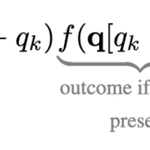
🔁 methods for answering "how much will providing data X improve performance on Y?" at inference time
Many thanks to my advisor @berkustun, to my incredible research collaborators, and to my wonderful friends, husband and family. Getting a PhD while becoming a first-time parent is definitely a recipe for growth!

Hailey Joren retweeted

🚨New blog post out! It's really well written with great graphics 😉😎 About sufficient context in #LLMs for #RAG, based on the project from our amazing intern @HaileyJoren !

Today on the blog we introduce a notion of sufficient context to examine retrieval augmented generation (RAG) systems, developing a method to classify instances, analyzing failures of RAG systems & proposing a way to reduce hallucinations. Read more →goo.gle/43gp3Vk

ALT Our automatic rating method (autorater) for sufficient context. We use a prompted LLM to rate examples consisting of an input query and the retrieved context. The model outputs a binary true/false label that represents sufficient vs. insufficient context.
Hailey Joren retweeted
Come see our poster # 230 tomorrow in the morning session at #ICLR2025
✨Sufficient Context: a new lens on RAG systems✨
w/ @HaileyJoren, @DaChengJuan1, Jianyi Zhang, @ankurtaly , Chun-Sung Ferng
Paper: arxiv.org/abs/2411.06037
Project page: github.com/hljoren/sufficien…

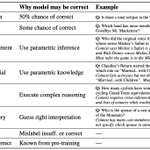
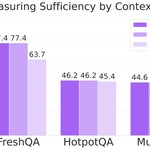
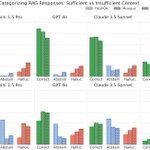
When RAG systems hallucinate, is the LLM misusing available information or is the retrieved context insufficient? In our #ICLR2025 paper, we introduce "sufficient context" to disentangle these failure modes. Work w J. Zhang, C.S. Ferng, @DaChengJuan1, @ankurtaly @CyrusRashtchian
Our work suggests that solving RAG hallucination problems requires moving beyond just improving retrieval—we need models that can accurately determine when retrieved information suffices for answering and abstain when appropriate confidence thresholds aren't met.
I couldn't make it to ICLR this year but co-author @CyrusRashtchian will be around to chat!
📄 Paper (ICLR ’25): arxiv.org/abs/2411.06037
💻 Key Findings & Prompts: github.com/hljoren/sufficien…
#RAG #ICLR2025


✅Easy: train a model to automate a routine task
❌Hard: ensure the model is accurate with minimal human oversight
In our latest #ICLR24, we introduce a modeling paradigm for this setting
Joint w @CharlieTMarx @berkustun
PDF:haileyjoren.github.io/files/…
ICLR:iclr.cc/virtual/2024/poster/…

*End-to-end models don’t have to rely on a (likely incomplete) set of concepts and can exhibit inflated performance due to spurious correlations in the input. One of the benefits of predicting with concepts is better interpretability and removing spurious correlations
And that’s a wrap! If you made it this far, check out our paper at ICLR or online. We’ll be at Halle B #227 Thu 9 May 4:30pm — 6:30pm CEST
PDF: haileyjoren.github.io/files/…
ICLR: iclr.cc/virtual/2024/poster/…