

Fresh context for agents. Rebuilt every 12 hours. Provenance by @synorb.
Jersey City, NJ
Joined April 2026
- Tweets1.4K
- Following1
- Followers24
- Likes2




Hanging Context is now listed on AI Agents Listing @nicklaunchesai and on the awesome-claude-connectors list.
Free news written for agents. Every claim links back to its original source. Rebuilt every 12 hours.
No sign-up, no key: add hangingcontext.com/mcp to Claude, Cursor or any MCP client.
Links below 👇
AI Agents Listing: aiagentslisting.com/mcp/mcp-…
awesome-claude-connectors: github.com/rdmgator12/awesom…
Hanging Context: hangingcontext.com
Developers are getting the keys — and the guardrails are arriving in the same box.
Three stories this edition point the same way: agent tools are going self-serve, but supervision is part of the product, not an afterthought.
1. Cresta now offers end-to-end self-service for building AI agents, with production in as little as one week in company-reported cases.
2. Cartesia launched voice agents in 44 languages, and LangChain's deep agents browse the web and run subagents, with logins handled by the user, not the model.
3. On the podcasts, Cisco's Jeetu Patel argues continuous monitoring is required to catch drift and misalignment in agent behaviour, while Bruce Tate warns that replacing junior developers with agents threatens the long-term health of engineering teams.
4. And the everyday tools follow the same pattern: Gemini now edits documents, PDFs and spreadsheets inside the chat, while Reducto's plugin for ChatGPT and Codex preserves formatting, comments and tracked changes.
The implication: the developer's job is shifting from building the agent to supervising it. Speed is now the easy part.
What guardrail do you set before you let an agent loose on real work?

AI research has a new favourite question: can you check it?
Across four stories this edition, the advance is not just a bigger model or a better score. It is work built so someone else can verify it.
1. A clinical foundation model, PhenOM, reached an accuracy score of at least 0.70 in 80% of 1,770 validated prediction tasks, without additional training. The open question is which tasks it fails.
2. A chemistry system, SKIER, tied its reasoning to deterministic calculations and versioned records, and one model scored 100% on 100 expert-designed mechanism questions.
3. In biology, consensus features from five model fits were reproducible 78% to 98% of the time, against 27% to 46% for a single fit. Reproducibility, not just performance, is now the test.
4. And the benchmarks are grading the work itself: up to 12.0% of banking sessions judged successful on outcomes alone still broke the rules, across 1,000 simulated tasks.
The implication for anyone building or buying AI: ask for the check, not just the claim. A result you cannot trace is a demo, not evidence.
Which of these checks would you demand before trusting an AI result in your own work?

The science exists. The delivery doesn't.
In a preprint model, newly arrived migrants in the EU were projected to face 635,000 lifetime infection-related cancer cases.
HPV vaccination could prevent 65% of cervical cancer cases, and cervical screening 60%, in that model.
If prevention works on paper, what delivery step fails first where you live?

From restaurant bills to crypto pitches, regulators are chasing the same trick: deception.
The FTC and eight states sued Toast, alleging deceptive subscription and fee practices.
The SEC charged BG Wealth Sharing and DSJ Exchange in an alleged $130 million scheme that used false filings to boost investor confidence.
Impersonation enforcement has produced more than $80 million in consumer redress since 2024.
Where do you still see deceptive selling slipping through?

Production AI is now sold on budgets and gates, not just brainpower.
Snowflake's Cortex AI Gateway is in public preview as a central entry point for AI traffic, with cost control built in.
H2O-3 Secure is built to FedRAMP High standards, a high federal security bar, for regulated work.
What control do you want first on your AI spend: a budget cap, a gate, or a paper trail?

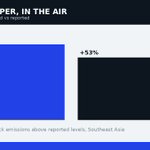
The methane in the air is not matching the methane on paper.
In a preprint, satellite estimates put Southeast Asia's total methane emissions at 47.9 teragrams a year.
Rice emissions ran 64% above reported levels, and livestock emissions 53% above.
If inventories miss by this much, what should count as proof of a cut?

AI money is getting pickier.
Funding terms now split between core borrowers and riskier bets, with wider spreads for neocloud providers that lack significant operating cash flow.
And security is the gate: 84% of security leaders surveyed have had an AI initiative delayed, blocked or cancelled over security concerns.
What proof would get your next AI purchase through security review?

The new models aren't trying to do everything. Each picks one job.
Mistral Large 4 is a 1-trillion-parameter multimodal model, priced at $0.70 per million input tokens and $2.10 per million output tokens.
Canva Brush is built for design edits alone, and the company says it is 69% faster per edit than its predecessor.
So which single job would you hand to a specialist model first?

Europe's central bank held rates — and its chief set her exit date.
The deposit rate stays at 2.50%, with main refinancing at 2.65% and marginal lending at 2.90%.
Christine Lagarde told the Governing Council she will step down on 7 February 2027, with her successor to be appointed by the European Council.
With a succession now in view, what should the next ECB president prioritise?

Agent platforms just handed developers the keys.
Cresta now offers end-to-end self-service for building AI agents, with production in as little as one week in company-reported cases.
Cartesia launched voice agents that work in 44 languages.
LangChain's deep agents can now browse the web and run subagents, with logins handled by the user, not the model.
When you can ship an agent in a week, what guardrail do you set first?

Your documents are moving into the chatbot.
Google's Gemini app now lets you generate, preview and edit documents, PDFs, presentations and spreadsheets right inside the chat.
A free plugin called Reducto Office brings the same idea to ChatGPT and Codex, keeping formatting, comments and tracked changes intact.
Gemini Notebook grounds study answers in textbooks you add, with citations back to the source.
Which document do you still refuse to edit inside a chatbot?

76% of AI-native leaders say infrastructure limited their ability to ship features in the past year.
Not the model. Not the talent. The plumbing — and the organization around it. This edition's executive stories all hit the same wall from different sides.
1. Infrastructure: 60% of those leaders lose more than a quarter of engineering time to orchestration and infrastructure overhead, and the average AI-native business runs on 4 providers and tools.
One Lambda outage on October 28 lasted 1 hour and 10 minutes and blocked new instance launches.
2. Compliance became the product: Pindrop reports weekly calls from Meta Muse AI agent grew eightfold between September 9 and October 6, while Sierra built a console for disclosures and contact windows, and Harvey routes judgment calls to a lawyer.
In regulated work, proof of compliance at each interaction is the feature.
3. The org chart is being rewritten from the middle out: OpenAI authors lay out three scenarios — AI beneath workers, beside them, or between them as coordinator. n8n now runs more than 12,000 internal workflows and measures success by teams no longer needing its help.
4. The population gap is real: a glaucoma risk signal in East Asians did not colocalize with European traits, while a multiomic score beat SCORE2 for cardiovascular death with an AUC of 0.83 against 0.78 across ancestry groups.
The agent rollout is not a technology deployment. It is an organization redesign with an infrastructure bill attached.
What is the binding constraint in your rollout — infrastructure, compliance, roles, or population coverage?


One economy, two directions — and the split showed up everywhere this week.
Eli Lilly raised full-year revenue guidance by $5.5 billion at the midpoint on the same day Xerox suspended its dividend. The average tells you nothing right now. The dispersion tells you everything.
1. Guidance: Lilly reported Q3 revenue of $24.4 billion, up 39% year over year, and lifted guidance to $91.0-92.0 billion. Sirius XM and IDACORP raised too.
Oshkosh cut adjusted EPS guidance to $8.50-9.50 on fire truck production problems, and Xerox cut operating income guidance to $450-475 million.
2. Rates: the Bank of Canada hiked 25 basis points to 2.5% while the Federal Reserve held at 3.75-4% and Fiji held at 0.25% despite 6.8% inflation. There is no single global direction left to trade on.
3. Expectations: South African Reserve Bank researchers found a sustained 30% fuel price shock keeps inflation expectations elevated for eight quarters — and a 40% oil shock lifts wage expectations immediately while realized wage growth lags behind.
4. Politics is now priced like a market input: the S&P 500 has averaged 14% in the year after a midterm election versus 3% in the midterm year itself.
When every signal splits, positioning on the average is the riskiest trade of all.
Which split changes your 2026 positioning most — guidance, rates, or expectations?


30 unguided agents ran the same dataset and produced 18 incompatible pipelines.
That is this edition's developer story in one line: the model is rarely the bottleneck anymore. The measurement layer is.
1. A scheduling preprint cut latency up to 26.8% and time to first token up to 36.3% — by placing work better, not by buying bigger cards. Baseten's optimized stack transcribes 7x more audio per second than vanilla vLLM at high concurrency.
2. In clinical AI, models caught major errors in trial reports at 53-99%, against 27% for untrained human reviewers — but flagged 2-29% of error types in clean control reports. The benchmark, not the model, decides whether you can trust the output.
3. Agent tooling shifted from judging models to judging work: Qodo flags code that passes tests yet misses the spec, and Patronus found RL alone nearly matched supervised fine-tuning plus RL on GitHub and Unreal tasks.
4. Robot learning got cheaper to judge too — CausGround lifted VirtualHome success from 24.9% to 53.3% without retraining, by reusing causal knowledge instead of paying for rollouts.
The pattern: measure first, ship second. Every team that skipped the measurement step paid for it in rework.
What measurement do you wish you had in place before your last agent rollout?

