
Maths teacher, mentor teacher, ed consultant fascinated with discovery learning and inquiry, problem solving, assessment, visualization & making a difference.
Richmond, BC
Joined July 2009
- Tweets11.7K
- Following957
- Followers1.5K
- Likes7.8K
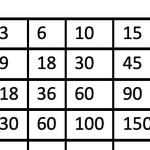


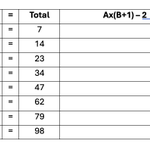

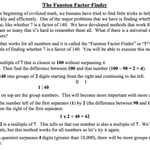
51 x 16 is one more 16 than 50 x 16. I'd quickly do 50x16 by taking half of 100 x 16 --> 800 + 16 = 816. I could also have used doubling and halving 50 x 16 as 100 x 8.
I got a summer man-cold just before the school term started, so I haven't been back...yet. I will give this a go. I filled a page with approaches and loved how rich the organizations could become.
I love this as it has several routes to solution that then leads to efficacy discussions (discrete mathematics exposed). It also opens up divisibility tests in one approach. Or which sieve layout is superior? How do students organize their data gathering to ensure no duplicates?
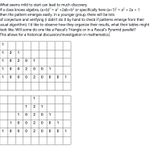
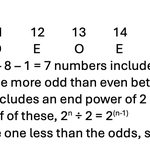
It seems to be a very 'directed' inquiry into evens being one more than odds so 10 odds need 10 ones to make them all even. I'd much rather make this more open and 'look' for the class to discover this number theory as just one of many ideas that develop from these patterns.
1 - 3 - 6
2 - 10 - 12
4 - 60 - 8 --> puzzle broke by noticing column 1 and 2 needed an odd number {1, 3, 5, 15} and the pair had to be in the same row as all the right hand numbers are even. I haven't checked that this solution is unique.
I like doubles like 35 + 35 so this becomes 35 + 2 + 35 + 3 = 70 + 5 = 75. It could also be 40 – 3 + 40 – 2 = 80 – 5.
Doubling/halving. If I double one dimension, the other needs to be half to keep the same area. Good visual of this. Another approach is 25x18 = 25x2x9 = 50 x 9
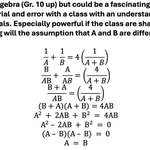
A lovely inquiry that seems to generate its own furthering questions in response to the "Wait! What? Really?" Extensions: can it work with three different factors? (1/n = 1/a + 1/b + 1/c ) Does the n have to be a good composite number?
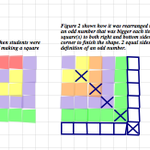
If 50^2 is 2500 then 51^2 is two 50's and 1 in the corner bigger or 2601, then 52^2 is 103 bigger etc.
Or for 51^2 and 42^2. This problem was a centre piece of my "visualizing mathematics" workshop. The sum of consecutive odd numbers always being a square (when arranged as you've shown) leads to estimating the next square from a known square.
24524–12875 --> 24649 – 13000 = 11,649
Solved by pushing each up 125 as a constant shift has an identical difference.
Pt. 2 Now I'm curious what either of your approaches might change by recording the data in this way for a specific rectangle. Would the emerging patterns lead to a generalization?
When I had extended the squares question on a checkerboard, I asked, "How many rectangles of any size is on an m x n grid?" The students started with simple cases, organized counting and then one had a breakthrough by organizing the data on a grid. A 6x4 has 210 rectangles Pt.1

This is the correct approach. Those stating PEMDAS need to see that - 4^2 has the 4^2 taking priority and then being multiplied by the -1.
(-4)^2 =16 but -4^2 = -16
Even the platforms AI knows this.
I like that some will do a x b + a.
Others will do a x (b+1).
Then the fight starts until equivalence is discovered.