

Chartered by Stephen W. Hawking at @UCF to help the public be more involved in space through research and education, because space is our future.
- Tweets308
- Following16
- Followers231
- Likes375





ALT A mostly-full Moon appears deep yellow in contrast with the blue night sky around it. A dark flock of birds flies just below it. The tops of buildings and trees peek out from the bottom of the photo.


ALT Three grainy black and white telescope cutouts from the Zwicky Transient Facility, dated June 25, July 9 and August 5, 2026, each showing asteroid 6993 as a bright dot near the center with a faint, narrow tail stretching to the right. Compass arrows mark north and east, and small yellow and red arrows show the anti-solar and anti-motion directions, which line up with the tail.

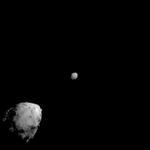
ALT Black and white image from NASA's DART spacecraft of the asteroid Didymos and its small moon Dimorphos against black space, taken about two and a half minutes before DART struck Dimorphos in 2022. The larger asteroid Didymos sits in the lower left corner, a lumpy, rocky body lit from one side. Dimorphos appears near the center as a small, round, bright speck.


ALT Hera spacecraft flying through space

ALT Two panels from a computer simulation of the Moon forming impact, seen from above on a black background with a 50,000 km scale bar in each. Particles are colored by temperature from purple for cooler to bright yellow for hotter. The top panel, labeled Strengthless, shows the glowing proto Earth surrounded by a scattered cloud of debris and a few small clumps. The bottom panel, labeled Strength, shows the glowing proto Earth with much less debris and a single intact, rounded body orbiting off to the upper left.

ALT NASA graphic titled Artemis III Operations Concept, set against black space with the Moon and Mars small at the top and the curve of Earth across the bottom. Three rockets rise from Earth: New Glenn carrying the Blue Moon Mark 2 lander test article from Launch Complex 36A, the Space Launch System carrying Orion from Pad 39B, and Starship carrying its lander test article from Pad 39A. A row of steps above them, labeled low Earth orbit, shows Blue Moon checkouts, Orion phasing and checkouts, Orion and Blue Moon operations, Orion free flight checkout, Orion and Starship operations, Orion tests, and Orion reentry, ending with Orion under three parachutes at splashdown.

ALT Photograph of the Moon taken by the Artemis II crew, showing part of the lunar disk against black space. The right side is lit gray and covered in overlapping craters of many sizes. Toward the upper left, the surface runs into the boundary between lunar day and night, where low sunlight catches only crater rims and ridges and long shadows fill the crater floors before the surface fades into darkness.

ALT Two overhead black-and-white images of the same patch of asteroid Bennu, stacked one above the other. The top panel, labeled "Before: March 7, 2019," shows a rubbly gray surface strewn with angular rocks and boulders around a darker, smoother patch of fine material near the center. The bottom panel, labeled "After: April 7, 2021," shows the same scene after NASA's OSIRIS-REx spacecraft collected its sample there: the smooth central patch is now a shallow depression with a scatter of bright fragments and rocks exposed at its bottom, and many of the surrounding rocks have shifted position. The large boulders at the edges of both frames match up.


ALT The full Moon is pictured just above Earth's horizon from the International Space Station as it soared 260 miles over Mexico.


ALT A grid of 37 small square panels from a research paper, each dated from 2011 to 2025. Every panel shows the same squashed, globe-like grid outline of Quaoar as it appeared in the sky for one star occultation. Blue lines mark where the star was blocked across the outline, short red ticks mark the uncertainty at each line's ends, and green dashed lines mark nearby misses. A small dark dot sits in or near most outlines. Axes are in kilometers.

ALT Artist's concept of NASA's VIPER rover on the Moon at night. The boxy, silver-wrapped rover has four ridged wheels and a tall mast with two headlights that cast a cone of pale blue light across dark gray ground. Low, barren lunar hills rise behind it under a black sky full of stars.

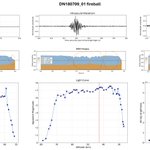
ALT Three columns of charts from a research paper, one for each of three fireballs. Top row, infrasound waveforms. The first fireball shows one short, sharp spike, the signature of a shock from the meteoroid's flight. The second shows a single smeared burst of wiggles, and the third shows two separate bursts, both signs of the rock breaking apart. Middle row, shaded probability plots of how smoothly each fireball lost mass. Bottom row, light curves plotting brightness against altitude, with a red dashed line marking the estimated source of the sound.

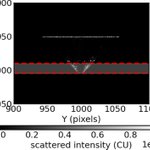
ALT Simulated camera image of a dust curtain thrown up by an impact, shown as a faint, grainy, upside-down cone on a black background. Only scattered specks of light outline the cone, and a gray band marked by red dashed lines near its tip shows the area used to measure brightness. A grayscale bar below gives scattered light intensity. This is the thick-dust case, which comes out dim.

ALT Grid of grayscale video frames from a NASA vacuum-chamber test, four rows of runs at 0, 2, 5, and 10 seconds. A gas jet blows into a bed of sand seen through a window. In the top row, where a strong jet sits close to the surface, a bright crater opens fast and grows wide and deep by 10 seconds. In the rows below, with the jet farther away or weaker, the sand surface erodes only slightly. Labels give chamber pressure, nozzle height, and gas flow for each run.

ALT Apollo 15 astronaut James Irwin in a white spacesuit works beside the Lunar Roving Vehicle on the gray, footprint-covered lunar surface. The rover carries a gold umbrella-shaped antenna and boxes of gear. Behind them rises the broad, sunlit slope of Mount Hadley against a black sky. The dark shadow of the lunar module Falcon stretches across the foreground.

ALT Plot of asteroid Strenua's outline rebuilt from the moment it passed in front of a star. A black dotted oval, about twice as wide as it is tall, sits on a grid marked in kilometers, wrapped in faint orange curves showing other possible outlines. Colored horizontal lines mark the four stations that saw the star vanish, with dots where it blinked out and came back. Gray lines above and below mark stations that saw no change.