

Independent investment research on public equities, macro, market structure, and digital assets.👉https://teapaw.org/t.co/dk52HsxybQ
Joined September 2026
- Tweets79
- Following123
- Followers31
- Likes60




Pinned Tweet
Most stock takes have an expiration date. They just don't tell you when.
Welcome to HAYABUSA RESEARCH.
Wall Street and social media have no shortage of opinions. What we're interested in is the evidence behind them—and what happens when that evidence changes.
We research public equities, AI, biotech, macro and market structure to answer three questions:
1. What does the market already believe?
2. Where might those expectations be wrong?
3. At what price does that difference become an investment opportunity?
We look for overlooked opportunities, second-order effects, hidden risks and potential mispricings.
But a clever thesis isn't alpha unless there's an actionable decision behind it.
So our research aims to explain what could justify an entry, what would make us wait, what could cause a permanent loss—and what evidence would change our minds.
And we don't stop at publication.
That's why we built LIVING RESEARCH.
Most research captures what someone believed on one particular day.
Ours is designed to keep the investment case alive:
• What we believe NOW.
• What could prove us WRONG.
• What evidence we're WATCHING.
• What would make the stock ACTIONABLE.
• How our conclusions have CHANGED over time.
Earlier views stay visible. Material revisions are timestamped.
No quietly moving the goalposts.
We won't always be right. But you should always be able to understand our reasoning, challenge our assumptions and see whether the evidence supports our conclusions.
That's the standard we're building toward.
Explore our Living Research:
hayabusaresearch.com/living-…
Follow @HayabusaRes if you believe investment research should do more than tell a good story.
Disclosure: Hayabusa Research publishes independent research for informational and educational purposes only. Nothing here is investment advice or a recommendation to buy or sell any security.
Curiosity Before Capital.
Return with evidence.

2
260
We started looking at SpaceX’s terrestrial network on October 9.
Our working thesis then:
SpaceX may disrupt the wireless carriers while becoming a new customer for the towers.
Since then, the evidence has moved.
• Bloomberg reported SpaceX was seeking access to at least 80,000 U.S. cell sites.
• Qualcomm has now confirmed a multi-year Starlink Mobile agreement covering terrestrial 5G infrastructure and tens of thousands of sites beginning in 2027.
• Q3 Connectivity revenue reached $5.25B, with roughly a 45% operating margin.
• Management reported 22M+ Starlink Mobile monthly users.
So the original architecture thesis is holding up: Starlink Mobile is increasingly looking like a hybrid satellite + terrestrial network, not a satellite-only replacement for towers.
But that means the research question has changed.
We no longer need to ask whether SpaceX intends to build a real terrestrial network.
Now we need to ask:
Can SpaceX combine satellites, spectrum, towers and its existing Starlink footprint into a national carrier with structurally better economics than AT&T, Verizon and T-Mobile?
That is a much harder—and much more investable—question.
Our current read:
Company thesis: Strengthening
Security thesis: Conditional
Action: Wait for proof
Updated SpaceX ($SPCX) Living Research:
hayabusaresearch.com/spacex-…
Curiosity Before Capital
Return with evidence.

45
Revolution Medicines ($RVMD): Its Pancreatic Cancer Pill Nearly Doubled Median Survival. What Does $38 Billion Buy?
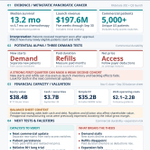
More than 5,000 U.S. patients received commercial Rasonque in its first five weeks. At the next earnings call, I want to know how many newly eligible patients started treatment after the initial waiting list cleared, and how many came back for a refill. At the November 5 close of $177.65, investors valued Revolution Medicines at $38.4 billion. Whether the company can grow into that valuation depends on both numbers.
The clinical evidence
In a randomized trial of 500 previously treated patients with metastatic pancreatic adenocarcinoma, median overall survival was 13.2 months on daraxonrasib versus 6.7 months on chemotherapy. The FDA approved the once-daily pill, sold as Rasonque, for adults with metastatic pancreatic adenocarcinoma who have received prior systemic therapy or are unsuitable for multiagent systemic therapy.
One detail matters when translating that survival benefit into sales. In the trial, 69% of patients treated with daraxonrasib had a dose interruption. Patients can pause and resume treatment, so commercial refill data will give investors a better estimate of how many paid months each new prescription ultimately generates.
Where the market could be wrong
The $197.6 million launch included distributors building inventory, patients moving from expanded access to commercial prescriptions, and patients who had been waiting for approval. As that backlog clears, reported sales growth could slow even while more newly eligible patients begin treatment. That is where an opportunity could emerge.
Consider what two months of refills are worth. Assume 20,000 patients start each year and RVMD receives $30,000 net per paid month. Four paid months per patient would support $2.4 billion in annual sales once prescribing settles into a steady pattern. Six months would support $3.6 billion. The same number of new patients produces a $1.2 billion difference in annual sales. These figures illustrate the sensitivity to treatment duration. The company’s actual commercial average is still unknown.
AstraZeneca is studying AZD0022, a competitor targeting the G12D mutation. Its early-stage study leaves comparative efficacy open. The more immediate risk for shareholders is that Rasonque succeeds in its approved population while expansion into first-line pancreatic cancer and lung cancer takes longer, or delivers less, than the valuation requires.
The balance sheet and the price
At September 30, RVMD held about $3.7 billion in cash and marketable securities against $500 million in convertible-note principal. Management expects its resources to fund at least twelve months of planned operations and projects $2.1–$2.2 billion in 2026 operating expenses. An October loan added $250 million to both cash and debt.
Using 216.3 million basic shares, the November 5 close implies a simplified enterprise value of about $35.2 billion. Royalty obligations reduce the cash shareholders can ultimately receive, and future share issuance can spread that cash across more shares.
Bear, base and bull
I modeled three outcomes for total annual net sales four years from now. Each assumes 230 million shares at that point, zero net cash and a 10% annual required return. I apply an enterprise-value-to-sales multiple to each outcome and discount the resulting share value back four years. The probabilities and multiples are my judgments.
Bear case: 25% probability · $24 per share today. The waiting list clears, refills disappoint and expansion contributes little. Annual sales reach $2 billion, valued at 4× sales.
Base case: 50% probability · $107 per share today. U.S. prescribing holds up, international sales grow, and earlier-line pancreatic treatment or lung cancer adds revenue. Annual sales reach $6 billion, valued at 6× sales.
Bull case: 25% probability · $285 per share today. Randomized trials open larger markets, RVMD scales internationally, and the business retains enough profitability and growth to command a premium. Annual sales reach $12 billion, valued at 8× sales.
The probability-weighted value is about $131 per share. Moving ten percentage points from the base case to the bull case lifts it to about $148. To support $177.65, the model requires roughly 51% bull probability if bear probability stays at 25%. That is more than twice the weight I would give the bull case on the evidence available today. Future dilution and the amount of cash remaining in four years could also move these estimates materially.
Current Hayabusa read — WATCHLIST
I would wait at $177.65. Around $105, I would reopen the underwriting if the operating evidence still supported these scenarios. That price offers a roughly 20% cushion to the weighted estimate.
At the next commercial update, I want RVMD to separate newly eligible patients from expanded-access transitions and show paid refills by the month patients started treatment. Sustained new starts and stable refills as inventory normalizes would strengthen the base case. Two successive groups with fewer starts and shorter paid duration would lead me to cut it.
The other event that could change my judgment is the Phase 3 lung-cancer trial. Management expects initial results in 2027. A survival benefit with manageable toxicity would give me reason to raise the bull probability. A failed study would remove that route to expansion from my model.
Disclosure: As of November 5, 2026, the author does not hold RVMD shares. For investment research and education.
Curiosity Before Capital.
Return with evidence.

264

$PLTR could beat Wall Street and still disappoint investors.
EPS consensus: ~$0.41. Published whisper: $0.49. Options price a ~13% weekly move.
What happens when exceptional growth meets extraordinary expectations?

157
On Oct 22, we published our $SDGR deep dive at roughly $22–23. By Oct 28, Schrödinger closed at $30.87 or 36.6% above its Oct 22 close.
Have you read it yet? teapaw.org/HayabusaRes/status/211…
Our question: Who gets paid to check which AI-designed drug molecules are worth testing?
Here's what we found: BEFORE the big jump, activity surged in May 2027 $30 call options—contracts tied to potential stock upside.
Outstanding contracts rose from just 61 to 2,794 by Oct 28 morning.
That means major new positions, not just busy trading.
Then, on rally day, 5,085 December $30 put options traded. By the next morning, outstanding puts had jumped from 61 to 5,015.
A put can be downside insurance or something an investor sells to collect a premium. The data can't tell us each trader's motive.
One key caveat: we uncovered these patterns AFTER the rally. We did not alert on them in real time, and we cannot prove options activity caused the price jump.
The bigger question remains whether SDGR's business can justify a higher valuation.
Our stance stays WATCHLIST—not chase.
Nov 4 earnings are the next test: software contracts, real revenue from AI tools, and cash spending.
A rising price is not proof of a stronger business.
Curiosity Before Capital. Return with evidence.
Research only; not investment advice.

$SDGR: What If the Biggest Winner in AI Drug Discovery Isn't a Drug Company?
Bill Gates has a substantial connection to Schrödinger ($SDGR). The Gates Foundation Trust holds approximately 16.1 million common and limited common shares, according to the company's 2026 proxy. But this is a longstanding investment, not evidence of a recent buying spree.
That's not the main reason we're interested.
As AI makes it easier to design millions of potential drug molecules, the bottleneck may shift from generating candidates to determining which ones are actually worth testing.
Schrödinger has spent decades building physics-based molecular simulation software that could become increasingly valuable in exactly that environment.
The Evidence
In Q2 2026, Schrödinger's reported software revenue declined 10% year over year. At first glance, that looks disappointing.
But annual contract value (ACV), excluding contribution funding, grew 23%. The discrepancy partly reflects its transition from software revenue recognized upfront toward hosted contracts recognized over time.
Its AI co-scientist, Bunsen, is also gaining commercial validation. Bristol Myers Squibb announced a strategic agreement to deploy the technology across its research organization in August.
That's meaningful. But deployment is not yet proof of incremental profitability.
Where's the Alpha?
We see three possibilities.
First, investors may be underestimating the underlying software business because reported revenue is temporarily obscured by the hosted transition.
Second, generative AI may actually increase the value of accurate physics-based simulation. More molecular candidates could mean greater demand for tools that help identify which ones deserve expensive laboratory experiments.
Third, Schrödinger participates in drug discovery economics through collaborations, milestones, royalties and biotech equity. These provide potential upside beyond software licensing.
But there's a catch: potential drug milestones are not guaranteed revenue, and successful science does not always translate into shareholder returns.
Our Valuation
At roughly $22–23 per share on October 22, SDGR carries a market capitalization of approximately $1.7 billion.
It reported $418.8 million in cash, restricted cash and marketable securities at June 30. A simplified lease-adjusted enterprise value is approximately $1.4 billion, or around 7× its $196 million trailing software ACV excluding contributions.
That's a whole-company valuation comparison, not a pure software multiple. And it isn't obviously cheap for a company still losing money.
Our Stance: WATCHLIST
We're interested in the technology and the potential economics. We're not yet convinced the current valuation offers enough margin of safety.
Software retention is a concern. Commercial net dollar retention fell from 113% in 2024 to 100% in 2025. The business also continues consuming cash.
The science is promising. The investment alpha remains unproven.
What's Actionable?
The next major checkpoint is November 4, when Schrödinger reports Q3 earnings.
Management guided to $41–45 million in quarterly ACV excluding contribution funding, implying approximately 14–25% comparable growth against Q3 2025 after adjusting for contributions.
We want evidence of sustained contract growth, improved margin economics, real Bunsen monetization and controlled cash consumption.
What Breaks the Thesis?
If contract growth disappoints despite the accounting transition, hosted software lowers margins without generating incremental spending, or cash losses and dilution persist, the investment case weakens materially.
Drug-discovery failures could further reduce the value of the pipeline and partnership optionality.
The Hayabusa Read
We think the more compelling question isn't whether AI can invent better molecules.
It's who gets paid to determine which ones are worth pursuing.
Schrödinger may become one of those companies. But the difference between a valuable technology and a valuable stock is the economics.
Curiosity Before Capital. Return with evidence.
Disclosure: The author does not hold positions in SDGR as of publication. Hayabusa Research publishes independent research for informational and educational purposes only. Nothing here constitutes personalized investment advice or a recommendation to buy or sell any security.

296

Micron Technology ($MU): Boom-time earnings are easy to admire. The earnings floor is harder to prove.
Our updated Micron Living Research finds stronger evidence for durability:
• About $134 billion in remaining contractual obligations, backed by committed volumes and minimum pricing.
• $12.75 billion in FY2026 customer deposits—largely repayable financing, not revenue or free cash flow.
• AI memory demand extending beyond HBM into server DRAM and storage.
The real test: do those protections hold when customers stop scrambling for supply?
We’re modestly more confident in the business. The stock still needs a valuation grounded in earnings that can survive fading scarcity.
Stronger commitments improve the case. They don’t abolish the memory cycle.
Read our October 23 Living Research update, with earlier research preserved:
hayabusaresearch.com/micron-…
NVIDIA ($NVDA) wants AI factories running in weeks. Investors still need to know when the cash comes back.
At GTC Berlin, NVIDIA said its DSX POD design could cut installation at a prepared site from six months to as little as 14 days. Its DSX software also promises the same AI output with up to 30% less power.
Faster deployment. Lower operating costs. Potentially better customer returns.
But “prepared site” matters. Power, cooling and supporting infrastructure must already be ready. The container doesn’t come with a complimentary grid connection.
And getting a factory running, making it profitable and collecting cash are three different milestones.
Our earlier research flagged $63.1 billion in receivables and collection stretching to 60 days from 45. Management cited extended terms for certain investment-grade customers—not evidence of bad debt by itself.
Berlin strengthens the engineering story. The next financial report tests the cash story.
Our updated Living Research explains what would change our view—and why our stance remains: wait for proof.
Read the update and prior editions:
hayabusaresearch.com/nvidia-…

1
88
SpaceX ($SPCX): We Were Watching the Towers
Our October 15 research identified the possibility that SpaceX could challenge wireless carriers while creating demand for existing towers.
Now Bloomberg reports talks for at least 80,000 U.S. cell sites, highlighted by Yahoo Finance.
We’ll take that one. The reporting supports the framework we put on paper before the site discussions became public.
Getting the architecture right is a useful first step. Signed contracts and attractive returns are the next test.
Yahoo’s coverage:
finance.yahoo.com/technology…
Our updated Living Research, including the October 15 archive:
hayabusaresearch.com/spacex-…

65
$META dropped nearly 7% today, despite 26% revenue growth.
So what's the market worried about? Not the ad engine. It's the $34.9B in Q3 capex against $32.8B in operating cash flow—and how that AI buildout gets financed.
We updated our META Living Research:
hayabusaresearch.com/meta-me…

39
$SDGR: What If the Biggest Winner in AI Drug Discovery Isn't a Drug Company?
Bill Gates has a substantial connection to Schrödinger ($SDGR). The Gates Foundation Trust holds approximately 16.1 million common and limited common shares, according to the company's 2026 proxy. But this is a longstanding investment, not evidence of a recent buying spree.
That's not the main reason we're interested.
As AI makes it easier to design millions of potential drug molecules, the bottleneck may shift from generating candidates to determining which ones are actually worth testing.
Schrödinger has spent decades building physics-based molecular simulation software that could become increasingly valuable in exactly that environment.
The Evidence
In Q2 2026, Schrödinger's reported software revenue declined 10% year over year. At first glance, that looks disappointing.
But annual contract value (ACV), excluding contribution funding, grew 23%. The discrepancy partly reflects its transition from software revenue recognized upfront toward hosted contracts recognized over time.
Its AI co-scientist, Bunsen, is also gaining commercial validation. Bristol Myers Squibb announced a strategic agreement to deploy the technology across its research organization in August.
That's meaningful. But deployment is not yet proof of incremental profitability.
Where's the Alpha?
We see three possibilities.
First, investors may be underestimating the underlying software business because reported revenue is temporarily obscured by the hosted transition.
Second, generative AI may actually increase the value of accurate physics-based simulation. More molecular candidates could mean greater demand for tools that help identify which ones deserve expensive laboratory experiments.
Third, Schrödinger participates in drug discovery economics through collaborations, milestones, royalties and biotech equity. These provide potential upside beyond software licensing.
But there's a catch: potential drug milestones are not guaranteed revenue, and successful science does not always translate into shareholder returns.
Our Valuation
At roughly $22–23 per share on October 22, SDGR carries a market capitalization of approximately $1.7 billion.
It reported $418.8 million in cash, restricted cash and marketable securities at June 30. A simplified lease-adjusted enterprise value is approximately $1.4 billion, or around 7× its $196 million trailing software ACV excluding contributions.
That's a whole-company valuation comparison, not a pure software multiple. And it isn't obviously cheap for a company still losing money.
Our Stance: WATCHLIST
We're interested in the technology and the potential economics. We're not yet convinced the current valuation offers enough margin of safety.
Software retention is a concern. Commercial net dollar retention fell from 113% in 2024 to 100% in 2025. The business also continues consuming cash.
The science is promising. The investment alpha remains unproven.
What's Actionable?
The next major checkpoint is November 4, when Schrödinger reports Q3 earnings.
Management guided to $41–45 million in quarterly ACV excluding contribution funding, implying approximately 14–25% comparable growth against Q3 2025 after adjusting for contributions.
We want evidence of sustained contract growth, improved margin economics, real Bunsen monetization and controlled cash consumption.
What Breaks the Thesis?
If contract growth disappoints despite the accounting transition, hosted software lowers margins without generating incremental spending, or cash losses and dilution persist, the investment case weakens materially.
Drug-discovery failures could further reduce the value of the pipeline and partnership optionality.
The Hayabusa Read
We think the more compelling question isn't whether AI can invent better molecules.
It's who gets paid to determine which ones are worth pursuing.
Schrödinger may become one of those companies. But the difference between a valuable technology and a valuable stock is the economics.
Curiosity Before Capital. Return with evidence.
Disclosure: The author does not hold positions in SDGR as of publication. Hayabusa Research publishes independent research for informational and educational purposes only. Nothing here constitutes personalized investment advice or a recommendation to buy or sell any security.
CytomX Therapeutics ($CTMX): An Overlooked Cancer Drug, or Another Biotech Value Trap?
CytomX is one of the more interesting speculative oncology setups we've found in our biotech screen.
The reason isn't just its PROBODY platform. It's that the company has started demonstrating clinical activity against a cancer target that has historically been difficult to drug safely.
Its lead candidate, Varseta-M, is a masked antibody-drug conjugate targeting EpCAM, a protein widely expressed in colorectal cancer.
The idea is to keep the drug relatively inactive in healthy tissue and activate it preferentially within tumors.
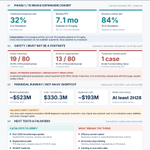
In a Phase 1 expansion cohort of heavily pretreated colorectal cancer patients, the 10 mg/kg dose produced a 32% confirmed objective response rate, with median progression-free survival of 7.1 months.
That's 6 responses among 19 evaluable patients—not enough to declare victory, but interesting in a population with limited treatment options.
Now here's where the potential alpha appears.
At approximately $2.39 per share, CTMX has an economic market capitalization around $524 million. It reported $330 million in cash and investments at June 30, plus a $37 million payment received from Regeneron in July.
After allowing for subsequent cash consumption, the market is roughly valuing the operating business at under $200 million, before other liabilities and obligations.
That business includes Varseta-M, another clinical-stage drug called CX-801, and partnerships involving companies such as Regeneron.
For a potentially registrational oncology asset with encouraging early efficacy, that valuation deserves attention.
But the risk is substantial.
Across an earlier 80-patient safety population, 19 patients experienced Grade 3 diarrhea. There was also one treatment-related fatal acute kidney injury. A smaller cohort using improved dosing and preventive medication subsequently reported Grade 3 diarrhea in 10% of patients.
We need to know whether that improvement holds up as more patients are treated.
Here's our thesis:
The market may be discounting Varseta-M's commercial potential too aggressively because of its early development stage and toxicity concerns. If the upcoming dose-optimization results confirm meaningful responses with acceptable safety, the market could begin assigning substantially more value to the drug.
That makes CTMX an interesting asymmetric speculation—not a de-risked biotech investment.
Our stance: SPECULATIVELY BULLISH.
At the current valuation, a small, risk-budgeted starter position is defensible for investors prepared for a substantial or total loss. We would not treat it as a full-conviction position ahead of the next data.
Our key test is the year-end clinical update. We'd want to see response rates remain meaningfully above historical late-line treatment benchmarks at the selected dose, with severe gastrointestinal toxicity convincingly controlled.
If efficacy deteriorates during dose optimization, or serious toxicity remains unacceptable, the thesis breaks.
If both efficacy and safety hold up, the case for a larger valuation becomes much stronger.
That's the opportunity we're underwriting.
Curiosity Before Capital. Return with evidence.
Disclosure: The author does not hold positions in UPB or CTMX as of publication. Hayabusa Research publishes independent research for informational and educational purposes only. Nothing here constitutes personalized investment advice or a recommendation to buy or sell any security.

280
Upstream Bio ($UPB): A Biotech Trading Below Cash. Is the Market Missing Something?
Upstream Bio has something most early-stage biotechs would love to have: positive randomized Phase 2 data in two diseases, a validated biological target, and a stock trading below its last reported cash balance.
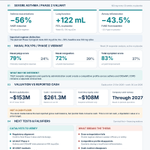
Its lead drug, verekitug, reduced severe asthma exacerbations by 56% versus placebo when administered every 12 weeks. A separate Phase 2 trial in chronic rhinosinusitis with nasal polyps also demonstrated meaningful clinical improvements.
That's encouraging evidence, especially for a company valued at approximately $153 million despite reporting $261 million in cash and short-term investments at June 30.
So why is the market valuing UPB below its cash?
Because that cash isn't sitting around waiting to be distributed to shareholders.
UPB consumed $83.5 million in operating cash during the first six months of 2026. At that rate, the approximately $107 million gap between its June cash and current market capitalization represents less than eight months of spending.
And the company is preparing two Phase 3 trials involving approximately 1,500 patients combined.
There's another wrinkle. The 56% reduction in asthma exacerbations came from 100 mg every 12 weeks. The pivotal trials will test 400 mg every 12 weeks, a different regimen. The efficacy of that exact regimen still needs to be demonstrated.
Competition isn't standing still either. GSK already has an approved biologic administered just twice a year for certain severe asthma patients.
Here's our read:
We like the clinical evidence. We don't yet like the financing setup enough to call the stock undervalued.
The potential alpha isn't simply buying $261 million in cash for $153 million. It's identifying whether verekitug can become a commercially competitive treatment without shareholders absorbing excessive dilution along the way.
Our stance: WATCH, NOT BUY — YET.
We'd become more constructive if UPB secures favorable financing or a development partner, preserves sufficient runway, and provides convincing support for the pivotal dosing strategy.
If those conditions come together, the current valuation could prove excessively pessimistic.
Until then, the discount may be entirely rational.
Survival first. Optionality second. Compounding follows.
Curiosity Before Capital. Return with evidence.
Disclosure: The author does not hold positions in UPB as of publication. Hayabusa Research publishes independent research for informational and educational purposes only. Nothing here constitutes personalized investment advice or a recommendation to buy or sell any security. Investing involves risk, including the potential loss of principal.

63
The AI boom doesn't need a demand collapse for investors to get hurt.
That's the uncomfortable conclusion I'm reaching as we examine the latest developments across the AI industry.
Meta just reported 26% revenue growth. NVIDIA continues to see strong demand for next-generation infrastructure. These are real businesses generating real economic value. The AI revolution isn't imaginary.
But look beneath the headlines.
CoreWeave's borrowing costs are flashing warning signs. Microsoft walked away from a planned Nscale data center because the power connection couldn't arrive on time. Meta's enormous infrastructure spending pushed quarterly free cash flow into negative territory.
Here's what concerns me: A data center can be contracted but not financed. Financed but not powered. Powered but not profitable.
Each failure creates problems for a different part of the AI ecosystem. And when those companies depend on one another's spending commitments, the risks can spread much further than investors expect.
This doesn't mean an AI crash has begun. Hyperscalers aren't collectively slashing spending, and we're not seeing broad systemic credit failures. In fact, some of the strongest bullish evidence is still intact.
But the cracks are becoming measurable rather than hypothetical.
We've just published AI Bubble Watch v1.1 at Hayabusa Research, incorporating our October 21 evidence check.
Our assessment remains CAUTION — Elevated.
We've also expanded the research with a 13-layer AI Ecosystem Fragility Map, capital-market transmission analysis, and specific signals that would tell us when isolated problems are becoming something more dangerous.
The biggest question isn't how much AI infrastructure gets announced or purchased.
It's how much becomes powered, productive, and capable of earning an acceptable return on capital.
That's the difference between an extraordinary technology revolution and a successful investment cycle. They aren't necessarily the same thing.
Full research: hayabusaresearch.com/ai-bubb…
Curiosity Before Capital.
Return with evidence.

45
Hayabusa Research retweeted

I'm often asked what to pay attention to there are two big things:
First, pay attention to the bond market and the cost of money, because that is the backbone to everything. Keep an eye on the Treasury yield and the spreads in relationship to that.
Second, pay attention to the concentration that is existing in one thing right now: AI. Whether or not you think AI is in a bubble, you have to recognize the amount of concentration risk. There is a lot stuck on one thing for the economy and the markets.
Because all of that is risky, I want to have less concentration on one thing and more diversification right now.
I provide a more thorough explanation on the US bond market in my latest article. You can find it here: teapaw.org/RayDalio/status/211007…
#BondMarket #AI #Investing #RayDalio


What if AI demand is real—but the bubble is in how we finance it?
AI Bubble Watch is now live. We’re tracking credit stress, hyperscaler capex, and whether promised compute turns into real cash returns.
Current read: CAUTION, not a confirmed bust.
hayabusaresearch.com/ai-bubb…
51
TOKENIZATION IS BOOMING. THAT DOESN'T MEAN TOKEN HOLDERS GET PAID.
Our first Hayabusa Digital Assets flagship is live:
THE TOKENIZATION PARADOX — When Blockchain Adoption Doesn't Reward Token Holders.
Suppose a fund tokenizes $1 trillion in Treasuries. Bondholders collect the yield. Custodians, issuers and platforms may collect fees. But how much of that activity MUST accrue to the network's native token?
That's the investment question almost everyone skips.
We examined SEVEN tokens. Their economics are radically different:
• SKY — protocol surplus can fund buybacks and staking distributions. What survives funding costs and credit losses?
• HYPE — trading fees can fund token purchases and burns. But are those fees durable, and how much dilution is coming?
• CC (Canton Coin) — institutional network usage can burn tokens, but validator/application rewards also mint supply. NET capture is what matters.
• LINK — a visible Reserve mechanism can turn certain service payments into LINK. But a growing reserve isn't audited recurring customer revenue.
• ETH — Ethereum provides security and settlement, while rollups can keep much of the user-facing fee economics.
• SOL — application growth is real; application profits are not automatically SOL-holder returns.
• XRP — Ripple deals and XRPL tokenization don't prove that XRP is the economically preferred bridge. Show us route economics and persistent liquidity demand.
THE POSSIBLE ALPHA:
The biggest blockchain winner may NOT be the best token investment. We want the gap between market expectations and sustainable token-specific value capture—AFTER dilution, issuance, incentives and intermediaries.
This is a RESEARCH PRIORITY list, not a buy ranking. We have not established that any of the seven is undervalued at today's price.
NEXT: A seven-token Full Underwriting series is planned, beginning with Canton Coin. We'll test bear/base/bull valuations, attractive entry conditions, catalysts and clear thesis-killers. We may conclude some are not worth owning.
Read the flagship:
hayabusaresearch.com/the-tok…
Disclosure: The author holds long positions in XRP, LINK and CC, creating potential conflicts. Research only; not investment advice.
Curiosity Before Capital.
Return with evidence.

Canton (canton-network:native) full underwriting available here: teapaw.org/HayabusaRes/status/211…
We promised seven full token underwritings. Here’s Canton Coin (canton-network:native).
Wall Street is interested. Should token holders be?
We follow the money, burns and dilution - find out our verdict at:
hayabusaresearch.com/canton-…

14
