



Hello all! I have moved from Twitter/X to Bluesky, for all the obvious reasons. I am now @heatherodox.bsky.social. I’ll be posting about my Legacy of the Vikings @Leverhulme project on Bluesky from now on. I hope you can still follow me. There’s still lots to come!
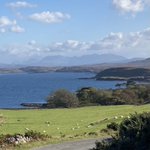
And I think this will actually be my final post from a wonderful week on Skye as part of my @LeverhulmeTrust Viking legacy project. Looking south from Husabost (yet another ON Bólstaðir name) towards the far Cuillins.

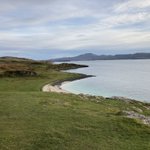
The arson attack at Trumpan was going to be my final post, but here is Loch Pooltiel, on Duirinish, in which, it is said, a Viking prince called Diel (Diel?) drowned, and his body laid on the rocks by mermaids. We saw seals on the rocks, basking in the sun. But no mermaids.

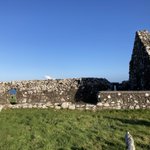
Last day of my @LeverhulmeTrust Viking Legacy project on Skye. This is Trumpan Church, on Waternish, in which in 1578 a whole Sunday morning congregation was burnt alive by a rival clan. The ruin itself may be a late Norse (12c) building, the only one on Skye. Spectacular views.


But historians are now more sceptical about Leòd/Ljótr (maybe his father was Ölvir, another ON name, for instance, not Olaf). These ancient flat-topped mountains across Loch Dunvegan are McLeod’s Tables. The Duirinish stone was erected in 2000, though, to mark the Millennium!

In Dunvegan, Skye, as part of my @LeverhulmeTrust project Viking Legacy. Dunvegan Castle is the seat of the McLeod clan, said to be descended from Leòd, Gaelic for ON Ljótr, son of Olaf the Black, 13c King of Man and the Isles - according to this information plaque near Dunvegan.

And only a few hundred yards from Tote Cairn, below left the Clach Ard Pictish picture stone from the 7c. I thought the Pictish kingdom was in the east of Scotland! Skye is a remarkable place. And there’s a Pictish stone on Raasay too- below right is a photo of a photo of it.


Archaeology Highlands calls Tote Cairn “one of the few Viking cremation burials in Scotland” and “important evidence of Viking presence [ie, I think, settlement] in Skye] because artefacts in it - now in Cambridge! - were dated to 10c. Oh dear. But what a great place to settle.

A wet day today, so went in search of Tote Cairn at Skeabost (?Skeið Bólstaðir, racetrack farm), a prehistoric burial mound with a later Viking cremation interred there. I thought the photo below was maybe it. But it turns out that a nearby crofter illegally levelled it in 2021!

And finally for today, a view south along the shore of Loch Dunvegan, with its remarkable Coral Beach. No wonder the Scandinavians colonised this place!!

A helpful information board at Dun Beag broch shows the artefacts Vikings occupying the broch seem to have lost, or left behind.

This magnificent Iron Age broch is Dun Beag, near Dunvegan. It commands views right over Loch Bracadale (Brekka dalr) to the Outer Hebrides. Some Viking age bling was found there - and no wonder: it’s a hugely strategic lookout site.


An idyllic morning on Raasay, site of Sorley Maclean’s Hallaig. Raasay is traditionally the home of the MacSweens, said to be descended from Sveinn Asleifsson, from Orkneyinga saga. Brochel Castle was once a Norse fortification. This is the Skye coast looking over from Raasay.

Also had to cancel a trip to the Viking canal at Rubh’ an Dúnain. But google “Viking canal”, and go to Canmore.org. Amazing. Maybe a similar natural feature at Loch Coruisk, where a boat could be carried over a narrow crossing point and anchored in a sheltered loch.

And can the name Elgol really be derived from the ON Helga Bólstaðr (Holy Farmstead)? The area around is said to be “famed for lush pastures” which might explain why Scandinavians named it like that, but this Elgol cow wasn’t tempted!

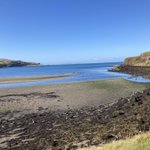
Wonderful day around Elgol, on Skye, on my @Leverhulme Viking legacy project. Had hoped to see remains of a possible Viking house in Scaladale, but this is the nearest I could get - by boat! Weather not great for a hike over a wild hillside. But this inlet is Scaladale.

The Viking connection is that on the shore by the Storr rock on Skye, a major Viking silver hoard was found. Here are views towards the sea from the rock. In the hoard, as well as hacksilver, there were over 100 coins, including 19 Arabic Samanid (Uzbekistani!) 9-10c CE dirhams.


Amazing visit to the Old Man of Storr today, as part of my @Leverhulme Trust project. The weather was “changeable” but perfect for dramatic views. Here’s the Storr rock in sun and in, er, shade, a few minutes apart. And the Viking connection (apart from the name)?


My own name is MacKinnon, so I was thrilled to see Cáisteal Moil, or Dun Aykin, which belonged to the 4th MacKinnon chief, one Findanus; he married a Norse princess who chose burial on a hill north of here so she could enjoy the breeze direct from Norway. I felt that wind today!

