

Accelerating humanity's expansion into the solar system through the development of fusion propulsion technology.
- Tweets88
- Following54
- Followers529
- Likes113






ALT Several stars fill the image, shining against black space. The stars are more closely concentrated near the center, and more dispersed closer to the edges. These stars shine in shades of white, orange, and blue.

ALT The Crab Nebula's complex oval structure lies against a black background. On the nebula’s exterior lie curtains of glowing red and orange fluffy material. Interior to this outer shell lie large-scale loops of mottled filaments of yellow-white and green. Many points of blue-white light are visible within and around the nebula.

ALT Clouds of gas and dust in shades of red cover the top of the image and a little bit of the bottom. Right in the middle is Supernova 1987a, the remnant of an exploded star. The site of the supernova is surrounded by an illuminated pinkish ring. Two faint outer rings are also visible. Stars and galaxies shine throughout, giving off red and blue light. Credit: NASA, ESA, R. Kirshner (Harvard-Smithsonian Center for Astrophysics and Gordon and Betty Moore Foundation), and M. Mutchler and R. Avila (STScI)

ALT A close-up shot of a spiral galaxy. A bright core is seen edge-on, with spiral arms surrounding it. These arms are full of dark brown dust and hazy blue star formation.



ALT The round blue insignia of NASA, aka "the meatball," appears on a glittering star field. Credit: NASA
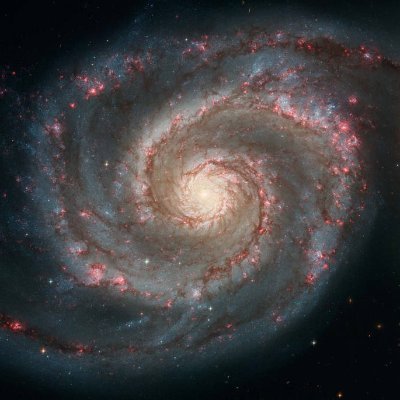

ALT This image was compiled using infrared data from NASA's Spitzer Space Telescope. Most of the image is filled with a triangular wispy green-and-orange shape, which is a nebula, or a cloud of gas and dust. A bright region at the tip of the nebula glows brightly because it has been heated by the stars' radiation, which creates a surrounding red glow. On the left side of this image, a dark filament runs horizontally through the green cloud. A smattering of baby stars appear inside it as red and yellow dots. A smaller glowing green nebula on the right side of the image includes a blue star crowned by a small, red arc of light. The image is watermarked with the words “Credit: NASA/JPL-Caltech.”