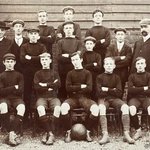
No information about this team, unfortunately. The image is on a postcard that was sent in Southampton to Miss Foy of 3 Upper Liverpool Street in October 1905.
The message reads: ‘Next time I will try to be looking more cheerful, perhaps the circumstances will have changed.’
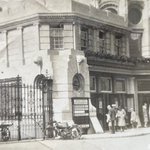
Southampton’s first purpose-built public library opened in 1893 on the corner of Cumberland Place and London Road. It was in use until the current library in the Civic Centre opened in 1939. Unfortunately, this lovely building was destroyed during the Blitz.
Ernest Frederick Heywood landed in Normandy with the 12th (Yorkshire) Parachute Bn at 00:50 on D-Day.
He was wounded in battle and brought back to Southampton where he died in hospital on 14 June 1944, eight days after D-Day. He was laid to rest in Hollybrook Cemetery. @CWGC
Historic Southampton retweeted
‘A Soldier’s Letter to his SWEETHEART.’
Harry sent this postcard to his dear Louisa Frampton of 45A Aberdeen Road. First World War era, exact year unknown. I’m not sure what happened to Harry. It appears Louisa (born in 1897) married a man named Reginald Whittle in 1925.
Historic Southampton retweeted
Replying to @HistoricalSoton
@HistoricalSoton This is my mates grandad and his tram around 1900 I believe. He's proud of his tram.
‘A Soldier’s Letter to his SWEETHEART.’
Harry sent this postcard to his dear Louisa Frampton of 45A Aberdeen Road. First World War era, exact year unknown. I’m not sure what happened to Harry. It appears Louisa (born in 1897) married a man named Reginald Whittle in 1925.
Historic Southampton retweeted
Replying to @HistoricalSoton
A fragment of the France lives on. A small part of the ship's bow is preserved alongside the harbour at Le Havre. Photo taken last year aboard a departing channel ferry ...
SS France leaving Southampton’s Ocean Terminal, possibly during her maiden voyage from Le Havre to New York via Southampton in 1962. At the time of her construction in 1960 she was the longest passenger ship ever built, a title she held until 2003 when Queen Mary 2 was completed.
‘The first Alexandra Rose Girl. Avenue, Southampton.’ The monument behind her is still there. Alexandra Rose Day - which saw people sell roses to raise money for those living in poverty - was launched by Queen Alexandra in 1912. @AlexRoseCharity continues to help people today.
King George III died #OnThisDay in 1820. This statue of George (dressed as a Roman emperor) was given to the town by the Marquess of Lansdowne in 1809. It has stood above the Bargate’s main archway ever since.
Today is #HolocaustRemembranceDay. In 1939, more than 900 Jews fled Nazi Germany and sailed to Cuba, only to be turned away. Returning to Europe, 300 or so disembarked at Southampton. The rest went to France, Belgium, and Holland. 254 of them would later be murdered by the Nazis.
I was disgusted to see photos of the anti-immigration protestors climbing on and trampling all over this part of the Cenotaph yesterday. Using Southampton’s main war memorial and symbol of remembrance as a platform to call for mass deportations is, in my opinion, utterly obscene.
In 1937, BUF leader Oswald Mosley (pictured here doing an instantly recognisable type of salute) tried to hold a fascist rally on Southampton Common. Ordinary Southampton folk came together to successfully disrupt the rally, attack Mosley, and drive him from the town.
Over two million American soldiers passed through Southampton during WW2 to help liberate Europe from the evil tyranny of fascism.
Paul Shimer, seen here with the mayor, was the ‘Millionth Yank’ to head off to war from the port. Sadly, he would be killed in action in April 1945.