

I didn’t grow up with history. Now I go looking for the parts that never made the textbook.
Joined April 2026
- Tweets1.6K
- Following306
- Followers1.9K
- Likes3K



Pinned Tweet
President Herbert Hoover built a private mountain retreat in Virginia, then turned it into a place where he conducted government business far from Washington.
In 1929, Hoover and his wife, Lou Henry Hoover, bought 164 acres in the Blue Ridge Mountains and developed what became known as Rapidan Camp.
Hoover paid for the property and much of the camp himself. U.S. Marines helped construct the roads, cabins, water system, and other facilities.
But Rapidan was more than a place to fish. Hoover brought Cabinet officials and foreign leaders there, and in October 1929 he hosted British Prime Minister Ramsay MacDonald at the camp to discuss naval disarmament.
Hoover once said he had discovered that government work could be improved by discussing problems “out under the trees where no bells or callers jar one’s thoughts.”

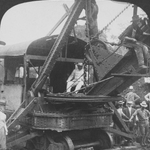
President Theodore Roosevelt went to Panama in 1906 and ended up climbing into a steam shovel at the Panama Canal construction site.
His visit, from November 14 to 17, was historic. He became the first sitting U.S. president to travel outside the country.
On November 16, Roosevelt toured the muddy Culebra Cut, where workers were excavating one of the most difficult sections of the canal. He climbed into a steam shovel, examined the machinery, and spoke with workers about their jobs and working conditions.
Roosevelt was deeply interested in the project. He spent hours moving around the construction site, questioning engineers and workers rather than simply observing from a distance.
The rainy season had turned parts of the excavation into mud, making the visit a very different experience from the formal presidential trips Americans were accustomed to seeing.
Roosevelt had crossed an international border to see the Panama Canal for himself. He did not simply inspect the project from an office. He went into the excavation and got close to the men and machines building it.
Authentic image: the photograph of Roosevelt operating or standing beside the steam shovel at Culebra Cut is the image I would use. It is an authentic 1906 photograph from the Library of Congress, not a reconstruction.

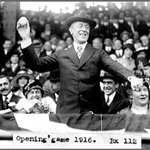
On April 20, 1916, President Woodrow Wilson stood before a packed baseball crowd in Washington and threw out the first ball of the season.
The game was the Washington Senators’ Opening Day against the New York Yankees at National Park. Wilson had become a familiar presence around Washington baseball, but this photograph captures one of his most recognizable appearances at the ballpark.
Beside him was Edith Bolling Galt, whom Wilson had married only four months earlier. The Senators went on to beat the Yankees 12–4, with Walter Johnson pitching for Washington.
Wilson would throw out the first ball at the Senators’ Opening Day again in 1915 and 1916. The tradition had already begun with William Howard Taft, but photographs like this helped establish the presidential first pitch as a lasting part of American baseball.
More than a century later, the photograph still captures something remarkably simple: a president, his wife, and a baseball game on an April afternoon in Washington.

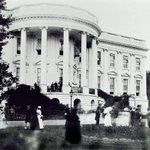
President Chester A. Arthur inherited a White House he disliked so much that he essentially emptied it.
When Arthur took office in 1881, the Executive Mansion was worn and filled with furniture that he considered outdated. He hired the young designer Louis Comfort Tiffany to transform its public rooms.
In 1882, twenty-four wagonloads of furniture and other furnishings were sent away for auction. Tiffany and his firm then redecorated rooms with colored glass, elaborate patterns, painted surfaces, and new decorative work.
Arthur’s renovation cost about $110,000, an enormous expenditure for the time. Critics accused him of turning the White House into a palace.
Most of Tiffany’s work would not survive. Theodore Roosevelt’s 1902 renovation removed much of it, including Tiffany’s famous colored-glass screen in the entrance hall.
For a brief period, however, Chester Arthur’s White House looked less like the old Executive Mansion and more like the fashionable interiors of Gilded Age New York.


President Warren G. Harding was already experimenting with radio before most Americans had ever heard a president through the new medium.
On May 30, 1922, Harding’s speech at the dedication of the Lincoln Memorial was broadcast using experimental radio technology.
Two weeks later, on June 14, he spoke at the dedication of a memorial to Francis Scott Key at Fort McHenry in Baltimore, and that speech was broadcast as well.
By December, Harding’s Annual Message to Congress was being broadcast live by radio, bringing a presidential address to listeners far beyond the Capitol.
Radio was quickly changing the presidency. Americans were no longer limited to reading what their president had said in newspapers. They could now hear his voice for themselves.

In July 1817, President James Monroe became the first U.S. president to travel by steamboat.
During his 16-week tour of New England, Monroe visited communities across the region in an effort to strengthen national unity after the War of 1812.
On July 25, he boarded the Phoenix at Burlington, Vermont. Cannons fired a salute as the steamboat departed for Vergennes. Monroe reportedly remained on deck, enjoying the scenery, and spent that night aboard the vessel.
The Phoenix had been launched only two years earlier, in 1815, and was one of the earliest commercial steamboats on Lake Champlain.
For Americans in 1817, a president traveling by steam was more than a novelty. It was a glimpse of how rapidly transportation technology was beginning to change the country.


2
160
March 11, 1925, began as an ordinary day for Vice President Charles G. Dawes.
He was at the Willard Hotel taking a nap when an urgent message arrived. The Senate was suddenly heading toward a vote on President Calvin Coolidge’s nominee for attorney general, Charles Warren, and the result looked dangerously close.
Dawes rushed out, caught a taxi, and raced toward the Capitol. By the time he arrived, the Senate was tied 40 to 40.
But he was already too late.
The one Democrat supporting Warren changed his vote before Dawes could cast the deciding vote. The final tally was 39 to 41, making Warren the first presidential nominee for attorney general ever rejected by the Senate.
The episode became so famous that Senator George Norris turned Dawes’s frantic taxi ride into a parody of “Sheridan’s Ride.” The vice president who had hurried to the Capitol to break a tie had arrived just in time to discover that the tie was already gone.


Vice President Richard Nixon’s motorcade was nearly overwhelmed by a mob in Caracas in 1958.
On May 13, during Nixon’s goodwill tour of South America, his motorcade was stopped by a crowd estimated at roughly 4,000 people in the Venezuelan capital.
The crowd surrounded the cars, broke the windows of the vehicle carrying Nixon and his wife Pat, and attacked members of the American party. Nixon and Pat were not injured, but several others were hurt.
The Venezuelan police escort failed to control the situation, leaving Nixon’s motorcade in a dangerous position. Secret Service agents and others worked to get the cars through the crowd, while Venezuelan troops eventually arrived with bayonets and helped clear a path.
Nixon later recalled the trip as one in which the faces around him were filled with hostility and people were throwing rocks and stones.
He had gone to Caracas as a representative of the United States. He left with his motorcade battered and his scheduled public events canceled.


111
Vice President John C. Breckinridge was once one of the most promising young politicians in America. Then he became the only U.S. vice president to take up arms against the country he had served.
Breckinridge was just 36 when he became vice president under James Buchanan in 1857, making him the youngest person ever to hold the office.
He later ran for president in 1860 as the Southern Democratic candidate, losing to Abraham Lincoln. After Kentucky remained in the Union, Breckinridge fled south and joined the Confederate Army. He rose to major general and commanded troops in several major battles.
In July 1864, he was part of the Confederate campaign that reached the outskirts of Washington, D.C. His forces came close enough for him to see the U.S. Capitol before retreating.
By February 1865, with the Confederacy collapsing, Jefferson Davis appointed Breckinridge its secretary of war.
The former vice president ended the war as a fugitive, fleeing the United States and remaining abroad until 1869.

78
In October 1919, Vice President Thomas R. Marshall learned that President Woodrow Wilson was seriously ill. But the news didn't come through official White House channels. It came from a newspaper reporter.
On October 2, Wilson suffered a severe stroke that left him partially paralyzed. His condition was kept from much of Washington, including the vice president.
About two weeks later, Baltimore Sun correspondent J. Fred Essary was sent by members of Wilson’s inner circle to inform Marshall of the president’s condition. Marshall was stunned. He later described the news as “the first great shock of my life.”
The situation exposed a serious constitutional problem. The Constitution provided no clear procedure for determining when a president was unable to perform his duties or for transferring presidential powers to the vice president.
Wilson remained in office until March 1921, despite never fully recovering from the stroke. It would take another 46 years, until the ratification of the 25th Amendment in 1967, for the country to establish a formal process for presidential disability.

In 1929, students from a Maryland high school asked President Herbert Hoover for an unusual favor. They wanted to borrow his pet opossum, Billy.
The students' own school mascot had disappeared, and they were hoping Billy could take its place as their athletic mascot.
Hoover agreed to lend him to the school. Billy became part of the students' sporting activities, including their baseball season.
Afterward, the students wrote to the president to thank him. Hoover replied that Billy's success would be added to his service record.
A presidential pet had officially become part of a high school's sporting history.

In 1942, Vice President Henry A. Wallace was photographed tending his victory garden in Washington, D.C.
Wallace had spent much of his career in agriculture before becoming vice president, serving as secretary of agriculture under Franklin D. Roosevelt from 1933 to 1940.
During World War II, victory gardens became part of everyday life across America. Millions of people grew vegetables to supplement the food supply and support the war effort.
Wallace was doing the same, right in the nation’s capital.

3
9
426
President William Howard Taft and Vice President James S. Sherman at a baseball game on May 5, 1909.
Taft was a passionate baseball fan. A year later, he became the first U.S. president to throw the ceremonial first pitch on Opening Day.
A simple photograph from a time when baseball was becoming part of presidential tradition.

The Vice President Who Spent His Own Money to Defend New York
Before becoming vice president, Daniel D. Tompkins was governor of New York during the War of 1812.
When New York needed money to equip and support its troops, Tompkins helped secure the funds by borrowing heavily and guaranteeing loans with his personal credit. He expected the government to reimburse him.
Instead, those financial obligations followed him for years. He faced accusations over the handling of military funds and spent much of his vice presidency trying to clear his name and recover the money.
He was eventually vindicated, but reimbursement came only partially and after years of delay.
Tompkins died in 1825 at just 51, having never fully recovered financially from the obligations he had taken on to help defend New York.

In 1903, a pony rode an elevator inside the White House.
The pony belonged to Archie Roosevelt, the young son of President Theodore Roosevelt. When Archie came down with measles, Edith Roosevelt decided he was too weak to go outside.
So his brothers Kermit and Quentin, along with White House staff, brought Archie’s pony, Algonquin, into the building and took him upstairs in the elevator.
Theodore Roosevelt learned about it afterward and was reportedly amused by the unusual scene.
There was no photograph of the elevator ride itself. The story survives through contemporary accounts, while photographs of Archie and Algonquin show the two together outdoors.
One of the strangest little stories from the Roosevelt White House began with a sick child who simply wanted to see his pony.

The Vice President Who Wrote a Manual for the Senate
Before Thomas Jefferson became president, he spent much of his vice presidency compiling a manual on parliamentary rules and procedures for the U.S. Senate.
Jefferson had begun researching the subject even before taking office in 1797. He brought together existing parliamentary practices and published his Manual of Parliamentary Practice in 1801.
It was primarily a guide for Jefferson himself as the Senate's presiding officer, rather than a new set of official Senate rules.
But the manual lasted far beyond his vice presidency. Congress continued using Jefferson's work, and later editions became an important part of congressional parliamentary practice.
Jefferson may have written it for himself, but the work outlived his time in the Senate.

The Vice President Who Had Almost Nothing to Do
For much of the 19th century, being vice president was a surprisingly quiet job.
Vice presidents rarely attended Cabinet meetings or took part in executive branch business. Their main responsibility was presiding over the Senate and casting a vote when the chamber was tied.
John Adams once described the office this way
“I am Vice President, in this I am nothing, but may be everything.”
For many 19th-century vice presidents, the job really was a strange combination of waiting, presiding over the Senate, and being ready to take over if the president could no longer serve.

1
7
312
The Vice President Whose Name Became a Political Word
Have you ever wondered where the word “gerrymandering” came from?
Its origins go back to 1812 and Massachusetts Governor Elbridge Gerry, who later became vice president under James Madison.
Gerry signed a controversial bill redrawing Massachusetts voting districts to give his political party an advantage. One district was so oddly shaped that critics compared it to a salamander.
On March 26, 1812, a political cartoon titled “The Gerry-Mander” appeared in the Boston Gazette. It combined Gerry's name with the word “salamander.”
The word stuck. More than 200 years later, we still use “gerrymandering” to describe manipulating electoral district boundaries for political advantage.
Interestingly, Gerry himself found the proposal highly disagreeable, yet his name became permanently associated with it.

I find it interesting that one of America's most famous presidential retreats got its name from a five-year-old boy.
In 1953, President Dwight D. Eisenhower decided to rename the presidential retreat in Maryland. Until then, it had been known as Shangri-La, a name given to it by Franklin D. Roosevelt.
Eisenhower chose something much more personal. He named it Camp David, after his grandson, Dwight David Eisenhower II, who was just five years old.
The little boy probably had no idea that his name would eventually become associated with some of the most important diplomatic meetings in American history.
Years later, David even visited the place that carried his name.
A family tribute had become part of the history of the American presidency.
