








Pinned Tweet
6 reasons why @0xPolygon needs to change its $POL economics.
#1 — Compounding concentrates fees in the hands of a few

1 of the 6 reasons why @0xPolygon needs to change its $pol economics ASAP:
The top 5 validators received 45% of the March 17 payout $1.5 M in POL.
Those fees can be restaked, increasing their stake, increasing their next fee allocation. This is compound interest — exponential growth for a small group, while 30,757 delegators compound on emission rewards only, which continue to decrease.
As priority fees grow and emissions shrink, stake concentrates further and delegators have diminishing economic incentive to participate — directly threatening the network’s long-term security budget.
Full PIP live on the forum: forum.polygon.technology/t/p…

Just Hopmans retweeted

This is craazy. I asked one of our PhD engineers to look into NEAR *Confidential* Intents wondering how they designed their system. Unredacted, word-for-word, this was his answer 😱😱😱
"Everything I found out about the privacy claims and confidential intents is so bad that it seems almost comical and I cannot believe what I am seeing. Apparently they run a completely separate instance of the protocol, which is called FAR (as an opposite to NEAR), and that has a permissioned operator set. The entire confidentiality claim seems to rest upon the fact that it is a permissioned chain and the nodes are trusted to keep things private, there doesn't seem to be any deep technology behind it and it also does not seem to be open source. The entities running the nodes are also not publicly known.
I almost feel weird writing this because it is so absurdly bad that it feels like ... I don't know ... a simulation? I know the usual level of overpromising in Web3 but this is so many levels beyond believable that it still feels unreal."


For years, people have asked: “Why do we need crypto when banks can already do everything?”
Generative UI just gave us a completely new answer.
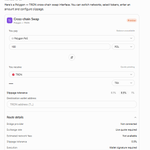
Imagine asking an AI to build a swap between Polygon and TRON, and seconds later, you have a working interface to execute it.
No bank could offer this kind of open, permissionless financial infrastructure.
This is why crypto matters.

Just Hopmans retweeted

Your agent can book the flight. It still can’t send your mom the money.
How to build a bank where Muse, Dots, @bot, Hark, and Towns can move money anywhere.
👇

Just Hopmans retweeted

I’ve been in crypto for 9 years. Writing about Polygon for 6.
For almost 5 of those years, $POL has been going down.
And for 5 years I’ve heard the same shit almost every day:
Polygon is dead.
The token is dead.
Polymarket is leaving.
Polygon is finished.
So yes - when actually dead chains finally shut down, I’m going to make fun of it.
At the same time, I genuinely wish their teams nothing but love and good luck with whatever they build next.
Polygon earned its place here.
It survived.
It deserves a comeback.
And I believe that comeback isn’t far away.


BREAKING: Vadim sold all his $POL at ath in 2021.

I went through the top 100 Polygon validators on @POLTRACK and one thing immediately stands out.
Most validators exist to make money from validating.
Professional staking companies.
Infrastructure providers.
CEXs.
Independent staking pools.
POLTRACK alone explicitly labels 15 as professional operators and 6 as custodial exchanges.
There are few actual applications running validators to offset the cost of using @0xPolygon.
I think that should change.
There are basically two reasons to run a validator:
Run validators as a business and earn a profit from other people’s stake.
Run a validator because your application spends heavily on the chain and you want to recycle part of that cost while helping secure the infrastructure you depend on.
Polygon already has plenty of #1.
It needs much more of #2.
Imagine Polymarket, major gaming apps, payment companies, DeFi protocols and other heavy Polygon users maintaining strategic POL reserves and validating the chain.
They don’t even need to operate the hardware themselves. A professional operator could maintain it for them.
The economic relationship is what matters.
Instead of:
App → buys POL → spends POL → validator captures revenue
You get:
App → holds POL → stakes POL → uses Polygon → earns part of its chain costs back → remains economically aligned with Polygon
That turns Polygon’s largest customers into owners and security participants.
The validator set shouldn’t only represent businesses that profit from validators.
It should increasingly represent the businesses that actually make Polygon useful.
@sandeepnailwal @0xPolygon @0xPolygonFdn @0xPolygonEco
ethereum:0x455e53cbb86018ac2b8092fdcd39d8444affc3f6 is about to fly. Safe flight everyone!

UPDATE: estimated 7.7% APY is coming for POL stakers starting Oct. 1*
For the next two months, accumulated network fees will fund higher rewards for people securing Polygon Chain.
Stake $POL: staking.polygon.technology

Polygon spent years building usage while $POL captured too little of the upside.
That was a fair criticism.
Now they are actively reversing it.
Real network fees are being routed to stakers. POL is being burned. Staking is becoming increasingly funded by actual usage instead of only inflation.
And somehow, now that @sandeepnailwal and some Polygon team members openly talk about creating value for $POL, that becomes the controversy.
That makes no sense.
For years the criticism was:
“Great network, but where is the value capture?”
Now Polygon is building the value capture.
And suddenly talking about the value of the token is considered a problem?
Crypto has no issue celebrating revenue, buybacks and token economics when it comes from trading platforms or memecoin launchpads.
A blockchain should be allowed to care about the economic value of the asset that secures it too.
Especially when that value is increasingly backed by:
real usage → real fees → burn + real yield for over more than a year.
You can’t spend years criticizing Polygon because $POL captured too little value — then call it a red flag when Polygon starts fixing exactly that.
@0xPolygon @0xPolygonFdn @0xPolygonEco
Why isn’t @Polymarket running its own Polygon validator?
Polymarket has bought roughly 188M $POL this year to keep its infrastructure running.
Now imagine it maintained a strategic reserve of that size and staked it through its own validator.
At the upcoming ~7.7% annualized staking rate, 188M POL would generate roughly:
~39.7K POL/day from staking
Add its estimated validator share of current priority fees:
~2.2K POL/day
Total:
~42K POL/day
And that’s before block-producer revenue.
So during that reward window, a 188M POL reserve could theoretically recycle a very meaningful share of its own network costs back into the business.
That changes how large apps can think about POL.
Instead of:
buy POL → spend POL → buy more
you can increasingly have:
hold POL → stake → secure Polygon → earn POL → fund operations
The point isn’t that Polymarket should buy $20M+ of POL purely for yield.
The interesting part is that a company already using Polygon at scale can turn a strategic POL reserve into productive working capital.
For Polygon’s biggest users, POL doesn’t have to be just gas anymore.
Guys, Polymarket is running out of $POL 👀
Only ~4M POL left in the tracked reserve.
Meanwhile, Polymarket is burning through ~400K POL/day to keep the machine running.
At this pace, that’s ~10 days of runway.
You know what comes next.
poltrack io

Polygon’s economics are going through a fundamental change.
In March, the problem was obvious.
Polygon was generating real revenue, but the benefits were heavily concentrated.
In the February priority-fee distribution:
89.9% went to the top 20 validators.
Delegators were putting the capital behind Polygon’s security, yet none of that priority-fee revenue reached them directly.
The chain was succeeding.
The economics weren’t sharing that success to all contributors.
That is changing.
Under the new model, every 100 POL in priority fees is roughly split into:
26 POL → block producers
37 POL → validators
37 POL → stakers
And 27.3M POL already accumulated for stakers is now being pushed through the staking system.
This is an important shift.
Stakers are no longer meant to earn only from inflation.
They are starting to earn from real economic activity on the network.
Polygon seems to have figured out something fundamental:
A sustainable economy isn’t just about how much revenue you generate. It’s about how that revenue flows.
Block producers need an incentive to produce blocks.
Validators need an incentive to operate and secure the network.
Stakers need to be rewarded for putting billions of POL behind that security.
Maintainers need resources to keep improving the system.
And now it’s time to continue balancing the economy.
Because there is one final piece:
the reward itself has to keep its value.
Paying everyone more POL means little if the asset they are being paid in continuously loses purchasing power.
That is where the broader economic design matters.
Real usage generates fees.
Some of those fees reward the people securing the network.
Other fees remove POL from supply.
More valuable staking rewards can increase the incentive to own and stake POL.
More POL staked means less liquid supply.
And a stronger asset makes every POL earned by validators, stakers and maintainers worth more.
That creates a very different loop:
real usage → real revenue → rewards + burn → stronger POL economics → more valuable rewards → stronger ecosystem
Polygon already figured out how to generate activity.
Now it is figuring out how to distribute the value that activity creates — while protecting the value of the asset everyone is being paid in.
That is what real economic alignment looks like.
@0xPolygon @0xPolygonFdn @0xPolygonEco @sandeepnailwal
Polygon is combining:
real revenue
ongoing burn
direct rewards to stakers
one of the lowest revenue multiples among major chains
Let me break it down in numbers:
30d revenue
Polygon: $2.24M
Solana: $2.72M
Ethereum: $2.57M
BNB Chain: $2.15M
Valuation
Polygon: $1.12B
Solana: $75.4B
Ethereum: $325.5B
BNB Chain: $104.1B
Staking
Current yield: ~3.3%
With real revenue: ~7.7% annualized
From 27.3M POL already set aside for stakers
37% of priority fees allocated to stakers
Burn
100M POL burned
burn continues with network usage
And this is what makes Polygon different:
the chain makes a lot of money and a meaningful part of that money goes directly back to the people staking and securing it.
That is much rarer than just having high fees.
@0xPolygon @0xPolygonFdn @0xPolygonEco @stacy_muur @sandeepnailwal


ALT @stacy_muur
Polygon is moving toward something more important than another narrative:
ecosystem alignment.
Polygon is building an open economic system where real usage can increasingly sustain the infrastructure around it.
Users create demand.
Useful Apps turn that demand into activity.
Validators and stakers secure the network.
Maintainers keep it alive and improving.
And the economic value created by that activity increasingly has a path back to the participants who make the ecosystem work.
use → build → secure → maintain → strengthen → grow
The most beautiful part is that it’s an open network.
Anyone can use it.
Anyone can build on it.
Anyone can secure it.
Anyone can maintain it.
Anyone can participate in the value it creates.
You don’t just use the system.
You can become part of it.
Users, apps, delegators, validators and maintainers aligned. 💜
@0xPolygon @0xPolygonFdn @0xPolygonEco @sandeepnailwal

Polygon is about to go on a legendary run.
Not because of memes.
Not because of an inflated metric.
Because the chain is generating real money — and it’s going directly to stakers, not to an expensive conference booth.
From April 8 to September 8, 27.3M ethereum:0x455e53cbb86018ac2b8092fdcd39d8444affc3f6 in priority-fee revenue accumulated specifically for the stakers securing Polygon with their capital.
From October 1 to December 1, that revenue is set to be distributed through the existing staking system.
Gross staking yield goes from ~3.0% to ~7.7% annualized during the distribution window.
And the additional yield is not new inflation.
It is money users already paid to use the network.
Real activity → real fees → real rewards for the capital securing the chain.
PIP-92 distributes the accumulated revenue. PIP-93 is being developed to make the process permanent and automated going forward.
If network usage grows, so does the real revenue available to stakers.
Now go look at your favorite coin.
How much real revenue does the network generate?
And how much of it actually reaches the people securing it?
The answer will probably surprise you.
@0xPolygon @0xPolygonFdn @0xPolygonEco @sandeepnailwal