




Pinned Tweet
A major unforced error in crypto is treating technical dashboards as financial dashboards. Nowhere is this as obvious as with TVL of lending protocols. TVL is NOT a substitute for accounting!
Let’s look at TVL defined as “Value of all coins held in smart contracts of the protocol”, and how it would treat a bank with the following balance sheet:
Deposits (a liability): $100m
Loans (an asset): $80m
Reserves (an asset): $20m
Equity: $10m
The TVL of this simplified balance sheet would show up as:
$100m deposits - $80m loans + $10m equity = $30m TVL
Does that feel accurate to you? It should not, because it structurally undercounts economic activity.
In fact, TVL - a technical metric - is treating the bank’s largest asset (its loan book) as a liability and largest liability (its deposits) as an asset!
The problem is one of using the wrong tool for the job. TVL counts how many tokens are in a smart contract or group of affiliated smart contracts. That’s it. In its most simple form, TVL is mostly just counting the reserve ratio of the bank (or lending protocol).
TVL is not a substitute for actual accounting, and people need to understand this.
A deposit on Aave/Morpho/SparkLend/Compound/Euler/Curvance is a liability to that protocol or pool. You could put $1 trillion in deposits onto one of those platforms and TVL would become $1 trillion. But that’s not an indication of economic activity!
Now imagine $999.999 billion of that got lent out. TVL has crashed from $1 trillion to $1 million. Looks bad on a chart, right? But now we’re seeing economic activity!
There is a reason why TVL is not used outside of crypto - it is a technical metric, not a financial one, and any overlap is coincidental and concentrated in very basic protocols like DEXes.
My calculator to show how many workers it takes to pay for a your social security benefit was popular (beyond just Twitter).
But there’s an inverse I wanted to explore: older people paying local property taxes.
What I found was unexpected!
whopaysformycheck.org/proper…

I made a calculator for people to understand how the lack of kids breaks the system
whopaysformycheck.org
…doesn’t tell you if the treatment is because of senior relief specifically or other special tax treatment (e.g. California’s sweetheart property taxes are based on length of occupancy which correlates with, but is not explicitly for, age)
You can use the new page to see what the share of homeownership and property taxes paid by ages (55 to 80+) in your own state and/or Census unit:
whopaysformycheck.org/proper…
PaperImperium retweeted

What do you do with vast quantities of old paper currency? East Germany decided to bury it.
After unification, 100 billion East German marks were entombed in old Nazi-era tunnels dug with concentration camp labor.
The cash was safe (so they thought)
familytreeofmoney.org/storie…

This is the trouble with banks. It’s a lot like railroads - it’s good to HAVE a railroad, but not a great return to build one from scratch today.
The business fundamentals tend not to be so amazing you’re dying to build from zero.

Newly chartered banks, such as Erebor Bank, Openreserve and Augustus, will likely have to keep raising money as they grow to maintain the capital cushion they need to satisfy higher regulatory requirements
theinformation.com/newslette…

I was discussing this today with someone, and my firm belief is the big money in tokenized stocks is NOT cowboys wrapping shares on their own. It’s being the officially sponsored issuer.
You see this in ADRs. BNY and Deutchebank dominate.
I’ll try to steelman the opposition position:
RH tokenized stocks are probably disliked for the same reason non-sponsored ADRs are disliked: the company’s name is on something it didn’t authorize and doesn’t do things like revert unvoted shares to management control.
The new (not old EU swap-based) RH tokenized stocks do not pass beneficial ownership, and are a debt instrument with exposure to RH itself potentially. Ondo put their backing into an SPV that’s designed for bankruptcy remoteness but the Jersey-issued RH tokens do not appear to be claiming remoteness from RH’s creditors that I’ve seen. Please correct me if you have seen otherwise.
So from AMC or another company’s view, you have people who view themselves as shareholders, but are not actually shareholders holders. The RH tokens feel closer to a Contract-For-Difference.
Legally, I suspect RH is right that everything is meeting the letter of the law, but from the public company’s perspective, the tokens create a big blast radius for you via vanilla creditors of Robinhood thinking they are owners in your company.
⬆️ That’s the steelman I’d construct for AMC et al. I think it breaks down if I’ve misunderstood how this generation of RH tokenized stocks are structured
PaperImperium retweeted
I made a calculator for people to understand how the lack of kids breaks the system
whopaysformycheck.org
Why are there no onion perps? It would offer an actual use case that’s blocked by the ban on onion futures.
Seems perps platforms could be a white knight for a real (niche) area of market repression.

PaperImperium retweeted
Before Benjamin Franklin’s face was on the $100 bill, he was making colonial money harder to fake… by using leaves.
A 1764 Pennsylvania note used intricate leaf veins, along with a less subtle security feature:
“To Counterfeit is DEATH.”
familytreeofmoney.org/storie…

What’s new in DeFi and CeFi that I might have missed?
Can be a complete product or even just a feature. (Just… no announcements of a Uniswap hook that recreates Old Tech from more than half a decade ago 🤪)
Shill me your interesting new projects, products, & features
PaperImperium retweeted
In 1711, Osaka audiences watched a young courier ruin his life by tearing open a packet of gold. The play was Meido No Hikyaku (The Courier for Hell in English).
familytreeofmoney.org/storie…

PaperImperium retweeted
A duck egg once cost $5,000 Taiwan dollars.
Taiwan’s dollar began in 1946, after Japanese rule ended. The Bank of Taiwan issued dollar notes to replace the oldTaiwanese yen still in circulating.
Within 3 years, prices had risen sharply. By 1949, a duck egg cost 5,000 dollars.

This is very on-brand for the UK! A mispriced bimetallic monetary standard is how Gresham’s Law came into existence as he explained this problem to Queen Elizabeth I.

One of my favourite Harry Potter loopholes doesn't even involve magic. It involves exploiting the Muggle economy.
Hagrid tells us there are 17 Sickles to a Galleon. Sickles are silver, Galleons are gold. Simple enough.
Except gold and silver don't have a fixed exchange rate in the Muggle world. Their market value fluctuates constantly. Before 1900, the gold-to-silver ratio averaged around 16:1, which is pretty close to the wizarding world's 17:1 rate. Throughout much of the twentieth century, however, it averaged around 45:1.
See where this is going?
Wait until the market heavily favours gold. Melt your Galleons down and sell the gold in the Muggle world. Use the money to buy as much silver as possible, then take that silver to Gringotts and have it converted into Sickles.
Finally, exchange those Sickles for Galleons at the fixed 17:1 rate.
Congratulations. You've potentially turned a small pile of wizarding gold into a much larger pile of wizarding gold, simply by exploiting the difference between Muggle market prices and Gringotts' fixed exchange rate.
No Dark Arts. No Horcruxes. No elaborate schemes.
Just precious metals, a fixed exchange rate and a wizard who understands arbitrage.
The real question is why nobody in the wizarding world seems to have built an entire financial empire around this.
Privacy protocols would help mitigate the perverse incentives of tontines (that you kill the other people in the pool with you), and would allow for old age insurance in places where public pensions are unstable or nonexistent.
Seems like a natural problem for crypto!
“A stablecoin cannot simply be an asset - it needs to be part of a service.”
I’ve castigated stablecoin issuers for not recognizing the commoditization of their core product, and that they must build products and services that use their stablecoin as an input to be viable.
At least twice a week, I get someone asking me for examples, so I’ll give a small one here to illustrate what I mean. I have a whole notebook of products sketched out in the unlikely event someone hands me $20m to run a skunkworks for a stable issuer, and just like even the smallest community bank, a stablecoin issuer needs a wide variety of ancillary services that add value to the underlying bank deposit they’re pitching.
Much of the world population struggles with consistent savings, especially formal savings. Two product features shown to increase savings rates are mobile access and commitment devices. Crypto is well positioned to provide these unchain.
First, let’s take a quick detour to a nearly extinct financial product: the tontine. Tontines were a way to provide a kind of insurance against living beyond your working years. Subscribers to a tontine would pool their money, and a tontine manager would invest it for them. Shares were generally non-transferrable, even upon death. So as people died over the years, survivors benefited not just from investment returns but from inheriting the shares of those who predeceased them. Thus, if you lived to 80, you would still get an income or lump sum distribution from the tontine. It was a way to hedge before longterm care insurance and government pensions became widespread.
Of course, tontines created a perverse incentive to kill your co-investors, provided you knew who they were. This is probably how most people know of tontines today — they make for salacious plot devices in old murder mystery novels. Having a worldwide, pseudo-anonymous distribution solves for a lot of this, though.
Back to savings products! Taking inspiration from the tontine, you can make a savings product where savers only receive interest in a month if they contributed. Because it’s investing 100% in your stablecoin, principal and accrued yield can always be withdrawn, but future yield is contingent upon contributing each month.
Pair with a simple mobile interface that allows people to on/offramp your stablecoin to their local currency or bank accounts.
This provides an onchain, incentivized savings account that has no managers to pay a fee to or trust (outside of those embedded in your stablecoin). Users know their savings are secure, can’t be seized without the entire pool being frozen.
If they miss a month of contribution, then it’s easy to recover the next month with a contribution. Heterogeneity amongst savers’ habits should allow for yield higher than your stablecoin’s base rate.
The key here is that 1) your stablecoin is the key input, 2) the product is not actually your stablecoin — it’s the incentivized savings account, 3) you are solving a real-world problem to offer secure, USD-denominated savings that should be at least a little higher than your stablecoin’s raw yield, and helping people build good, longterm savings habits.
It should also provide a stickier deposit base, since users are dripping in each month until they need the money for emergencies, a large purchase, or whatever their savings goal was.
Your stablecoin needs 10 to 20 of these fairly narrow, focused products that create demand for your token. This is why a stablecoin that is serious needs to have its own skunkworks rather than relying on the slowing pace of DeFi innovation and the anemic distribution power of DeFi teams.
Intuitively this makes sense. When you open up your bank or brokerage’s website, they have all kinds of niche services that are only used occasionally or do not work as standalone products. If you need inspiration, go look at your mobile banking app and see what you can do besides deposit, withdraw, and get margin/payday loans.

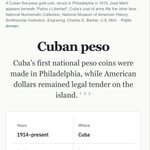
If anyone feels like taking a look at this currency profile to see if they like or dislike the format and content, I’m trying to establish a standardized feel before doing a bunch of them
Cuban peso can be found here: familytreeofmoney.org/curren…

