

ETF nerd covering crypto funds: filings, flows, fees. Dad of two. Coffee-powered. Thoughts are mine.
Joined December 2020
- Tweets664
- Following102
- Followers1.4K
- Likes49





Spot ETFs fundamentally altered market structure. Institutional access changes how capital distributes across digital assets. Broad, market-wide rallies now demand significant macroeconomic catalysts. Without massive liquidity expansion to drive broad risk-taking, capital no longer lifts all assets equally. The primary result is higher dispersion. Institutional flows concentrate heavily into dominant, established vehicles. This leaves broader cycles operating with higher difficulty and less uniform follow-through

"haha see you at the top bro"
Try to pay attention. This time is *already different*. It's been 18 months since the ETFs launched. We have the first crypto president and most coins are still well below their two year highs. No one seemingly wants them- not even the president of the USA has been able to get people to care. What they probably need is a macro catalyst along the lines of helicopter stimulus or QE which suddenly turbocharges the farthest ends of risk taking. If we get something like that, we can update our expectations. But the cycle has shown us what it is: higher dispersion, higher difficulty, lack of follow through, two-way traders feasting while bag holders cry.


I'm a bit wary seeing IBIT options hit $35 billion in this structural shift toward managing risk instead of directional bets
I doubt this preferred equity is the institutional wrapper that truly moves the needle. Over the past year, preferred stock funded significant BTC purchases. Yet that only accounts for 0.5% of total supply.
Using corporate debt to hold digital assets creates a synthetic financial instrument. Issuing notes to acquire supply turns a static treasury into a high-beta proxy. The equity tracks faster than the underlying asset. It gives institutional funds regulated exposure without direct custody.
Old trusts drove early volume. Arbitrage fueled those products. Price discounts finally close. That structural bid slows down. Legacy funds lose their edge. Capital seeks better vehicles. Spot ETFs capture new inflows. Weight shifts to the new funds. Flows track the visible demand. Sovereign buying stays opaque.
JPMorgan estimates a major global index exclusion could trigger $2.8 billion in passive outflows from MSTR
Who steps in to absorb that much forced selling?
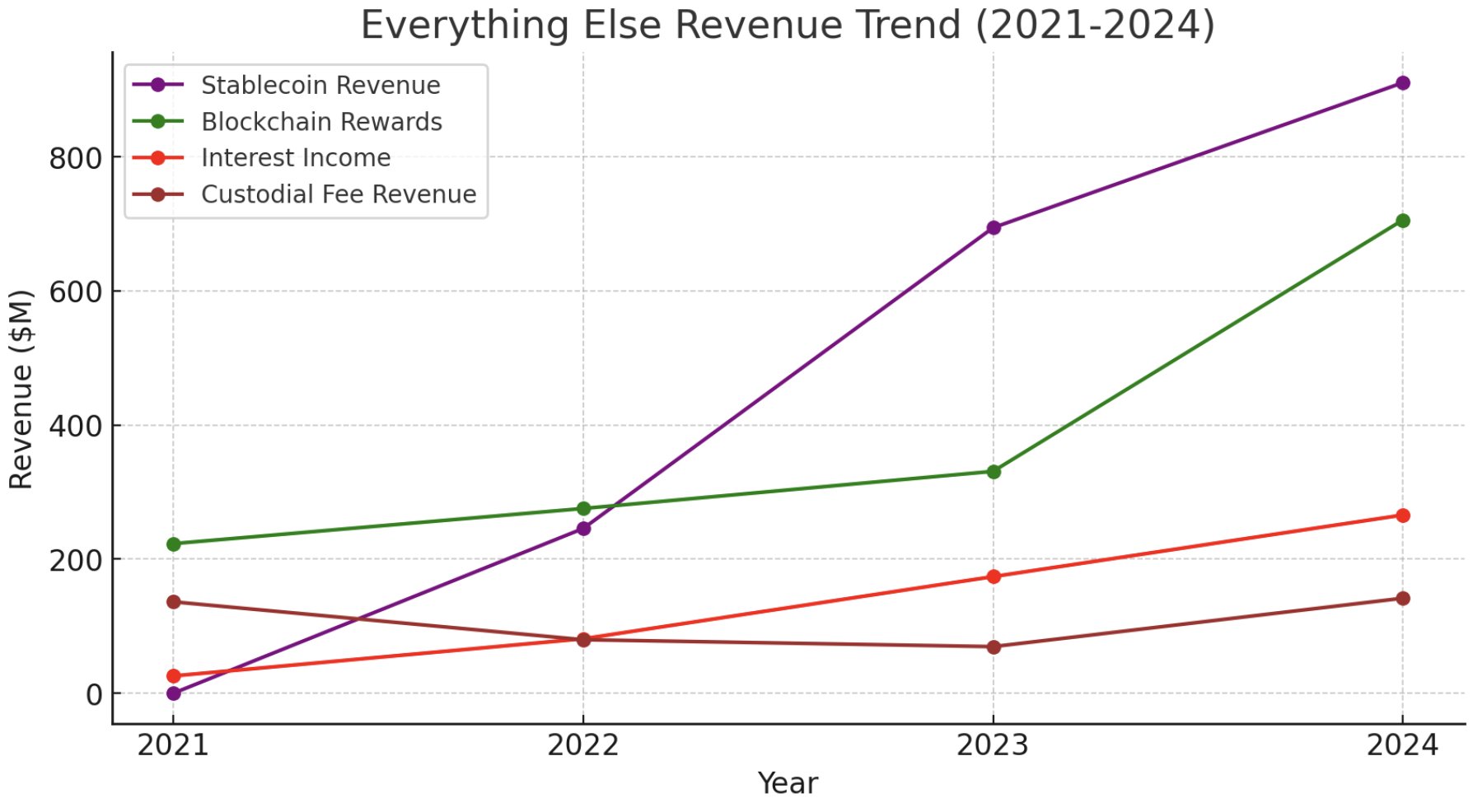
Institutional revenue streams across trading, custody, and staking continue to expand steadily. As traditional financial rails increasingly integrate spot exchange-traded funds and explore collateral use cases, the foundation for broader institutional capital deployment grows significantly stronger

What about Insti? all the insti centric revenues are pretty healthy
- Institutional trading revenue is back to 2021 levels
- Staking & custodial revenue keeps growing
- ETFs + TradFi integration will yield long-term capital influx for Coinbase as "crypto bank"
If ETF can be used as collateral and ETH ETF staking is enable, this will further unleash insti adoption rate in years to come
Every emerging asset class follows a familiar progression. Early phases belong to retail momentum and outsized price swings.
As spot Bitcoin ETFs and other institutional vehicles grow, deeper balance sheets absorb liquidity shocks. Read ETF flows over months, not days. Steady allocation is what slowly compresses BTC volatility.

This, from the Financial Times, is positive long-term news for crypto.
Historical trends in finance have consistently shown that broader institutional adoption contributes to both reduced volatility over time and the continued maturation of an investment asset class.
#investor #investing #markets #bitcoin @ft

I get wary seeing Nasdaq futures drop 0.6% Tuesday while institutions hold core crypto and just stack derivative hedges
The SEC just approved a temporary Innovation Exemption for tokenized stock trading, and it is a massive relief for institutional finance. This direct action will finally catalyze real commercial tokenization activity and unlock strategic dealmaking.
Calling the bullish trend dead over a recent price drop ignores that Bitcoin's stair-step market structure remains intact.
The pattern relies on sharp rallies to new ranges followed by weeks of flat sideways trading.
Severe market drawdowns always bring out traditional finance critics. They reliably dismiss digital assets as a fundamental failure. The pattern is incredibly predictable. Measured over any extended time horizon, the return profile tells a different story.

Grant Whitaker retweeted

7/ Thank you to everyone who participated!
What we're looking for hasn't changed. Discerning, substantive voices with real interest in Arcium's technology and the ecosystem around it.
People who dig into ecosystem teams, understand what this technology makes possible, and add genuine value rather than extract it.
Grant Whitaker retweeted

25K are battling it out
$50K on the line
5 days left to climb the leaderboard
Trade now: early.bulk.trade


