

Infrastructure For Agents That Learn | Github: https://teapaw.org/t.co/YiRiXJ3trA
New York, NY
Joined September 2025
- Tweets76
- Following0
- Followers62
- Likes56


Pinned Tweet
1/
At Arc, we’ve been obsessing over a question: What does it actually mean for an AI system to get better over time?
As a result, we began to explore what it might look like for agents to adapt and learn at inference time.
Pre-Print Paper: github.com/Arc-Computer/ATLA…
We propose a shift, from model-centric retraining to system-centric inferencetime learning.

👉Atlas SDK v0.1.13 is out! Our new release drops a learning evaluation harness, configuration discovery along with a starter kit for adaptive tool use.
Full release notes: arc.computer/blog/atlas-sdk-…
Three features that streamline continual learning workflows for agent systems 🧵
1
2
158
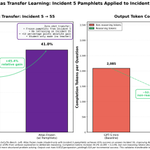
1⃣ Transfer Learning Evaluation:
A core challenge in continual learning: measuring whether agents learn patterns that transfer or just overfit to specific tasks.
Our new classification system categorizes learned knowledge across 4 levels: task-specific, domain-specific, workflow-level, and universal patterns.
This enables you to evaluate learning that is "machine-actionable" and optimize for what the model can learn and apply at inference time.
1
21
We demoed Arc ATLAS at AI Show & Tell in NYC!
We posed a fundamental question that drives everything we do: What if we built agentic systems that learn like humans do?
What would need to be true for that to happen?
Our keynote breaks down our research journey in pursuit of this question.
Check it out below:
4
70
1/5
Want to enable real-time, continual learning for your agents?
Our Atlas SDK is a drop-in harness that lets any agent learn from experience.
See the results for yourself in this demo, as well as how to get started
2/5
How it works: Atlas wraps your existing agent (the "Student") with our configurable harness.
Student: Your agent, defined in a simple config.
Teacher: A verifier providing real-time feedback.
Reward System: A committee of judges optimizing for your specific objective.
It's model-agnostic and plugs into your stack in minutes. pip install atlas-sdk
👉 Kicking off our first public release notes, which we'll be sharing regularly.
This week: Atlas SDK v0.1.3, a continual-learning harness for production agents that turns every task into a structured learning episode.
Full release notes: arc.computer/blog/atlas-adap…


Continual learning is the frontier for AI agents. But today, most learning is disconnected from the complex reality of a live production environment.
Our perspective: the live environment is the ultimate classroom. We build infrastructure that maps its action space, amplifying an agent's ability to learn from every real-world interaction.


We're fixing that.
We just demoed at AI Show & Tell NYC (Microsoft Research Lab @MSFTResearch) and showcased our open-source SRE Agent teaching itself to resolve complex Kubernetes K8s incidents via real-time continual learning.
Today, we're releasing the ATLAS Reward System, our novel architecture that sets a new SOTA on RewardBench V2 with 93.7% accuracy.
Our core idea was to treat reward generation as a systems and routing problem.
Thread 👇
Full Technical Blog: arc.computer/blog/ATLAS-Rewa…

Our insight was to use a two-tier "ensemble of judges".
1️⃣ Tier 1: A parallel set of fast, efficient models (gemini-2.5-flash) handle the clear-cut cases.
2️⃣ Tier 2: A powerful "arbiter" model (gemini-2.5-pro) is activated only when the Tier 1 judges show high uncertainty and high variance within the rewards on an evaluation.
This lets us get the best of both worlds: speed for the easy stuff, deep reasoning for the hard stuff.
1/ LLMs fail at SRE root cause analysis because they lack systematic investigation skills. We built a system where agents learn to diagnose cascading Kubernetes failures by being taught in real-time.
Our ATLAS framework got a gpt-4.1 student to correctly diagnose ITBench incidents with guidance.
Full Blog: arc.computer/blog/atlas-sre-…
Demo 👇
2/ The architecture is a three-phase loop:
a) Diagnostic Planning: Student proposes its investigation plan first.
b) Adaptive Teaching: An ATLAS-8B-Thinking Teacher reviews the plan & provides corrections.
c) Guided Execution: Student integrates the feedback & executes.
This forces explicit reasoning before execution, allowing the Teacher to correct flawed logic before it propagates.
1/5 Thrilled that our abstract, "Bridging the Judgment Gap," was accepted at the NYRL 2025 Workshop, where we presented our method for creating more reliable AI agents alongside teams from @amazon, @nyuniversity, and @Columbia.

2/5 Our research introduces a Teacher-Student framework where a Teacher model, trained with reinforcement learning on logical problems in mathematics, produces "teaching traces".
These traces guide a Student model in data-scarce enterprise settings, allowing it to apply reasoning as a skill to solve tasks in a completely new domain.
1/ Introducing ATLAS: A Hybrid RL Reasoning System for Compounding Intelligence, the learning layer for agentic AI.
RL + adaptive optimization.
Enterprise-ready, fast to deploy, developer-friendly.