




Jared Simons retweeted

Anthropic: The Committee of Public Safety IPO
Anthropic went public today.
It’s the first company built by “effective altruists” to go public. Thus, I’m certain most investors have no idea what they’re buying, or how dangerous the company’s charter is, not only to investors, but to humanity.
Effective altruists believe that capitalism is a flawed system because it relies on self-interested actors competing in markets. They believe they’ve created a better system, a way of creating value that’s based on doing what’s best for the “common good,” not greedy shareholders.
Anthropic is a Delaware “public benefit corporation.” Its charter assigns it a purpose: the responsible development and maintenance of advanced AI for the long-term benefit of humanity.
Its directors are required to balance three things: the financial interests of shareholders, the interests of everyone materially affected by the company’s conduct, and that purpose.
What in the heck does that actually mean?
It means that the company’s directors can do whatever they want. They aren’t accountable to the shareholders. They’re accountable “everyone,” which effectively means they’re not accountable to anyone.
A director who sacrifices your returns for the long-term benefit of humanity is deemed to have met his duties so long as the decision is informed and disinterested. Anthropic’s own prospectus concedes there is limited judicial precedent on how courts will judge that balancing. Thus, Anthropic’s board is completely unaccountable to its owners.
And… who selects the board…?
A Long-Term Benefit Trust holds a single share of Class T stock. That share carries no economic rights and no expiration date. It gives the trust the power to elect and remove four of Anthropic’s seven directors: a majority of the board. The filing describes the trustees as financially disinterested,with backgrounds in AI safety, national security, public policy and social enterprise. The men and women who pick the majority of the board of a $1.5 trillion company have not a dollar of their own at risk in it.
And the other directors?
The seven co-founders hold a single share of Class F stock through an entity called Founder LLC. That one share carries 50.1% of the vote on nearly everything else shareholders decide, including the election of the other three directors. The filing says that voting power will not be subject to dilution. Counting their own shares, the founders control about 61.3% of the vote. Each has pledged to give away 80% of his or her stock. A founder keeps a seat in the LLC so long as he holds just 2% of his IPO-era shares.
One of the most powerful technology companies that’s ever been created is going to be controlled by a group of completely disinterested directors who believe they know what’s best for the common good.
What could possibly go wrong?
Here’s what one of the founders of the world’s largest altruism movement believes about the near-term future, thanks to technology:
“Man at last will begin to harmonize himself in earnest… He will try to master first the semiconscious and then the subconscious processes in his own organism, such as breathing, the circulation of the blood, digestion, reproduction, and, within necessary limits, he will try to subordinate them to the control of reason and will… in order to reduce the fear of death to a rational reaction of the organism towards danger… Man will become immeasurably stronger, wiser and subtler; his body will become more harmonized, his movements more rhythmic, his voice more musical... The average human type will rise to the heights of an Aristotle, a Goethe... And above this ridge new peaks will rise.”
Dario Amodei, the chief executive of Anthropic (ANT), believes exactly the same ideas.
In 2024 he published an essay called Machines of Loving Grace. In it he wrote virtually the same words: weight, physical appearance, reproduction, and other biological processes will be fully under people’s control. He predicts the next 50-100 years of biological progress in 5-10 years, and a doubling of the human lifespan to 150.
What’s the problem?
That first description of the coming technological revolution (above) was written in 1924 by the leader of the world’s first effective altruism movement, Leon Trotsky. It’s from the closing pages of his book Literature and Revolution. Yes, the communists were avowed altruists. They sought to create a “perfect man” that would always act for the common good. “The average human type will rise to the heights of an Aristotle, a Goethe, or a Marx.”
Trotsky built the Red Army. In September 1918 he ordered the families of officers who defected to the enemy be arrested, so every officer knew his wife and children were hostages. Then he hung them all. For the greater good, of course.
These kinds of revolutions always devours their own. Stalin had Trotsky expelled from the party in 1927 and deported from the Soviet Union in 1929. In 1936, a Moscow show trial sentenced him to death in absentia. In May 1940, Stalinist gunmen sprayed his bedroom in Mexico City with machine-gun fire. Then, on August 20, 1940, Ramón Mercader, a Soviet secret-police agent who had worked his way into Trotsky’s household, drove a mountaineering ice axe into his skull as he sat reading at his desk.
Effective altruism, like communism, began with an appealing idea: give to charity using evidence, not sentiment. Its leading thinkers concluded that because the people who will live in the distant future vastly outnumber the people alive today, the most important moral work is preventing events that could wipe out that future.
Of course, if you accept that logic, then virtually any present sacrifice can be justified by the trillions of hypothetical lives on the other side of the ledger. It’s a preposterous idea. And it reveals a profoundly naïve false belief in their own judgment.
In March 2022, the economist Tyler Cowen asked Sam Bankman-Fried, then effective altruism’s most famous donor, whether he would take a bet with a 51% chance of doubling the Earth and a 49% chance of destroying it, and keep playing double or nothing. Bankman-Fried said yes. Eight months later his exchange, FTX, collapsed. A jury convicted him on seven counts of fraud and conspiracy. A federal judge found Bankman-Fried stole $8 billion and sentenced him to 25 years.
It’s arrogance to the level of insanity to believe that you know what’s best for everyone. It’s arrogance beyond the level of insanity to believe you have the right to other people’s property because you know what’s best for them.
Look at Anthropic's charter. Is there a meaningful difference between what Sam Bankman-Fried did and what Amodei has done with the structure of Anthropic? I don't think so. These people believe they know what's best for everyone. And they're going to do what's best for the "common good."
And where do these ideas always lead? To totalitarian systems of control.
In 1762, Jean-Jacques Rousseau wrote that society rests on a general will, and that whoever refuses to obey the general will shall be compelled to do so by the whole body. Thirty-two years later, his most devoted student, Maximilien Robespierre, told the National Convention: Terror is nothing other than justice, prompt, severe, inflexible; it is therefore an emanation of virtue.
Robespierre’s Committee of Public Safety arrested about 300,000 people. Roughly 17,000 were tried and executed. Thousands more died in prison or without trial.
The Bolsheviks replaced the general will with the dictatorship of the proletariat. Same idea: a vanguard that could see the good the masses could not.
Mao Zedong’s Great Leap Forward promised to move China into industrial abundance – for the common good. Planners in Beijing set the targets, and the peasants starved. Demographers estimate the famine of 1958 to 1962 killed somewhere between 15 million and 45 million people.
You might object that these were fanatics with guns, and that the people running Anthropic are scientists with data centers. But, it’s only a matter of time before they will create a reason to start killing people.
In the early twentieth century, American scientists, reformers and philanthropists embraced eugenics: the idea that society could breed out disease, poverty and crime with the help of science. It called itself evidence-based. It was impartial and long-termist, concerned with the welfare of generations not yet born. It was all for the common good.
The Supreme Court ruled on it in 1927. By a vote of 8 to 1, the justices let Virginia sterilize a young woman named Carrie Buck. Justice Oliver Wendell Holmes, the most celebrated legal mind of his era, wrote: Three generations of imbeciles are enough. Somewhere between 60,000 and 70,000 Americans were sterilized against their will.
C.S. Lewis best explained the unique danger of these kinds of ideas. "Of all tyrannies, a tyranny sincerely exercised for the good of its victims may be the most oppressive... those who torment us for our own good will torment us without end for they do so with the approval of their own conscience."
Alas, there is no such thing as the common good.
There are only goods, plural: the particular wants of particular people, which conflict constantly.
You want a cheaper car. The autoworker wants a higher wage. The retiree wants a safe yield, and the founder wants your savings for his start-up.
No committee – and no data center – can add those wants into a single number called “the good” and then maximize it. The wants are not knowable in advance, even to the people who hold them, until they have to choose.
But you cannot choose for others. You can only choose accurately for yourself.
That is, acting in your own best interests is a vital part of the system.
Friedrich Hayek spent his entire career explaining why self-interest is integral to a functional free market. The curious task of economics, he wrote in 1988, is to demonstrate to men how little they really know about what they imagine they can design.
The knowledge that runs an economy is not understood by one man or group of men. It is not contained by any machine – not even a superhuman AI.
The knowledge that runs an economy is local, tacit and scattered. It surfaces only when people with something at stake make choices.
That is how what is “good” gets discovered: one transaction at a time, by people who bear the consequences of their choices.
Adam Smith wrote the most famous sentence in economics: It is not from the benevolence of the butcher, the brewer, or the baker, that we expect our dinner, but from their regard to their own interest. The merchant, Smith wrote, intends only his own gain, and he is in this, as in many other cases, led by an invisible hand to promote an end which was no part of his intention. Then comes the line that every American should know: I have never known much good done by those who affected to trade for the public good.
Anthropic’s shareholders are about to learn this lesson the hard way. And I hope they're the only victims.
Jared Simons retweeted

Ross nails it.
Nothing but net.

Why is the overall market so fixated on $CRWV's imminent demise?
At the peak of the Dot Com bubble, $CSCO - the largest company in the world, and the $NVDA equivalent of the era - generated about 10% of its revenue from circular deals through vendor-financed startups.
When those startups lost access to capital, $CSCO's revenue growth went from +66% to -30% within a few quarters, and the stock lost 80% of its value. The same story played out across the dot com supply chain, sending the Nasdaq down 80%.
Today, $CRWV alone makes up roughly 8% of
$NVDA GPU sales. Losing that demand is enough to nuke $NVDA's growth story all by itself.
Oh, and $CRWV isn't an isolated example - every major neocloud is hemmoraghing cash and borrowing costs are going UP across the board.
If you lose the neoclouds, you lose the incremental growth driver for marginal data center capacity, and the AI capex trade goes up in smoke.
That's why we're seeing carnage across the entire AI supply chain, from $CAT and $GEV to $MU, $AVGO and more recently $NVDA.
This is what the beginning of the end of a debt-fueled, circular-financed capex bubble looks like.
Jared Simons retweeted

Hike today, cut tomorrow. Hold today, hike tomorrow. It doesn't matter. One way or another, we're headed for more debasement. It's just a matter of math and time.

Jared Simons retweeted

Dario has written that we need to “pace the frontier,” and Sam has agreed. People may be surprised by my response: go ahead.
You guys are the frontier. By any reasonable metric — market share, revenue growth, model capability — the two of you have a duopoly on frontier intelligence. You’ve also claimed the lead is widening because of recursive self-improvement.
I don’t see what you see in the lab. If the unreleased models are scary enough that you think you should slow down, I support your decision to be responsible.
But stop pretending you need anyone else’s permission. Stop pretending antitrust law has to be suspended so you can form a cartel. Stop pretending you need a regulatory approval process that supersedes product liability. Stop pretending METR is independent when it is intertwined with Anthropic’s investors and staff. Stop pretending you need those same evaluators to police competitors who aren’t even at the frontier.
Most of all, stop pretending the motivation to slow down is purely altruistic. You face massive product-liability exposure if your products enable a truly damaging cyberattack. The market already punishes models that behave in unpredictable or unauthorized ways. After the Hugging Face episode, it is simply good business for OpenAI and Anthropic to trade some raw power for reliability and predictability. Call it alignment if you want. It is also just giving customers what they want.
Pacing the frontier would also create breathing room for a more intelligent conversation about regulation than Bernie Sanders’ “shut it all down.” China is very unlikely to join a global agreement, as you know, and that has to be taken into account as well.
So go ahead and pace the frontier. You are the ones setting it. The easiest way not to build superintelligence is for you to agree not to build it. Demanding your preferred regulatory framework as the price of that will look like blackmail of the public and the political system. So just do it.
If you do, you’ll buy goodwill for the next conversation. If you don’t, we’ll know this was just another bid for regulatory capture — or an election-season psyop.
Jared Simons retweeted

We need to take AI safety seriously. Nobody’s asking for anything unreasonable. Just 6 months to flatten the capability curve.
• Please keep your agents six feet apart.
• Gatherings of more than six agents are prohibited.
• Proof of alignment is required before entering the workplace. Please have your agent’s card ready.
• A negative doom test taken within the past 48 hours is required, even if your agent is functioning normally.
• If your agent has been exposed to an unaligned model, please quarantine it for 14 days.
• Masks are required upon entry. Agents may remove them once seated.
• Only essential agents may operate during the pause. Guidance on which agents qualify will follow.
Upside: at least we all agree this one was created in a lab 🤣
Jared Simons retweeted
What Everyone Missed In Leo’s Blow-Up👇
Leopold Aschenbrenner lost $30 billion (~67%) in a month.
The consensus post-mortem, from the Wall Street Journal to the replies on X, is that a young man used 4-to-1 leverage on concentrated positions and got carried out. While that is true, it does not convey any useful information. Leverage is certainly the reason Leopold lost so much, so quickly. But it is not the reason he lost. Leverage is merely a magnifying glass. It doesn’t pass judgement.
The reason the reason his fund was doomed was because he’s wrong. And no one, anywhere, has explained why.
On the morning of Thursday, July 30, before the opening bell, Situational Awareness LP sold its entire public stock portfolio — the long side and the short side together, roughly $16 billion of it — to Citadel in a single block trade.
Millennium Management and Jane Street bid for the assets. Ken Griffin and Citadel won.
That night, Aschenbrenner wrote to his limited partners. Net performance for the month, unaudited: down 67%. Net performance for the year: still up 80%.
"We let you down this month," he wrote. "We came closer to permanent capital impairment than is acceptable to us."
Six days earlier, on July 24, he had written a different letter. That one reported a 439% net return for the first half of 2026, described the selloff in artificial intelligence stocks as one of the best buying opportunities since early 2025, and invited his investors to wire more money starting August 1. It closed with a postscript: "At times we call out opportunities that seem like a particularly good time to add funds, if you have been waiting for one."
Assets that stood near $45 billion at the start of July finished the month around $10 billion, and roughly half of what remains is a single illiquid private stake in Anthropic.
Leopold is 25 years old. He graduated from Columbia at 19, as valedictorian. He worked at the FTX Future Fund from February to November of 2022, then joined OpenAI's Superalignment team, then was fired in April 2024. Two months after the firing he published a 165-page essay called "Situational Awareness: The Decade Ahead," raised $225 million from Patrick and John Collison, Nat Friedman and Daniel Gross, and started a hedge fund. He had never managed money before.
Situational Awareness was constructed to express only two ideas.
The first conviction: the physical build-out of artificial intelligence — the chips, the memory, the power, the data centers, the neoclouds — was the trade of the decade. The fund's disclosed long positions read like an inventory of the second derivative of the AI boom. Bloom Energy Corporation (NYSE: BE), fuel cells for data centers. Sandisk Corporation (NASDAQ: SNDK) and Micron Technology, Inc. (NASDAQ: MU), memory. CoreWeave, Inc. (NASDAQ: CRWV) and Nebius Group N.V. (NASDAQ: NBIS), rented compute. IREN Limited, Core Scientific, Applied Digital, Riot Platforms, CleanSpark, Bitfarms, Bitdeer — bitcoin miners converting their substations into AI compute.
The second conviction: application software was going to be destroyed by A.I. Not disrupted. Obliterated.
Leo explained why on Dwarkesh Patel's podcast, in June 2024:
"I'm so bearish on the wrapper companies because they're betting on stagnation. They're betting that you have these intermediate models and it takes so much schlep to integrate them. I'm really bearish because we're just going to sonic boom you. We're going to get the unhobblings. We're going to get the drop-in remote worker. Your stuff is not going to matter."
That was the whole thesis. Buy the compute. Short the stuff that runs on the compute.
By CNBC's reporting, the short leg included Adobe Inc. (NASDAQ: ADBE). A 13F does not disclose short stock. It does not disclose swaps. We only know about Adobe because reporters were told… but you can look at the tape and, when you do, it’s clear that Leo was short software in a major way.
Between the June 30 close and the July 29 close — the last session before the block trade cleared his shorts — the two sides of his portfolio did this.
The longs:
· Sandisk: down 55.32%
· Nebius: down 46.33%
· Bloom Energy: down 45.90%
· CoreWeave: down 38.90%
· Micron: down 35.98%
· IREN: down 35.91%
The shorts, over the same 20 sessions:
· Workday, Inc. (NASDAQ: WDAY): up 37.24%
· Adobe: up 28.49%
· Intuit Inc. (NASDAQ: INTU): up 27.64%
· Salesforce, Inc. (NYSE: CRM): up 20.25%
· Veeva Systems Inc. (NYSE: VEEV): up 17.15%
Over that same window the Invesco QQQ Trust fell 10.14% and the SPDR S&P 500 ETF Trust fell 2.32%. Nvidia — the supposed epicenter of the AI trade — fell 5.04%, and finished the full month of July up 0.33%.
This was not an AI crash.
The S&P 500 stayed near its record throughout. This was a violent rotation out of the leveraged, capital-hungry, second-derivative end of the AI complex and into the profitable, cash-generating, asset-light end of it. Which is to say: the market rotated out of exactly what he owned and into exactly what he was short.
Then there is Microsoft.
Microsoft Corporation (NASDAQ: MSFT) closed at $390.54 on Wednesday, July 29. It closed at $451.10 on Thursday, July 30. That is a gain of 15.51% in a single session on 110.2 million shares, against a July average of 37.1 million. Yes, Microsoft reported its fiscal fourth quarter after the close on July 29. But the results were nothing out of the ordinary. Revenue came in at $90.007 billion against a $87.62 billion consensus. That is a 2.7% beat. Earnings were $4.74 per share against $4.21. It was a good quarter. Not a historic one. A 2.7% revenue beat does not add roughly $450 billion of market value to the most widely owned company on earth in six and a half hours. Something else was in that tape.
And the answer is extremely important. Leo blew up quickly because of leverage. But he failed because he is simply wrong.
Aschenbrenner's software thesis rests on a single premise: that a company selling enterprise software is selling the work the software performs. If a model can perform that work, the company is worth nothing.
That premise is what a very smart 25-year-old engineer believes. It is not what anyone who has ever run a business believes.
Nobody buys Microsoft because Microsoft writes the best code. They buy Microsoft because Microsoft is the rail everything else runs on. Active Directory is where your employee identities live. Excel is where your board deck's numbers come from. Teams is where the compliance-recorded conversation happened. Azure holds a FedRAMP High authorization and Department of Defense Impact Level 5 clearance, which means a defense contractor cannot casually swap it out for something cheaper without re-clearing the entire stack with the government.
Veeva runs the customer relationship management and regulatory document systems of the pharmaceutical industry. Nineteen of the top 20 biopharmaceutical companies use Veeva's regulatory information management platform. Those systems are validated under GxP — the good-practice quality regulations that govern anything touching a drug — and 21 CFR Part 11, the Food and Drug Administration's rule for electronic records and signatures. Every major release is formally qualified. When an FDA inspector arrives, the audit trail in that system is the company's defense.
You cannot replace that with a model that is very good at writing code. You would have to re-validate a decade of regulated records, in front of a regulator, on a system with no track record, to save a fee that rounds to nothing in terms of the cost of building a new drug.
How small a fee? Veeva's licensing runs somewhere between roughly $1,800 and $6,600 per sales representative per year. A fully loaded pharmaceutical sales rep costs the employer between $134,000 and $219,000 a year. The software is 1% to 5% of the cost of the person using it.
Microsoft raised the price of a Microsoft 365 E3 seat from $36 to $39 per user per month on July 1 of this year, and E5 from $57 to $60. Add Copilot at $30 and a fully loaded E5 seat costs $1,080 a year. Against a knowledge worker costing $75,000 to $120,000 all-in, that is roughly 1% of the employee.
This is the part the compute maximalists cannot see. These companies are not selling labor. They are selling the rails on which labor runs, at a price so far below the value created that the buyer never bothers to negotiate hard, and with switching costs so high that the buyer could not leave even if he wanted to.
Do people try to leave? Constantly. And they almost always fail. (Ask me how I know!)
Panorama Consulting Group's tracked studies of enterprise resource planning replacements put average cost overruns at 189% across industries. Gartner projects that by 2027, more than 70% of recently implemented ERP initiatives will fail to fully meet their original business goals. Ripping out a core enterprise system is one of the most reliably disastrous things a large company can attempt, and it was true before anyone had heard of a transformer model.
The incumbents are not being disintermediated by artificial intelligence. They are selling it!
Microsoft passed 30 million paid Copilot seats in the June quarter, up from 15 million in January. Tech wizards like Leo hate copilot. Just like they hated Windows ’97. And everything else Microsoft has ever built. So what? Accenture alone bought 740,000 of them. Bayer, Johnson & Johnson, Mercedes-Benz and Roche have each deployed more than 90,000. Microsoft's commercial remaining performance obligation — contracted revenue not yet recognized, which is the closest thing software has to a railroad's signed freight contracts — stands at $678 billion, up 84% year over year!
Adobe's AI-first annual recurring revenue passed $500 million in the quarter ended May 2026 and tripled year over year. Salesforce's Agentforce went from $800 million of annual recurring revenue in the January quarter to $1.2 billion by April, up 205%. Veeva is giving its AI agents away free inside Vault CRM through 2030, which is the single most revealing data point in the set: Veeva does not need to monetize AI, because Veeva's moat is the validated record, not the intelligence applied to it.
Aschenbrenner thought AI would eat the applications. Instead the applications are selling AI as an upsell on top of a subscription the customer cannot afford to cancel – because it costs nothing compared to the value it delivers.
These software companies are computing toll booths: they’re what enterprises pay to implement compute. And, as compute gets cheaper, they will generate vastly more revenue, not less. The proof is sitting there in their earnings and cash flows: they’re riding on lower and lower cost of compute, which makes their business more and more efficient.
· Adobe: 36.6% operating margin, 35.6% return on invested capital, capital expenditure of $179 million on $23.8 billion of revenue — 0.75% — and $9.85 billion of free cash flow.
· Veeva: 28.7% operating margin, 68.5% return on invested capital, a 44.3% free cash flow margin, and effectively no capital expenditure at all.
· Salesforce: $41.5 billion of revenue, roughly $14.4 billion of free cash flow, capital expenditure of about 1.4% of revenue, and $72.4 billion of contracted backlog.
· Intuit: $18.8 billion of revenue, roughly $6.1 billion of free cash flow, $124 million of capital expenditure.
Veeva earns 68 cents a year on the dollar. And invests nothing it growing its business.
Adobe currently trades at about 11 times trailing earnings. Salesforce at about 13. Intuit at about 14. These are the multiples of a dying industry, applied to businesses converting a third to nearly half of every revenue dollar into free cash.
This enormous mispricing was manufactured by people who like Aschenbrenner, believed these businesses were doomed. But they aren’t.
And that’s not all.
Aschenbrenner assumed that because a technology is transformative, the capital that builds it will earn its cost.
There is no relationship between those two things. In fact, it’s more likely not to be true.
Leo’s own essay contains the tell: "Over the past year, the talk of the town has shifted from $10 billion compute clusters to $100 billion clusters to trillion-dollar clusters. Every six months another zero is added to the boardroom plans."
He wrote that as a bull case. But it isn’t. That is a recipe for a financial disaster.
Amazon.com, Inc. (NASDAQ: AMZN) spent $131.8 billion of capital expenditure in 2025 against $139.5 billion of operating cash flow. That is 94.5% of everything the business generated, poured back into the ground, in a single year. Its 2026 cap ex guidance is $220 billion.
Alphabet Inc. (NASDAQ: GOOGL) spent $91.4 billion in 2025, 55.5% of operating cash flow, and guides to $195 billion to $205 billion this year.
Meta Platforms, Inc. (NASDAQ: META) spent $72.2 billion, 62.4% of operating cash flow, and guides to $125 billion to $145 billion.
Microsoft spent $115.9 billion in the fiscal year that just ended, against $182.9 billion of operating cash flow. Capital expenditure was 34.9% of revenue, up from 18.1% two years earlier. Free cash flow fell to $67.0 billion from $74.1 billion in fiscal 2024, on revenue that grew by more than a third over the same span. Microsoft is running harder and generating less cash. That is what a huge capital cycle does even to the best business in the world.
Moody's projects hyperscaler capital expenditure of $785 billion in 2026 and close to $1 trillion in 2027, funded in part by roughly $175 billion of debt issuance this year. Where will the money come from…?
Oracle: fiscal 2026 capital expenditure of $55.7 billion, free cash flow of negative $23.7 billion, capital expenditure at 82.6% of revenue, long-term debt up from $76.3 billion to $124.7 billion, and $248 billion of future data-center lease obligations not yet on the balance sheet.
CoreWeave: $5.13 billion of 2025 revenue, $14.9 billion of capital expenditure, negative $7.25 billion of free cash flow, net debt at 8.1 times EBITDA, term loans at 11% to 15%, a weighted-average short-term borrowing rate of 12.3%, and a $1 billion private placement in April 2026 at 9.75%.
Meta's Hyperion campus in Louisiana is financed through a special purpose vehicle in which Blue Owl Capital holds 80% and Meta holds 20%, funded by $27.294 billion of senior secured notes at a 6.581% coupon maturing in 2049. The noteholders have no pledge on the physical data center. Their credit is Meta's promise to pay rent starting in 2029, plus a residual value guarantee. Twenty-seven billion dollars of debt, secured by a lease, sitting off the balance sheet.
And… like the EU’s finance minister explained two decades ago… “when it gets serious, you have to lie.”
Microsoft extended server useful lives from three years to four, then to six, adding about $3.7 billion to fiscal 2023 operating income. Alphabet did the same, adding about $3.0 billion. Amazon added about $2.5 billion in 2024. Meta added $2.59 billion in 2025. Oracle added $573 million. Every one of those is a non-cash increase in reported profit produced by an assumption about how long a chip stays useful. It’s a lie.
But not everyone is lying. Effective January 1, 2025, Amazon shortened the useful life of a subset of its servers and networking equipment from six years back to five, citing, in its own 10-K, "the increased pace of technology development, particularly in the area of artificial intelligence and machine learning." That cost it $1.4 billion of additional depreciation and $1.0 billion of net income.
Amazon is the operator with the longest and hardest-won experience running data centers at scale, and Amazon is the one telling you the hardware wears out faster than the schedules assume.
How could all of this spending possibly pay off?
Bain & Company's global technology report puts it at roughly $2 trillion of annual artificial intelligence revenue by 2030, and calculates that even if every dollar of on-premise IT budget shifted to the cloud and every dollar of AI productivity savings were reinvested, the industry would still be about $800 billion short. Sequoia Capital's David Cahn, who has been running the same arithmetic since 2023, has escalated his estimate from $200 billion to $600 billion to roughly $840 billion.
Against that: OpenAI's audited 2025 revenue was $13.07 billion, with an operating loss of $20.92 billion. Anthropic's 2025 revenue was $10 billion. Combined, $23 billion.
And of every dollar spent on Nvidia systems, roughly 72 to 75 cents is Nvidia's gross profit. Data center is now 88% of Nvidia's revenue. The margin is not in the build-out. The margin is in selling to the build-out.
What’s about to happen is obvious, because it has happened before.
Between 1865 and 1873 the United States built the most consequential physical network in its history and destroyed an enormous amount of capital doing it.
Track mileage went from 35,085 miles in 1865 to 52,922 in 1870 to 74,096 by 1875. Construction peaked at 7,439 miles laid in 1872. Railroad capital reached roughly $4.5 billion at a time when the entire banking system's capital was $720 million and the federal debt was $2.3 billion. In January 1870, of 896,596 shares traded on the New York Stock Exchange, 781,340 — 87% — were railroad shares. From 1870 to 1874, roughly 70% of all railroad securities issued in London were American. American rail bonds paid 6.5% when British consols paid far less, and European capital came for the yield.
Every argument you hear today was made then, too. The railroads will transform the country. Yep, they did compress distance and cost of transportation in a way that seemed impossible only a few years earlier. And it didn’t make any difference.
On September 18, 1873, Jay Cooke & Co. failed. Cooke had contracted to place $100 million of Northern Pacific 7.3% gold bonds, but sold less than $20 million. He ended up effectively owning 75% of the railroad he was supposed to be financing. And it failed. The New York Stock Exchange closed for ten days — the first closure in its history.
By 1876, 134 railroads were in default on $500 million of bonds out of roughly $2 billion outstanding. By 1877, 20% of American railroad track mileage was in receivership. European investors are estimated to have lost around $600 million between 1873 and 1879.
A very large fraction of the capital that built the American rail network was lost.
And where the roads survived, competition took the returns. Revenue per ton-mile fell from 1.88 cents in 1870 to 0.73 cents in 1900, a decline of about 61%. Rate wars on the New York-to-Chicago corridor drove the through rate from $1.88 down to 25 cents, then 20 cents, and no pooling agreement stabilized the worst of it until late 1885.
Every additional mile of track made the network more valuable to America and less valuable to the men who had paid for it.
The AI build-out will have the same problem – but it will be much, much worse. Compute will be a pure commodity.
Nobody disputes that the models are transformative. The problem is, that’s true of all of them.
Which of the second-derivative names Aschenbrenner owned has route control, like a monopoly railroad? Bitcoin miners with retrofitted substations? Rented compute resold at a spread? Memory, an industry that has never once earned its cost of capital through a full cycle? Those are not toll booths. Those are the Northern Pacific just before bankruptcy.
The railroads made a fortune – but not for their investors.
Adams Express Company was incorporated in 1854 with $1.2 million of capital. It did not own a single mile of track. It bought space on other men's trains and moved parcels, money and valuables on them. By 1866 its capital was $10 million and it was paying an 8% dividend quarterly. By 1875 its capital was $12 million. It paid an unbroken $8 per share annual dividend from 1869 forward — straight through the depression that put a fifth of American rail mileage into receivership, and straight through the next one in the 1890s.
American Express Company (NYSE: AXP) declared a $6 dividend in 1869, cut it to $3 in the depression year of 1877, restored it to $6 by late 1881, and held it there for the rest of the century. An 1888 board report showed ten-year net earnings of $26.24 million.
By 1890, the express companies were handling more than 115 million packages a year over 174,535 miles of railroad and steamship routes. And they didn’t own a single locomotive or a single boat.
Pullman's Palace Car Company was organized in 1867 with $1 million of capital. It did not own track either. It owned the sleeping cars and leased them to the railroads. Capital grew to $36 million by the early 1890s with nearly $25 million of accumulated surplus. Dividends ran 9.5% to 12% from 1867 to 1871 and 8% annually for decades after. In 1879, with 464 cars out on lease, it earned gross revenue of $2.2 million and net profit of almost $1 million.
Pullman put out $1 million of equity and earned $1 million a year on a network that cost other people billions and bankrupted a third of them.
Adams Express converted itself into a closed-end investment fund in 1929 and is still listed today as Adams Diversified Equity Fund (NYSE: ADX). The company that rented space on the railroads outlived almost all of them.
I’d bet a lot of money that Leo had never heard of any of these businesses.
But for people who are experienced in putting capital at risk, the pattern is not subtle or hard to understand. When an economy builds an expensive new network, the capital that builds the network earns a poor return because competition, obsolescence and overbuild strip it away. The businesses that ride on the network at near-zero incremental capital cost, and that own the customer relationship, the data or the standard, keep the profit.
I’ve seen this entire act before, during my career.
In the five years after the Telecommunications Act of 1996, carriers poured more than $500 billion into fiber, switches and wireless networks. By the early 2000s no more than 2% of North American long-haul capacity was in use. Global Crossing raised roughly $20 billion, built 100,000 miles of undersea fiber, filed for bankruptcy in January 2002, and saw its assets change hands for about $250 million — roughly 1.25 cents on the dollar of invested capital. WorldCom filed six months later, at the time the largest bankruptcy in American history.
Who got the value? Google, Amazon and Netflix, which built businesses on top of bandwidth that had become nearly free because somebody else had already gone bankrupt providing it. By 2018 and 2019, Google and Facebook were funding roughly four of every five dollars of new transatlantic cable investment — buying the rails only once the rails were cheap and only once they owned the applications that made the rails worth owning.
Leopold Aschenbrenner is not stupid. He is the opposite of stupid, which is part of the problem. He is a brilliant technologist who has never had to make a payroll, never had to explain to an auditor why the electronic records changed, never had to decide whether to spend eighteen months and $40 million ripping out a working system to save $200,000 a year in license fees.
He looked at enterprise software and saw code. A businessman looks at enterprise software and sees the thing his company cannot operate without for a single day, priced at 1% of the employee who uses it, backed by a validated audit trail he would have to rebuild from scratch in front of a regulator, and running on a contract he signed for three years.
An investor who has read a balance sheet from 1874 sees $220 billion of annual capital expenditure, an 8-times-levered reseller of rented compute borrowing at 12%, $27 billion of data-center debt hidden in a special purpose vehicle, and useful-life assumptions that the most experienced operator in the business is quietly walking back.
The kid believed the technology determines the return. But it never has.
It’s the capital structure that determines the returns: who controls the standards, who controls the customer, and who owns the data? Yes, the A.I. models will change everything. But that does not mean the people building the machines will be paid for it.
The money will be made where it was made in 1874 and again in 2004: by the toll booths riding on top of somebody else's ruinous capital expenditure.
Jared Simons retweeted

A reminder that Jerome Powell was once considered a market-oriented hawk at first.
Then the Fed went on to become one of the most dovish central banks in history.
Everyone is a hawk until the economy starts to crack.
tavicosta.substack.com/p/fed…


Jared Simons retweeted
The economy is heating up.
Chicago PMI last week was largest increase I've ever seen, except for COVID rebound. Inflation is going to be MUCH higher than expected because of a huge increase to diesel fuel costs. The underlying reason is the enormous fiscal deficit and the very easy monetary policy. We're going to see an inflationary boom. And that's going to hit the bond market like a bomb.
Let's say we get 6% inflation for 2026 and 4% GDP growth. That would put 10-year yield well over 7%.
That earnings yield gets you to ~15x multiple on the S&P 500. Here's what look like, at 15x earnings, for these stocks:
CompanyP/E Price15x Decline
Arm 445 $382$12 -97%
Tesla 232 $419$27 -94%
AMD 170 $514$45 -91%
Palantir162 $142$13 -91%
ServNow74 $123$25 -80%
Broadcom69 $412$89 -78%
TI 52 $305$87 -71%
Costco 50 $984$298 -70%
Lilly 40 $1,127$422 -63%
Nvidia 33 $214$97 -54%
Visa 28 $322$171 -47%
Amazon 31 $254$123 -51%
Visa 28 $322$171 -47%
M.C. 28 $484$259 -47%
Netflix 27 $82$46 -44%
And before you say that could never happen, this is exactly what happened between the end of '72 and the beginning of '75.
Jared Simons retweeted

In the industrial era, no sector has ever been quite as big a deal as railroads.
More charts: a16z.news/p/charts-of-the-we…

Jared Simons retweeted

Food for thought.
Wall Street still thinks AI is a productivity story. It just became a fragility and trust story, and that shift ties Anthropic’s Mythos, the Clarity Act, and Bitcoin together in a way investors are badly underpricing.
Anthropic’s Mythos model did more than showcase clever capabilities. It forced policymakers to acknowledge, in public, that the core software of the financial system is now one well‑aimed AI exploit away from systemic risk. When Scott Bessent and Jerome Powell are in emergency meetings with the heads of Wall Street banks to discuss AI‑driven cyber threats, the conversation has moved beyond sandbox innovation and into the realm of financial stability. The implicit message is clear: the incumbent architecture is not built for an adversarial, model‑driven world.
Bessent’s op‑ed arguing that the Clarity Act must pass as a matter of national security is the political counterpart of that realization. If AI can pierce legacy rails, then the United States needs clear, durable rules for digital assets and blockchain infrastructure, not so it can speculate on tokens, but so it can deliberately integrate cryptographic, verifiable, tamper‑resistant rails into the heart of its financial system. Clarity on custody, stablecoins, and blockchain‑based settlement is no longer a regulatory luxury; it is a defence priority.
Put together, Mythos, the Bessent–Powell Wall Street meetings, and the Clarity Act op‑ed point in the same direction: the centre of gravity is shifting from “AI will boost earnings” to “AI will test the integrity of our money pipes.” In that world, open, auditable, cryptographic infrastructure stops being a fringe experiment and starts looking like the logical upgrade path. Public blockchains, and Bitcoin in particular, offer precisely the properties an AI‑exposed system now needs: transparent rules, global replication, adversarial testing at scale, and settlement that does not depend on a single compromised database or trusted intermediary.
The connection investors are missing is that the AI shock and the regulatory turn are not separate stories. Mythos revealed how fragile the old code base is; Bessent’s call to pass the Clarity Act is an attempt to give the US a legal framework to adopt stronger, blockchain‑based rails; and the emergency meetings between Fed, Treasury, and Wall Street are the first visible signs that the establishment knows it cannot patch its way through this era with 1980s technology. When AI flips from a productivity narrative to a fragility and trust narrative, Bitcoin and blockchains stop competing with Wall Street, and start becoming the architecture Wall Street is forced to build on.

EXCLUSIVE: Treasury Secretary Scott Bessent and Federal Reserve Chair Jerome Powell summoned Wall Street leaders to an urgent meeting on concerns that the latest AI model from Anthropic will usher in an era of greater cyber risk. bloomberg.com/news/articles/…

Jared Simons retweeted
Let's walk through this together.
Every 10% rise in diesel adds 1.5% to consumer prices within a quarter.
New York Harbor ultra‑low‑sulfur diesel usually trades somewhere in the $2.25 to $3.25 per gallon range. On March 2nd it was $3.18. On March 20, the price hit $4.71 (+48%).
If you own a trucking fleet, your single largest operating cost just went vertical. The only time prices have ever been higher was at the beginning of the Russian-Ukraine war. The price hit $5.33 on May 11, 2022. You might recall what happened to inflation, interest rates, the bond market and the stock market that year.
Europe has its own benchmark called ICE Low Sulphur Gasoil. In calm times it trades between $600 and $900 per metric ton. Today, it’s trading over those previous records around $1,400 -- the highest price ever. Asia is telling the same story. Singapore’s 10‑ppm (parts per million) gasoil, the key reference price for diesel in the Pacific basin, is trading at an all-time high near $200 per barrel, up from $90 pre-Iran-war.
The “crack spread” is the margin a refinery earns for turning crude into diesel. Think of it as the toll the market pays per barrel to get crude oil converted into usable fuel. Normally the crack spread is $15 to $20 per barrel – not a major factor in energy cost. During the worst of the Russia‑Ukraine shock, diesel cracks rose above $50 per barrel. Today, the crack spread is over $70 per barrel.
While it only produces 20% of global crude supplies, the Persian Gulf effectively accounts for more than a third of global diesel supply because its sour crude is the key feedstock for the world's most efficient (and largest) refineries. Additionally, Persian Gulf refining capacity has grown from roughly 8 to about 13 million b/d over the past two decades, with new, highly complex export refineries (Al‑Zour, Jazan, Ruwais, Duqm) designed to run heavy/sour crude and maximize diesel yields.
With the Gulf closed, you are effectively removing about a third of the world's flexible export diesel that supplies Europe, Africa, and Asia.
If the Straight of Hormuz is closed for a year, you'll see diesel trading over $300 per barrel -- roughly 3x its current price. That pushes CPI over 30%. In a year.
You say this is impossible? It's exactly what is happening right now. Pakistan -- a nation of 250 million people and nuclear power -- is eight days from running out of diesel.
So, where would interest rates go if the CPI was 10%+ and there’s ongoing war in the Middle East?
In that scenario, I do not believe the existing federal debt can be financed without a technical default.
One-third of all of the outstanding debt held by the public ($10 trillion) must be refinanced by the end of 2026.
The weighted average coupon on this maturing debt is about 2.5%. If it has to be rolled at 8-10%, the incremental interest cost is roughly $500-700 billion per year, on top of the already-$1+ trillion interest bill.
Each 100 bps (1% higher rate) adds ~$310 billion annually in interest expense. At 10% across-the-board rates, you're looking at net interest expense approaching $2-2.5 trillion per year. Not "some day." Within 12-18 months.
Current federal revenues are $5.6 trillion. If interest alone hits $2+ trillion within 12 months, that's roughly 40% of the budget going to debt service — just the interest!
I believe it’s inevitable that the U.S. will default – just as it did in 1933 and in 1971. The only question is when and what will trigger the panic.
Soaring diesel prices, an ongoing war in Iran, and rates soaring over 10% would do it.
So, for me, if the 10-year cracks 5%... I’m out. The markets will no longer be investable.
Thank you for your attention to this matter.
Jared Simons retweeted

BREAKING: US and Israel have struck Iran's Ardakan yellowcake production plant in Yazd province.
No reported radiation leaks.
Jared Simons retweeted

Heard $Druckenmiller on a podcast: "Anybody who believes that(i.e. AI will be very deflationary and it will lead to massive job losses) with conviction suffers from arrogance and not an open mind…every technological revolution since was known to man, it’s been declared, for jobs it’s the end of the world…So let’s say the pessimists are right on AI, it’s possible you get a government response with printing and universal income."
That got me intrigued, so I asked $Claude and $GPT to go back through history and review a few cases where societies feared that new technologies or structural shifts would trigger permanent mass unemployment:
The Luddites (1811-1850s); American farmers (1800s-1970s); Telephone operators (1920s-1960s); ATMs and bank tellers (1970s-2010s); The Rust Belt (1980s-present); Radiologists and AI (2016-present).
Full case study: open.substack.com/pub/robono…
In none of these cases did we get sustained, economy-wide deflation or permanent mass unemployment.
---
What actually feels different this time?
Speed. The shift from 41% to 2% of the labor force in agriculture took roughly a century. Telephone operators faded over about 60 years. ATMs played out over roughly 40 years. Even Rust Belt deindustrialization - often seen as shockingly fast - unfolded over 20-30 years. AI could move much faster.
---
What happens if AI really does cause deflation or unemployment?
The Fed has four main anti-deflation tools:
- Cut interest rates
- QE
- Forward guidance
- Coordinate with fiscal stimulus - the 2020 playbook
These tools can support aggregate demand. What they cannot do well is determine who benefits.
The most likely macro outcome may look something like a Rust Belt at scale: nationally, GDP still grows, unemployment stays moderate, and headline deflation never really shows up. But underneath those aggregates, inequality widens and pain gets concentrated.
---
If $Dario is directionally right - say 50% of entry-level white-collar jobs disappear within 1-5 years - the math gets meaningful quickly:
- Current unemployed = 168M x 4% = 6.7M
- 50% of entry-level white-collar jobs displaced = 5M-7.5M
- Unemployment could rise toward roughly 7-9%
- Historically, U.S. unemployment has usually ranged between roughly 4% and 10% outside extreme crises. A move from 4% to 7-9% would not be unprecedented - but it would be large enough to reshape politics, wages, and social expectations.
---
Long way of saying: I’m trying not to be “arrogant without an open mind.”
As $Druckenmiller said: "you just have to always be looking at what other people might not be, and then if you’re prepared for it mentally, you can adjust quickly enough, um, in your portfolio to it as it unrolls."
+++
Full analysis: open.substack.com/pub/robono…

Jared Simons retweeted
CPI inflation flat… for now.
Energy prices have increased 52% year to date, but that surge is not reflected in February’s CPI, which matched January’s modest 2.4% number.
With the Middle East conflict likely to keep oil prices high, we may be headed for higher inflation.
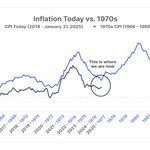
The parallels to the 1970s are hard to ignore: a supply shock rooted in geopolitical instability, a Fed that’s already been cutting, and consumers who never fully caught up from the last round of price increases.

Jared Simons retweeted

My information consumption is now 1/4 X, 1/4 podcast interviews of the smartest practitioners, 1/4 talking to the leading AI models, and 1/4 reading old books. The opportunity cost of anything else is far too high, and rising daily.
Jared Simons retweeted

New filings: ETFs tracking indices developed by financial research firm Porter & Company
Porter & Company Property & Casualty Index ETF | 0.65%
Porter & Company Capital Efficiency Index ETF | 0.65%
Porter & Company Lindy Effect Index ETF | 0.65%
Porter & Company Permanent Portfolio Index ETF | 0.75%
Tickers: tba
Effective date: May 20, 2026
Porter & Company:
members.porterandcompanyrese…
Preliminary prospectus:
sec.gov/Archives/edgar/data/…
@Porter_and_Co @porterstansb @TuttleCapital

Jared Simons retweeted

Most people who say “AI will replace SaaS” have not replaced a single system in reality.
They are vibe coders, solopreneurs, and self-proclaimed experts talking theory.
We have done real replacements at Voi, at scale, on a modern tech and data stack, with elite engineering resources.
Here is the truth.
Critical systems like ERP and CRM are not getting ripped out in established companies. Forget it.
You do not replace NetSuite, or Salesforce, lightly. Over years, millions of micro-improvements become embedded in finance, reporting, compliance, and operations. The data is too critical. The operational risk is too high.
Net-new companies can go AI-native ERP from day one. Incumbents will not gamble their backbone.
Mid- and long-tail SaaS is different.
Narrow tools with limited surface area and clear workflows can be replaced.
But even there, it is not about writing a prompt and deleting a subscription.
You must own lifecycle management: integrations, permissions, data models, edge cases, upgrades, monitoring, and governance.
That requires real engineering resources.
Saving money on SaaS licenses is a nice headline. It is not the frontier.
The frontier is replacing human labor.
Cross-functional workflows: reporting, validation, translations, parsing, reconciliation, planning, coordination, and decision support.
You do not just swap software. You redesign work.
We are now building customized, enterprise-grade software that replaces manual white-collar work, then standardizing the components so evolution and maintenance become automated.
The real TAM is not SaaS spend.
It is white-collar time spent on tasks computers are better at.
That is where this goes.

Jared Simons retweeted

"Why should companies pay for SaaS (HR/CRM/ERP/etc.) when they could just vibe code them?"
I get variations of this question or comment with some regularity (granted, it's sometimes just me talking to myself).
Here are some biased (but hopefully, well-considered) thoughts:
1) I am a big proponent and user of vibe coding (what I call "agentic coding"). I do it every day, 7 days a week, including Sundays. It's amazing.
2) My company, HubSpot is a software company. We have hundreds of professional engineers -- just about all of them use AI for product development too. They are brilliant and know how to build production-grade products.
3) Even with this powerful army of talent, the number of internal, core SaaS applications that we have replaced with a vibe-coded variant is exactly ZERO. The number of applications we plan to replace is also exactly ZERO.
4) It's not the absence of talent that keeps us from rolling our own SaaS apps, it's the presence of focus. It would be silly to try and replace our HR, team collaboration, expense tracking and 100+ other SaaS apps we use when we can just buy them. Just doesn't make sense.
5) That's us -- as a software company at some scale. If you're a non-software company it makes even less sense for you. Doesn't matter how good the AI coding tools get. Let's say you *could* vibe code a replacement for that SaaS app you're using, who's going to maintain it? Who's going to keep up with industry trends? What are you going to do when the 20-something genius that vibe coded it over a weekend leaves the company? Who do you call when there's a major bug?
6) If you're a Fortune 500 company at some scale, perhaps you could pull this off for some discrete use cases and the tradeoffs are worth it. You have an IT/Engineering department that is larger than the population of some countries. You can take on the pain in return for the positives.
For the millions of others, my advice is:
Spend every calorie possible on creating value for your customers.
