

We are a global poverty research center @MIT that conducts randomized evaluations and builds partnerships to bring innovative, effective programs to scale.
MIT, Cambridge, MA
Joined August 2011
- Tweets10.8K
- Following580
- Followers60.9K
- Likes2.9K




In rural Ghana, a US$3 cash offer raised verified Covid-19 vaccination by 12.3 percentage points, a 43% increase.
A US$10 offer had no effect.
Researchers suggest matching incentives to vaccination's real costs: too much cash may breed suspicion instead of uptake. bit.ly/3VXN3wo

How does an evaluation's design impact a study's credibility?
When researchers design a study—including randomized evaluations—they rely on assumptions, like the assumption that people in a study are split into truly random groups. The credibility of any impact evaluation depends on whether those assumptions are plausible in a given context. J-PAL Research and Training Lead Michala Riis-Vestergaard explores what those assumptions are, why they matter, and how to assess them across different evaluation designs.
povertyactionlab.org/blog/6-…

Bihar set out to reach its most vulnerable households. Two years on, households in the program had 2x the monthly income and 8x the business revenue of comparable households.
Built and scaled by Government of Bihar and JEEViKA, and now scaling to 12+ states. Read more: bit.ly/482Kj3v


From MicroMasters to master’s at MIT. 🎓If you’re completing (or have completed) the DEDP MicroMasters, join us on Wednesday, October 21, 2026, at 9:00 am ET to learn how you can apply to the DEDP master’s program at MIT.
DEDP program staff and a program alum will be answering questions live. Register: bit.ly/46GnXo0

About 800 million people live in extreme poverty. One approach with strong evidence: the Graduation approach, 1-2 years of support that includes a business asset, cash, training, and coaching.
In India, gains a decade later were nearly 4x the cost.
bit.ly/4jslTYm #EndPoverty

Interested in impact evaluation but can’t enroll in a full-time class? You can complete J-PAL’s free, online course on #EvaluatingSocialPrograms on your own schedule.
Enroll today: bit.ly/4y9wGKN

One simple, low-cost way to save children’s lives: chlorine in drinking water.
It can cut the odds of death for under-fives by about a quarter. In Malawi, vouchers for free chlorine matched door-to-door use at lower cost.
bit.ly/4s8xcqS

Does charging a small fee for a mosquito net help?
In Kenya, almost all pregnant women took a free bednet at clinics. When it cost US$0.60, most didn’t.
17 studies: even low prices can keep families in need from getting these products.
bit.ly/3TDIxm5

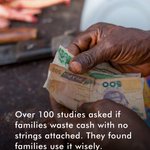
Will families waste cash if there are no strings attached?
Evidence from over 100 studies shows better food security, income, savings, and mental health. No drop in work, and no rise in alcohol or tobacco spending.
povertyactionlab.org/evidenc…

More than 800 million live in extreme poverty. But rigorous evidence shows which approaches work, and which work best in different contexts.
This week ahead of #InternationalDayfortheEradicationofPoverty, we're sharing six evidence-backed approaches being scaled globally. Follow along for one each day.
Explore The Evidence Effect: bit.ly/46OklS0
#EndPoverty

Join us in J-PAL’s online #EvaluatingSocialPrograms course to explore our updated Evidence to Policy module, highlighting how rigorous evidence has helped inform and scale effective programs around the world. 🌍
bit.ly/4y9wGKN


The results:
✅ 138,500+ vulnerable people identified and enrolled for emergency cash transfers
✅ 4-21% fewer exclusion errors than geographic targeting alone
And it was not just about targeting accuracy.
Recipients experienced improvements in food security, mental health, and overall well-being.
povertyactionlab.org/case-st…

Thinking about applying to MIT’s DEDP master’s program? Applications open in November. Prep starts now. 🗓️ Join us Oct 21, 9am ET for everything you need on requirements, funding, and what makes a strong DEDP candidate, straight from Prof. Sara Ellison, the team, and an alum.
bit.ly/46GnXo0

History is full of technologies that promised transformation but struggled to deliver impact at scale.
AI may be different. But only if implementation, trust, institutional capacity, and evidence keep pace with technological progress. J-PAL's AI Evidence Playbook explores where AI shows promise, what barriers may limit its impact, and how evidence can help.
📖: bit.ly/3On3m1U

Health systems have spent decades expanding access to care—but access to what kind of care matters.
A randomized evaluation in Nigeria shows: posting recently graduated doctors to rural facilities closed the rural-urban infant mortality gap.
bit.ly/4ARVJnV
