

Professor of Economics at Yale SOM
New Haven, CT
Joined April 2009
- Tweets14K
- Following540
- Followers16.7K
- Likes6.3K




Pinned Tweet
I thought I'd try to reconstruct Bryan's discussion with a 13-year-old about the minimum wage based on the below tweet:
(@bryan_caplan let me know if anything is inaccurate)

This is certainly correct, but of course the path to AI ending aging or killing everyone (if it happens via biological mechanisms) is that AI itself could autonomously orchestrate this instrumentation revolution.
Theoretical modeling and instrumentation are highly complementary. This instrumentation revolution will be slow and take decades if it is humans assisted by AI but it could be very fast if AI can autonomously develop both new and better theoretical models, and then new measurement devices on the basis of those models.
What skeptics of this kind of takeoff fail to articulate is why an instrumentation revolution like this takes a long time if you have a sophisticated enough autonomous system. What prevents the robots from discovering very quickly what would take humans hundreds or thousands of years if they can accumulate the equivalent amount of work-hours that humans would accumulate over that time?
It's possible that serendipity is required, but why can't serendipity occur for the machines as well? It's possible that certain physical, chemical or biological processes are sufficiently complex that they can only be understood by watching them evolve over a very long period, but nothing in our current theoretical understanding of chemistry or biology establishes or precludes this.

Dreams of AI ending aging and of AI killing everyone through a purely in-silico-designed pandemic both rely on this fallacy.
It's understated here how much we lack ground truth data about what's happening inside of cells, or sensors to get that data. A single cell contains billions of protein molecules, across at least thousands of types, and at least trillions of interactions per second.
Think we solved protein folding? We've made enormous progress predicting static protein structures. But these proteins constantly change their conformation and interact with one another, often in ways we can't observe or model accurately.
Our best sensors capture a miniscule fraction of the activity in a living cell, orders of magnitude short of what's happening.
We actually lack the ability to perceive what's going on that would be required to build such a bottoms up simulation.
Let alone to scale this up to an organism or a global population.
We know we have an expanding universe not because of breakthroughs in theory or computation - but because Edwin Hubble got new data by looking through the Hooker telescope. Possibly the greatest mind, Einstein, was wrong in his model of the universe because he lacked the right instrument to bring him the right data.
That's where we are in biology. Our sensors are still so crude. No amount of pure computation or AI can build a perfect model.
We need an instrument revolution in biology, not just a computational or intelligence revolution. AI can generate hypotheses, but without sufficient ground truth data, we can't know whether our simulations are modeling reality.
I mostly agree, with the caveats that: a) massive investments in physical infrastructure to connect models with AI labs are happening today, in parallel with massive compute investments and b) these investments may be things models do autonomously once they are cognitively capable enough.
I definitely appreciate the distinction between "software only takeoff" and "software + requiring new physical infrastructure." I think you're correct that fundamental biological breakthroughs are in the latter group, although it's possible that physical infrastructure can be constructed very quickly with sufficiently capable autonomous agents.
A corrollary of the point that bottlenecks are everywhere in a pre-AGI world: until you do get AGI (and then all bets are off), growth comes from disruption; e.g. it doesn't come from hospitals using GPT, it comes from circumventing hospitals entirely.

Was about to write this but Ben beat me to it. Econ is unique among the sciences in that it is several pretty different fields living under one umbrella.
Empirical econ is the biggest subfield and its closest to biology or chemistry: it’s about designing or—even better—finding a natural experiment, or documenting interesting and important patterns in data. Most of the arguments in that field are about methods, eg do you have identification. More and more are starting to study AI now but obviously this won’t be transformative AI because, well, there is no data on transformative AI.
Then there are macro economists. They work with a set of pretty standard models and mainly expand them by slowly adding/subtracting different sectors or micro founding factors of production in different ways. Many of the arguments are on the parameter values that we should assume when simulating the economy. Early research on transformative AI started there—as demonstrated recently by Chad, Anton et al, the different levels of transformation are due to different assumptions on parameters rather than some new type of economics. The same model can predict basically no impact of AI vs huge transformation, it’s all about assumptions on parameters.
Finally there is micro theory. This is where decision theory, game theory, mech design, org econ (sort of) live. This field works by setting out a set of assumptions and then *deriving* the expected results; alternatively one could start with a result and work backwards to derive the necessary and sufficient assumptions. There is a ton of potential here to do work on transformative AI: start with assumptions on how AI differs than human agents (eg relax basic assumptions on constraints, on scarcity, introduce completely different objective functions), then derive implications. But this is where there is the least amount of work, and it’s important for that to change (and I believe that it already is).
I think we can make a ton of progress from these three subfields on better understanding the potential AGI and post AGI transformation.
But there is another scenario, post strong ASI, where I don’t think economics has much to say about. Here I agree with @Jabaluck that the economy (if you can even call it that) and the agents in it will be so vastly different and beyond our imagination that I wouldn’t know where to start modeling it. Not to discourage others, but post singularity seems like pure epistemic uncertainty to me.
A lot of the critiques I hear about AI and economics come from people who don’t quite get what economists do. They look around at different results and if they don’t like some of them, they say “oh economics isn’t “pilled” or something. But economists don’t debate results, they *derive* results from assumptions. Thats where the debate is. Saying “but you don’t understand a world with 15 billion AI agents”. What does that mean for the economy? What are those agents doing, who is buying what they are producing, what do property rights look like? Depending on those assumptions you’ll get vastly different economic scenarios, from 2% growth and high human labor share to completely alien centralized systems with no prices or markets.
There used to be a show called Crossfire whose premise was to take two complete partisans, neither of whom cared at all about trying to get to the truth, and have them argue about politics. This show was terrible and Jon Stewart got it cancelled: youtube.com/watch?v=aFQFB5Yp…
At this time, the premise of the Daily Show was something like, "First, we will try to find things in politics that are genuinely funny. Second, we will expose obvious hypocrisy among public figures" -- and this was actually useful! -- it highlighted the foolishness of partisanship, and how dumb it was to platform people whose job was to repeat the party line in a totally unprincipled way.
I think a wrong turn was taken when the Daily Show and its descendants moved to a model which said, "We will try to make our audience more informed about politics."
While this is a very tempting idea, comedy writers themselves lack the epistemic community to arrive at the truth -- it's a very hard problem, and comedy writers might be better at this than partisans, but they're not good at this, and not clearly better than much maligned traditional news media. Even worse, combining information with jokes often means snark. Now you get John Oliver acting like his specific narrative about a complex issue is so obviously correct that the opposing view is laughable.
If there is a lesson, I think it is that comparative advantage is underrated. Comedy shows should try to be funny, news shows should try to inform, and everyone should try to make their audience bewildered by the complexity of the world and their inability to grasp most of what is going on, instead of deluding their audience into thinking it is simple.

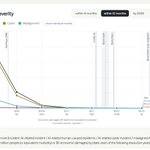
All AI related incidents that have happened so far have tiny costs compared to benefits that have already materialized, let alone will materialize in the future.
Net benefits will hinge on whether or not we get catastrophes (loss of control / biodisaster / wars)
Jason Abaluck retweeted

Where do you go next after reporting from the Strait of Hormuz? For the past three months, Citrini Research, an independent research firm, has been working with our team and an internal research model to see if they could use AI to create a new drug. What follows is an entertaining, candid, and humbling account of a group of motivated nonexperts (or “filthy casuals”, as Citrini would say) trying to tackle a real problem in human health with Claude.
We landed on scorpion neurotoxins, which kill over 3,000 people a year. Of the 211 designs we produced and tested, 17 met our criteria for a binder. None of the designs bound more than one toxin and none have been tested for neutralizing a toxin.
One of my favorite quotes from the piece is: “Our virtual biologist may have compressed a year's worth of work into a couple days, but biology works at the speed of life…Over two days, we watched Claude work through problems at a speed that was difficult to comprehend. For the next two months, we spent much of the time becoming familiar with laboratory turnaround times (This mostly involved sending memes in Slack).”

What is AI really capable of in bio?
To separate hype from reality, we spent 3 months working firsthand with @AnthropicAI's internal research model to see if it could create an experimental scorpion antivenom.
Introducing Citrini Therapeutics.
citriniresearch.com/p/citrin…

This view of the future seems fairly naive to me. I don't think the reasoning of a superintelligence would be "legible to us" in any meaningful way. Even among humans, which exhibit a very narrow range of intelligence, core normative concepts like efficiency are legible to only a tiny fraction of the population.
A superintelligence could give us a dumbed down explanation for why it believes a given course of action is best, but the idea that humans will need to vote to ratify this course of action is somewhat ludicrous, and an overextrapolation from human norms where there are strong pragmatic reasons to prefer democracy to alternative institutions like meritocratic authoritarianism.
I think it's correct that there is intrinsic value to democratic decision-making even if it leads to worse outcomes. But this intrinsic value is not infinite and is not particularly relevant in a world where some entities are far better at normative reasoning and orders of magnitude more efficient at achieving goals if not bottlenecked by dumber and more fallible human review.

What kind of political singularity are we heading towards?
A few interesting points / suggestions that came in from this:
(1) If AI is omniscient won’t it know our values and be able to aggregate them to make the tradeoffs for us? I guess that might be right but we would need the AI to remain legible to us, and we would need to have final override abilities, so that we ensure continued human control in case it goes off the rails
(2) Is it really so easy to separate the information part from the values tradeoff part? Here I’m not sure. We need to study this more!
“That sounds like sci-fi,” he said of computers programming smarter computers, in a world of conversational robots, driverless taxis, personalized gene editing, and brain implants that turn thoughts into speech.
Current frontier models seem to nearly always err on the side of massively overfitting models if you ask for their advice. If some coefficient varies by age, they'll immediately suggest replacing 1 parameter with 11. They have no sense of the value of parsimony.
I wonder if we will see more AI-polarization by age as both the benefits and risk become more clear. The net benefits of moving fast seem considerably larger for the elderly, who have more to gain from medical benefits and face less labor market risk.
Jason Abaluck retweeted

We have never seen a model do this before, but GLM-5.3 sometimes reasons (unprompted) about how its current actions could become training data and impact its future self. 🧵

Even if humans maintain control of AI and labor markets exist, we will have to get used to the fact that in nearly every analytical domain, AI will be doing things that humans understand at only a very high-level or not at all. That's how comparative advantage works.

These posts are mostly nonsense hype or equivocation about the definition of RSI. The right data to evaluate things isn't publicly available, but naive extrapolation of data like the below from Anthropic would project that full automation (their level 5) is not imminent.


Some rumors I've heard. I'll start with Google, then Anthropic and OpenAI.
Google: Insiders say Google has either cracked RSI (recursive self-improvement) or is very close. Their pace has picked up fast in recent months. They went from GPT-5 level to Opus 5.5 level in months, and speculation is that RSI made that possible.
Anthropic: About a week ago, Anthropic started a new pretraining run. It is not Fable 5.5 but what would become Fable 6, or something bigger, to catch up to OpenAI's Bel.
OpenAI: Bel (it may have another codename) is the model behind the math results OpenAI published a few days ago, and RSI apparently helped there too.
From what I'm hearing, OpenAI, Anthropic, and Google are all very close to cracking RSI or already have. It will get scary and exciting at the same time.

When you debate AI consciousness or questions like the moral status of animals, it's always worth keeping in mind questions like:
1) How would the Greeks have discussed how many pieces an apple can be cut into?
2) How would the Romans have discussed the distance to the sun and stars?
3) How would Tang Dynasty physicians have explained why people are ill?
This is not meant to be dismissive of philosophical questions! The point is not that the Greeks, Romans and Tang Chinese would have gotten these questions wrong.
Ptolemy estimated the sun was 4.8 million miles away. That's pretty impressive! (he was only off by a factor of 20 or so). He wasn't perfect either -- he was off by 5-6 orders of magnitude for other stars.
The lessons from these examples are:
a) Some answers are much more reasonable than others. You'd do a lot better to trust Ptolemy than to trust Gallus who thought the stars were 50,000 miles from earth.
b) These people weren't stupid, but they lacked conceptual frameworks which took centuries to develop which were necessary to understand what a reliable answer would even look like. For some formulations of this question, we still don't know how many pieces an apple can be cut into without a complete theory of quantum gravity.
c) When a field lacks reliable methods for discovering the truth, we should be deeply suspicious of people who claim confident understanding. Even if they are right on some points, they likely have deep and fundamental misunderstandings about the nature of the phenomena in question.
People without reliable methods of discovering truth should be uncertain not only about what is true, but about the conceptual frameworks they use to formulate their conclusions.
The central benchmark for most of the social sciences is predicting counterfactuals. Either:
a) Predicting the results of RCTs
or
b) Predicting the results of the best available empirical estimates (before they happen)
Strongly agree with Joe on this---while there are big parts of the social sciences that tackle important but squishy problems that don't lend themselves to concretely defined open problems, we could do a lot more to foster a culture of open problems for certain important and quantifiable parts of the fields.
Here's what I wrote about it for @rootsofprogress in my piece on the 100x research institute.

These is where I think models will ultimately leapfrog the existing literature. When you have models predicting the results of human-generated studies, this is useful, but partly you are predicting what will come of errant humans stumbling around.
Jason Abaluck retweeted

debating your value system vs mine is a bit like debating overpopulation on mars. the most important bit of the alignment is about avoiding creating a superintelligent competitor species on accident
