

Educational Psychologist sharing evidence & ideas - infants, early years, literacy, trauma, family wellbeing & more. Enjoys: different views. Loathes: broccoli
Joined March 2017
- Tweets6.8K
- Following3.1K
- Followers6.5K
- Likes9.6K





Pinned Tweet
To close the #gap, we need to think - which gaps? Not just #attainment & schools - addressing #ACE will need everyone working together

James McTaggart retweeted

Join us for 45 minutes on Wednesday 3 June to learn about the impact of Project Intercept, our innovative partnership programme with the world's biggest online platforms to implement warning messages that prevent online child sexual abuse.
Sign up here: lnkd.in/erQXEkZY


Good to see connections being explored (at last). Whole post worth reading.
And:
1) TI is as much in the *how* as the *what*
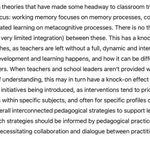
2) Deeper connections exist, e.g., impact of dissociation on attention & memory (v state dependent so apt for teaching strategies) 1/4

This is a hugely important piece by @PamelaSnow2. A very insightful application of cognitive load theory to neurodivergence and trauma-informed classroom practice. To the best of my knowledge there is no research on this topic and this has really illuminated my understanding on the topic both as a researcher but more importantly as a SEN parent. I do hope Pam explores this area further. pamelasnow.blogspot.com/2026…

5) Great to read that CYP emotional and physical state impacts on learning - not all of this can be solved by schools alone. A weakness of some cogsci approaches that needs addressing
6) Less attention to the relational environment means both connections & dissonances missed 3/4
James McTaggart retweeted
A knock from the police changed Deana's life. Her dad was arrested for online child sexual offences. These are her own words, with images inspired by her drawings.
Find out more: lucyfaithfull.org.uk/what-ab…
Webinar: events.teams.microsoft.com/e…
James McTaggart retweeted
#SaferInternetDay from @UK_SIC is today! We're taking part alongside thousands of other organisations.
There are many great resources to help parents and children on saferinternetday.org.uk.
Young people can get guidance, reassurance, and support: shorespace.org.uk/topics/onl…

Often adults struggle to solve problems *about* children that are better solved *with* children. They have the info about what's really going on & their perspective makes complex problems simpler. Which makes solutions more (cost) effective. Oh, and it's their right!
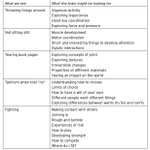
Lots of conversations atm about #behaviour in #earlyyears.
Children’s actions can often be understood as their "voice", giving us info about their developmental needs - especially when they are inconvenient or difficult!
Some ideas in the table:

Lots of conversations atm about behaviour in early years. Children’s actions can often be understood as their "voice", giving us info about their developmental needs - especially when they are inconvenient or difficult! Some ideas in the table:

James McTaggart retweeted
Our anonymous Stop It Now service is here for anyone who needs us over the holiday period, with some adjustments to our regular hours, and a period of closure over the Christmas week.
If you're concerned about child sexual abuse, get in touch at stopitnow.org.uk

Superb advice here, and fits v well with NICE Guidance 204 on Babies, Children and Young People's Experiences of Healthcare
nice.org.uk/guidance/ng204

Interesting new paper on transfer of research to educational practice, although it lacks the educator perspective on this
Narrow focus, lack of theoretical integration, small piecemeal changes - with some solutions
nature.com/articles/s41539-0…

James McTaggart retweeted

Some of our children had never been to the cinema – until today! 🎞️🍿🤩
There’s no standardised score, progress measure or league table to demonstrate the importance of this but when you’re serving a community where this stuff isn’t a given, let me tell you, it matters.
💙


James McTaggart retweeted

We used to have a lot more autonomy to do this. Since the huge push on “fidelity” regardless of age or stage, things have moved to a much more “one size fits all” approach which has led to some children having gaps and still being expected to make the same progress. It’s complex.
James McTaggart retweeted
Absolutely. The cognitive load of sitting still for children who haven’t fully mapped their bodies is often overlooked by CLT enthusiasts. If a child hasn’t developed proprioception, they’re not what Pagani (2012) refers to as “mind free” . They won’t be able to focus for long
James McTaggart retweeted
Just because we can, it doesn’t mean we should. This is why we need people to understand that literacy is a physical process. We can’t separate brain and body, not should we try to. There’s so much research available to back this up.
This is as much the science of #reading (and writing) as #phonics
Time spent on these is time well invested in long term progress, and we need a system that supports teachers to do this well into primary school, as for some children that's the natural developmental timescale

True that avoiding a source of anxiety can maintain it. Also true that exposure only works if it is supported and successful.
The action point from this is not to just remove adaptations or “make them do it”. Some practical considerations 🧵
TLDR: care is needed!
1/12

“Academic accommodations for anxiety convey two harmful messages. First, they imply that the feared situation is truly dangerous. Public speaking, testing, or lunch with classmates are too risky for a student. Second, they suggest that the student can’t withstand the distress. Those messages increase anxiety.”
What a fantastic article!! Eliminating things that cause anxiety don’t teach students how to cope with difficult situations and can heighten anxiety in the long term!! Avoidance is a TEMPORARY solution but can be harmful in the long run!
This article is well worth the read: tc.columbia.edu/articles/202… @BostonGlobe @TeachersCollege

None of this means school necessarily causes the anxiety. But it can exacerbate it, which also means we can be a big part of solving it together
11/12