
Mainly electric vehicles. 🐙
Joined January 2009
- Tweets3K
- Following1.1K
- Followers1K
- Likes1.7K



James Court retweeted

🎤 LabourList's photos from our karaoke are now live! 🎵
🎶 Were you at our karaoke last Monday? It's crazy to think it's already been a week. Bring back the memories, and scroll through our gallery to see if you were papped by our photographer! 📷️
labourlist.org/2026/10/labou…


James Court retweeted

Danger: a personal post about running… If interested after that disclaimer, read on:
I started running, really for the first time, four years ago (September 2022). Apart from the odd 3 km or 5 km run, I had never really run any meaningful distance. I ran my first 10 km on a treadmill in Jakarta in October 2022, which at the time felt like a massive achievement.
I then got into it for a bunch of reasons: being unfit and overweight, and work being particularly stressful. It has created some invaluable space for me to just think and reflect, and to have a firebreak between work and me. It has also become an amazing way to redevelop my relationship with place, including my own home city and places I thought I knew well. I’m sure other runners have similar reasons for getting into it and sustaining it. Basically, it is a tremendous life hack that I wish I had discovered much earlier in life.
In March 2023, while on holiday in Rome, I saw the Rome Marathon in action and decided to sign up for the 2024 edition. Why not? People seemed to be having fun, it had a great energy, and I love Rome. I was feeling more confident as a runner and felt that completing it was doable. I had a year to prepare, after all.
One year later, in March 2024, and with much trepidation, I ran my first marathon. Rome went amazingly well, and somehow I managed sub-3 hours (2:59:55), which felt insane and hugely exhilarating, as I wasn’t targeting that barrier. I can’t overstate how great it felt. It was one of the most rewarding achievements I’ve experienced, more rewarding than any professional or academic achievement. A real high that lasted quite a while.
Cutting a long story short, I decided after that unexpected success to try and run the original big six major marathons (Berlin, Boston, Chicago, London, NYC and Tokyo) each in under 3 hours, and to do them all within two years of my first major. I had delivered sub-3 (by a whisker), but could I do it consistently across very different courses while avoiding injury and illness and fitting it in with work commitments?
And the answer is: YES! Between being in NYC for Climate Week last week and heading to IPCC meetings this week, I ran the last of the big six in Berlin, with a PB of 2:47:31, on Sunday.
The six times:
• Chicago: 2:54:41
• Tokyo: 2:56:42
• London: 2:51:54
• NYC: 2:48:27
• Boston: 2:50:40
• Berlin: 2:47:31
I can’t recommend running enough, and the marathons are great fun and, for the most part, incredibly well organised.
In terms of kit, East London-based Soar is brilliant. And thank you, @newbalance, for giving me free kit for London 2025.
Big thanks to my friends and family who have supported me with the races and the running.


James Court retweeted

Data centres - zero so far. V few building in uk. If they do, there’s a good chance their huge investment will pay for infrastructure that helps everyone else too
Elec cars - should cut bills for everyone. They don’t add to peak load so don’t need new grid etc but they will put more load through at off peak times, reducing fixed costs for everyone
Policy needs amending to maximise this
James Court retweeted

As the Nissan Exec who brought the Nissan LEAF to the U.K., weakening the U.K. ZEV mandate would be a profound mistake @Heidi_Labour .
It will be presented as “pragmatism”: protecting consumers and manufacturers from weak EV demand. But it will achieve precisely the opposite — higher costs, less innovation, greater oil dependence and a weaker British car industry.
Start with cost of living.
Yes, EVs remain too expensive to buy in many segments. That is the problem we should fix. Once bought, they are considerably cheaper to run. HMRC’s benchmark for home charging is around 7p/mile. A petrol car doing 40mpg at £1.50/litre costs about 17p/mile — roughly £1,000 more over 10,000 miles.
Why slow the transition to the cheaper-to-run technology?
The problem is purchase price — and demand is price elastic. Put an EV beside an equivalent ICE car with a £5,000 premium and of course demand suffers. Close the gap and demand rises.
The mandate creates pressure to achieve the scale, competition and battery cost reductions needed to close that gap.
Then there’s the claim that the mandate is crippling manufacturers.
Show us the evidence.
The ZEV mandate deliberately includes banking, borrowing and credit trading. Manufacturers have met their obligations within these flexibilities in all years and likely in 2026.
If OEMs say this is costing billions, publish the TPVA data. Show actual transaction prices, not list prices. Show the real incentives on BEV versus ICE. Show the contribution margins. Demonstrate that incentives really are higher and profits lower on EVs.
Industrial policy involving billions of pounds of investment shouldn’t be rewritten on anecdotes.
And then there’s China.
You don’t protect an industry from technological change by protecting yesterday’s technology.
China became formidable by investing relentlessly in batteries, motors, power electronics, software and manufacturing scale.
Weakening our mandate doesn’t keep Chinese manufacturers out. It risks giving them more time to increase their cost and technology advantage while we continue investing in two powertrains.
Consumers will ultimately buy the best technology at the best price. British and European manufacturers must compete, not retreat.
Recent events around Iran add another dimension: energy security.
Around 20% of global petroleum liquids consumption normally passes through the Strait of Hormuz. A crisis thousands of miles away can therefore increase the cost of driving in Britain.
An EV can run on electricity generated from wind, solar, nuclear, gas or hydro. Electrification gives transport something oil never can: energy diversity.
And climate change hasn’t disappeared because the politics have become difficult. Transport remains one of Britain’s largest sources of CO₂. The physics hasn’t changed.
Finally, consider investment.
Automotive product decisions are made five or ten years ahead. Factories and battery plants require billions in capital. Constantly changing policy tells international boards considering Britain: the rules might change again.
Fix expensive public charging. Accelerate infrastructure. Bring EV purchase prices down. And if manufacturers can prove the mandate is damaging them, examine the evidence.
Don’t mistake difficulty executing a transition for evidence that it’s wrong.
If the problem is affordability, make EVs cheaper.
If it’s manufacturer profitability, show the data.
If it’s China, compete.
If it’s energy security, reduce oil dependence.
If it’s climate change, decarbonise.
Britain will not protect its car industry by slowing technological change. We protect it by making sure British engineers, factories and suppliers lead it.
If we slow down while China speeds up, don’t be surprised by who wins.
@Heidi_Labour changing the mandate doesn’t makes investment in the U.K. car industry more likely - it makes foreign owned Boards further distrust U.K. policy makers and their reliability
James Court retweeted

As others (@OwenWntr, MiC etc) have noted, social attitudes cut by financial security is quite a neat prism. Financially insecure social liberals going Green, financially insecure conservatives Reform. Lab & LD left with financially secure liberals. Con higher with secure cons.

James Court retweeted

I spent years organising local elections. I am glad that I am out of the game, but there are some things I miss:
- Running on the final heady fuel that kept me going, furious animosity towards the Lib Dems
- The frenzied & often touching camaraderie of a polling day operation
James Court retweeted

44% of evening peak met by batteries. In California, world’s 4th largest economy. Not some tiny pilot project or a niche experiment, a global industrial powerhouse
If you’re still sitting in boardrooms or parliament banging on about baseload and the intermittency of renewables, you’re not just wrong, you’re a dinosaur
California's 44% isn't an anomaly. It's a preview of the 2027-2030 reality for every major grid overbuilding renewables
The "technical barriers" the fossil fuel lobby loves to cry about are gone. We are shifting solar and wind into the night at a massive, industrial scale. We don't need expensive, inflexible coal or gas to keep the lights on; we need more storage and we need it now - everywhere
reneweconomy.com.au/grid-bat…

James Court retweeted

Shifting from bills to taxation makes energy costs more accountable. Treasury officials pay a LOT more attention to the impact of policy cost creep than DESNZ. It’s one reason the energy sector has long been split on this - subsidy beneficiaries worry about what HMT will notice.
James Court retweeted

Unlike the 1970s oil crises, there are now better alternatives:
🔌 EVs + renewables + heat pumps could cut fossil fuel imports by 70%
🚗 EVs alone: $600bn/year in savings
Every country has the potential to be energy independent with electrotech.
🔗ember-energy.org/latest-insi…

James Court retweeted

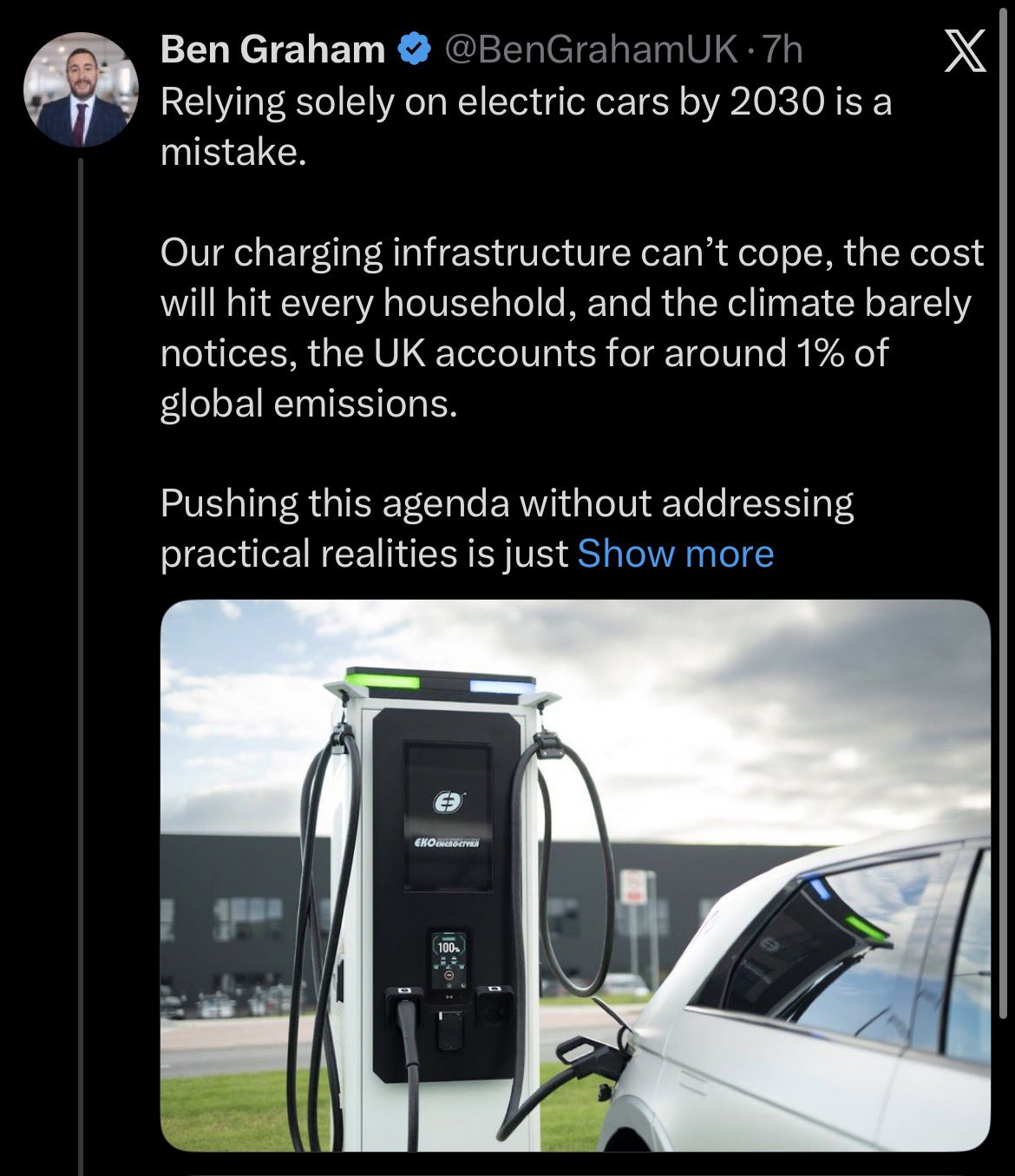
Classic EV misinfo from @BenGrahamUK here
No, we will not be “relying solely on EVs by 2030”
1 - you can buy a new car with an engine in until 2035 i.e. hybrids
2 - you can buy a 2nd hand petrol car for as long as you’d like, absolutely no phase out date in place…
1/2
James Court retweeted
75% of the world lives in fossil fuel importing countries. Every $10 oil price rise adds $160bn/year to the global import bill.
The single biggest fix: EVs replacing imported oil in transport could save importers $600bn/year.
Read the report:
🔗ember-energy.org/latest-insi…

independent.co.uk/cars/elect…
EV pay-per-mile tax could cost fleets £260m a year in admin alone. Pay-per-mile is the wrong policy at the wrong time, and this is just the latest in a long line of unforeseen issues, govt should have a serious rethink and properly consult with industry.

James Court retweeted

It's time for a Plunge Pricing event in the UK! 🇬🇧🌿 Get 15% off today (25/03) at all Osprey Charging Network, @InstaVoltUK, IONITY, @RawCharging, @GeniePointEV & @BeEV_Charging locations when you start a charge using the Octopus Electroverse app or charging card (Electrocard) between 10:00 - 14:00! 🤩🔌 Want to learn more about Plunge Pricing? Head to the Electroverse blog here: bit.ly/plungepricingelectrov… 🔗
James Court retweeted

EXC Does your council wrongly block projects, and have to pay millions in council tax when the decisions are overturned?
We reveal what's going wrong.
Investigation by @JoeCookJ and me, interrogating everyone planning council in England
James Court retweeted

Get Fingleton Done. Full Zonal Now. Cut The Levies.

How do you respond to an energy crisis? We'll get the Government's answer today. 4 years ago I was being asked the same question when I worked in No10.
Back then, Boris Johnson deployed the secret weapon of the British state- endless Cabinet Office committees- to tackle two problems: how to shield billpayers from surging gas costs in the short term, and how to stop taxpayers footing the bill again in a future crisis.
Boris would erupt with fury when civil servants explained how a few hundred kittiwakes were stopping us building vital energy infrastructure. His answer was 2022’s British Energy Security Strategy, which I helped write. Its premise was simple: speed up homegrown energy- new nuclear, renewables, and oil and gas- to insulate Britain from global price shocks.
On any reasonable measure, it failed.
Four years on we have the highest industrial energy costs in the world, the second highest domestic bills in Europe, and our energy system remains reliant on imported gas that spikes in global crises (and increasingly on imported turbines and panels from China). The government is again considering paying everyone's bills. What went wrong?
This Government would argue we didn’t go fast enough on renewables. Their policy is to buy lots of renewables very quickly to replace gas. We can and should remove the planning barriers that slow down deployment and increase the cost of all new energy, including renewables. But the catch is that while solar and batteries work in Spain or Texas, the cost of building wind turbines, our main option, has soared.
Buying lots of offshore wind in 2021 made sense at £57/MWh. But the latest deals cost nearly double that. In trying to avoid volatility, the Government has bought a record amount of the most expensive wind power in a decade.
Wind farms also require more grid than a smaller number of assets like nuclear power plants, both for themselves and for the backup gas they rely on. The cost of building that grid will add £108 per year to bills by 2031 yet we’ll still pay billions to switch wind farms off when it’s too windy for the grid to handle.
There are other hidden bill costs: from carbon pricing levied upstream, to subsidies for industry. It’s got so bad that energy bosses have said that even if the wholesale price fell to zero, bills would still go up. Even if we bring down the cost of wind through planning and market reform, a grid dominated by it faces a core challenge: the wind doesn’t always blow.
Solving this problem leads you back to burning gas. While more wind in the mix means we burn less gas - handy when prices spike - the trade-off is the cost of building the system twice: once for wind and once for gas backup. And if gas plants run intermittently, their economics get much worse.
If we’re going to burn gas anyway should we have ignored renewables and gone hell for leather on gas? Our current crisis suggests otherwise. The North Sea is not what it was, leaving us reliant on imports and exposed to global events.
That doesn’t mean current policy makes sense. Banning new exploration licenses in a gas-hungry system that imports half its supply is self-defeating, and the windfall tax is clearly accelerating the North Sea's decline.
But that decline is geological not political; it began well before net zero. New licenses and a better fiscal regime can extend its life, not reverse its fortunes.
Could fracking have saved us? My view then and now is that the geology, geography, population density and politics of Britain make the economics of US style fracking impossible here. Would a country that struggles with objections to new homes accept thousands of fracking pads across our countryside? Lancashire’s new Reform council certainly doesn't seem to think so.
The deeper problem is the 2022 Strategy, in true Johnsonian fashion, set boosterish new targets, but lacked the concrete plan for achieving them. Fortunately this Government now has practical plans it can implement today.
First: radical supply side reform to make it easier to build new nuclear. Nuclear cuts the gordian knot; it reduces our reliance on both imported fossil fuels and kit from China, insulating us from price shocks. It carries fewer hidden costs because it is on whatever the weather, and it is zero carbon to boot.
The challenge is that our current approach to building nuclear is ruinously expensive - but it doesn’t have to be. Korea builds them six times cheaper; in this country we used to build nuclear power stations for a quarter of current costs.
The Fingleton review, which the Government has said they will deliver in full, provides a roadmap for getting costs to that level again - the Government should commit to passing the regulatory changes and legislation needed by the end of the year. Think of it as a vaccine taskforce for nuclear.
Second: market reform to cut waste. We can drive down the cost of renewables and add more to the grid, but they should stand on their own two feet. If data centres want to sign a deal to build solar and batteries we shouldn’t stand in their way, but our energy system should be guided by prices not planned from Whitehall. The same applies to grid queues.
Finally: cut unnecessary taxes and remove levies to slash bills now. Carbon taxes on electricity have got coal off the grid and now only serve to make all types of power more expensive. They should be removed. Government handouts to industry should not be hidden on bills but moved to general taxation or scrapped.
Taken together this would cut the cost of electricity in the short and long term. Good for industry, good for households, while making the shift from the (often) imported oil and gas we use in our boilers and petrol cars more attractive for consumers. The heart of the 2022 strategy: making it easier to build energy infrastructure in Britain, remains correct. The Government now has a blueprint. They should get on with it.
James Court retweeted
Octopus have long pushed for reforms to give people cheap electricity rather than *paying wind farms to switch off* so I’m pleased to see this but…
trials are hugely ineffective. Permanent changes would mean you could buy an electric car, or a heat pump or batteries to use power when it’s cheap. Or build a data center, or hydrogen electrolysers or kilns or…. (Of course it’s not windy all the time but average elec costs would be much lower)
These would all shift demand far more effectively than we will see in any trial. Indeed, trials could be pretty ineffective without this.
The rejection of zonal was to favour generators but giving them certainty.
Trials do the exact opposite for users. No certainty so consumers of electricity can’t invest.
Which is a shame because an energy transition would see 6x more investment on the consumption side than the generation side, but that side bears far more uncertainty than generators, grids and networks.
So - great to see all this “zonal by the back door” stuff - but why not make it permanent immediately so we can have confidence in investing in electrification, and why not go the whole hog and do zonal properly

Sometimes there is too much wind for our outdated grid to handle, especially in Scotland and the East of England.
Rather than paying wind farms to switch off we’re trialling a new system where people who live near these constrained areas get cheaper - or even free - electricity.

ALT photo of a wind farm with a headline Discounted power on windy days instead of paying to turn turbines off.
James Court retweeted

Battery storage has proven itself invaluable during California's record-breaking spring heatwave.
During peak demand, grid batteries delivered ~11 GW – a third of demand.
They kept power price spikes lower and short-lived.
Chart for March 19

James Court retweeted

I've written part two of my two blogs on levy reform. Cutting levies is the only option left on the table for the government to really make a lasting, noticeable difference on bills, beyond more subsidies.
jackpardoe.substack.com/p/th…

James Court retweeted
Moronic observation. Nissan, Mitsubishi and Tesla gave birth to modern EVs. Early investment in Japan, UK and US gave an unassailable lead to the West in the EV technology including gigafactories in U.K. Sunderland and US. Yet poor management and poor Government support, often flic-flak regulations caused the west to waste its lead while China stayed the course and invested. Car making is all about economies of scale, and that is what China created and Europe didn’t. After that it’s about technological leadership; EVs are the future and you can’t put that genie back in the lamp!