

Bringing the Balance Between Agronomics and Economics! Always looking for Consultants/Growers and Retail to partner with to help bring value.
Beadle County S.D
Joined May 2013
- Tweets4.1K
- Following6K
- Followers9K
- Likes35.2K





Got a tip from my good friend Mr cropcast, @sean_nettleton to paste the link instead nextlevelag.com/resources/ hoping this works better.

If interested in a micro nutrient guide the lab released its free - nextlevelag.com/

A lot of people are looking at next year's numbers right now and thinking about trimming fertility.
I get it. I'd be thinking the same thing.
Here's the thing though. Cutting back is easy. Anybody can write a smaller check. Cutting back with confidence is a different deal. That takes knowing what your ground is actually holding, field by field, and what the crop actually hauled off this year.
So before you cut, ask yourself one question. Do I know which acres can take it and which ones can't?
If you're not sure, that's okay. Most of us aren't. Ask your retailer what data is behind their recommendation. And ask them if they use Next Level Ag.

Jason Schley retweeted

Don’t just add more fertility. Make more available.
The plant and soil are built to feed each other. Sean Nettleton and Blake Hadley on getting more from every fertilizer dollar.
Episode 87: Less In, More Out is now live>> open.spotify.com/episode/4eG…
Jason Schley retweeted
Tomorrow: Crop Cast Live.
Fertilizer isn’t getting cheaper, and buying more isn’t the answer. Sean Nettleton and Blake Hadley go live tomorrow on how to make every purchased pound count.
Friday, Oct. 23 · 10 AM ET / 9 AM CT
Register now>> us06web.zoom.us/webinar/regi…

Your plant has a sensor for ethylene, the hormone that drives ripening and stress response. Researchers found that sensor doesn't work without a copper atom sitting in it.
And that's just one of copper's jobs. It helps move energy through photosynthesis, it helps build the lignin that keeps stems standing, and it keeps pollen fertile so you actually set grain.
When copper runs short you see pale plants, twisted dead leaf tips in wheat, and in bad cases heads that don't fill. Copper doesn't move much in the plant, so new growth shows it first.
Where do we see it? Organic soils hold copper tighter than any other micro, so high-OM ground, sands and high-pH spots are the ones to watch.
Here's the catch: this is a nutrient I have seen nearly 0 responses to by applying it on its own. Have you had luck? One exception for me is on wheat.
Next up: molybdenum.
#NextLevelAg #Agronomy365 #The5Percent #copper #agronomy
Staggering maturities to capture more yield.
How many people do it and how big of maturity gaps do you use? We used to start with our 0.8 maturities and move to a 2.6 ish. Last few years we haven’t been focused on getting wheat in so we quit doing it.
This year it would have paid well. Seems every field is 7.5-9.

Building soil P is expensive. The math and the field don’t agree.
Just jumped in the combine helping the family farm . Bean yields around here have been pretty good. Can’t speak for everybody, but overall solid. Quality’s a little off.
I was listening to a video saying phosphorus needs to be 50 ppm, preferably 100. We just finished a field that made over 60. Around here most APHs are 43 to 45. Mother Nature gets the credit. She did the work.
That field tested 3 to 10 ppm phosphorus. Do you really believe another 10, 12, 15 bushel was sitting there just because the soil test number was higher?
I ran the math with Grok on building this ground to 50. 11-52-0 at $1,152 a ton is $1.11 a pound of P₂O₅. University data (Iowa State, Minnesota, SDSU, Tri-State) says it takes about 16 to 20 pounds of P₂O₅ to move a Mehlich-3 test 1 ppm. From 5 ppm to 50, that’s roughly $900 an acre on paper. At pH 7.2, calcium ties a lot of that up. Figure 40 percent fixation and you’re closer to $1,500 an acre before you even count crop removal working against you every year.
Then ask how many bushels that takes to break even. Chasing that ppm, I’d go broke — or I’d be better off buying more land.
We foliar fed this field several times. No check strip, so I can’t prove it paid. I believe it did. Exudation drives phosphorus uptake, stimulation and plant health drives exudation. The more you stimulate the crop, the more phosphorus gets in the plant. - both are important soil P and Uptake. Can’t spend it all just to get it applied to the soil.
I’m not anti-phosphorus. I want P in the field. I’m anti-losing money chasing a magical ppm.
South Dakota cash beans are about $12.40 tonight. At that price, $1,200 an acre is 97 bushels. $2,000 is 161 bushels. Spread over five years, you need an extra 19 to 32 bushel every single year just to get your money back. Not once. Every year.
Next Level and Agronomy 365 is always looking to get better, we are releasing our grain analysis test with seed count to better understand what your farm and management is doing for you.
1) Grain Analysis + Seed Weight sets the base of understanding your removal rates
2) Indicator Complete/Max determines the estimated release rates and what the soil can provide for free
3) Baseline recommendations are created by filling the gap (what is needed for yield goal - what the soil can release
All in house data driven to create efficiency on your farm.
The standards most use for the base of a nutrient plan is just a guess based off of averages.
Your grain is the only real receipt.
This is one field. One grower, one 2026 corn crop, six zones. Not a regional average — just what this field actually did.
Nitrogen ran 26% under the book. Phosphate 18% under. Potash 7% over. Sulfur 6% over. Same hybrid family, same field, and phosphate removal still swung from 53 to 80 pounds per acre.
So the question isn’t whether the book is wrong. It’s whether you’ve ever checked yours.
1) Removal is only one piece of the puzzle.
2) The next step is the soil test — what percent of that need your soil already covers naturally.
3) The prescription file makes up the difference.
That gap is all you should be spending on a crop.
Grain analysis tells you what it takes to create the bushel. Soil tells you what’s already there. The prescription closes the gap.
This is one field. Let’s find out what yours says.
Send grain. We’ll show you what actually left.


An iron-deficient leaf often has plenty of iron in the soil beneath its feet.
The common line is that iron “makes chlorophyll.” It doesn’t sit in the molecule. Magnesium does. Iron runs the enzymes that build the ring. No iron, no chlorophyll, and the new leaf bleaches. Old leaves stay green. Iron moves poorly, so the miss shows on the youngest tissue first. Huge miss in capturing sunlight.
Young leaves go yellow, then almost white, with the veins still dark and sharp. Not the olive stripe and white flecks of manganese. Not the small, narrow blade of zinc. Soybean shows it harder than corn. Iron deficiency chlorosis on calcareous ground can take 20 to 30% off yield in the bad pockets, and the rest of the field looks fine. 
The connection is bicarbonate and lime, not a missing pile of iron. Above about pH 6.5, iron sits as Fe³⁺ and drops out of solution. Roots try to acidify a little zone and reduce it to Fe²⁺. Finely divided lime neutralizes that acid. Nitrate uptake releases more bicarbonate and makes it worse.
Wet, cold, high-salt, and heavy phosphorus, copper, zinc, or manganese can induce the same yellow leaf on a soil test that says iron is adequate. A sulfate dumped on that ground usually ties right back up. The form that holds is a strong chelate.
Foliar apps is a bandage on the new leaf, it can help and can allow a plant root to get into a potential depth of soil that can potentially take the right forms up. But to rely on Foliar alone it typically won’t make up the gap. Applied Biology and Fulvic acids have made meaningful difference in most fields. If you’ve planted green before my guess is you seen a reduction in Fe deficiencies. Root exudates from the existing crop allow for better iron uptake.
Where to watch: calcareous spots, pH above about 7, poorly drained lows, high residual nitrate, and a cold wet start.
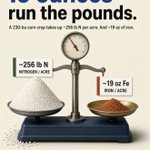
How small is the need? A 230-bushel Illinois corn crop took up about 19 ounces of iron per acre. Only about 18% ended up in the grain. 
CHO takeaway: iron doesn’t add carbon, and it isn’t in the chlorophyll. It builds the pigment that catches the light so carbon can be fixed.
A soil test shows the supply, and it lies if you ignore pH and bicarbonate. Tissue shows what the plant got. Grain shows what left the field. Most of it didn’t.
Next: Copper.
#NextLevelAg #Agronomy365 #The5Percent #iron #micronutrients #agronomy

A manganese-a deficiency in the plants can still look green and already be short on the machine that splits water.
That was the point of a 2016 review by Schmidt, Jensen and Husted. Photosystem II is the first thing manganese deficiency hits. And typically the
The oxygen-evolving complex — four manganese atoms and one calcium — falls apart before the leaf yellows. They called it latent. No dead growing point. Yield already leaking, and the field still looks fine. Young leaves go olive to yellow between the veins. Veins stay green. White flecks show up in the yellow. Stems get short and thin. Manganese moves poorly, so new growth shows it first. Easy to call iron. Easy to call a cold snap. After glyphosate, the same look can flash and fade.
The job that fails first is water splitting. Those four manganese atoms crack water into oxygen, protons, and the electrons that run carbon fixation. A 2010 maize chloroplast study found oxygen release shut down when manganese was short. Adding it back repaired the damage.
The pounds connection: each unit rise in soil pH drops solution manganese about a hundred-fold. Lime does that. High organic matter ties Mn²⁺ up too. On those soils a soil-applied sulfate often oxidizes and never reaches the root. Foliar is the correction, not another broadcast pound. Below about pH 5 it flips — manganese floods the solution and can go toxic. pH above about 6.5, recently limed ground, mucks, poorly drained spots, sandy lows, and cold wet springs. Acid knobs, for the opposite problem.
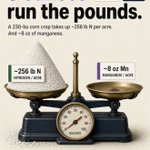
How small is the need? A 230-bushel Illinois corn crop took up about 8 ounces of manganese per acre. Only about 13% ended up in the grain.
CHO takeaway: manganese doesn’t add carbon. It splits the water so the leaf can make the oxygen and the electrons that fix it.
A soil test shows the supply, and it lies if you ignore pH. Tissue shows what the plant got. Grain shows what left the field. Most of it didn’t.
Next: Iron.
#NextLevelAg #Agronomy365 #The5Percent #manganese #micronutrients #agronomy

1 ounce runs the pounds.
A boron-short corn plant can look almost finished in the leaves and still fail to set an ear.
That was the finding of a 2011 maize study by Lordkaew, Dell, Jamjod and Rerkasem. Vegetative dry weight barely moved. Hand-pollinated boron-deficient plants made 0.4 kernels per ear. The plants with boron made 410. When they crossed them, good pollen on boron-short silk made almost no grain. The silk was the bottleneck. The common line that boron is “just for cell walls” undersells what the field actually loses: pollination. 
It fits what boron deficiency looks like.
Young leaves pick up narrow white-to-transparent streaks between the veins. Internodes shorten. Growing points stall. Tassels come out small, with dead branches and shriveled anthers that have no pollen. Ears come out multiple, short, and poorly silked. Kernel set is scattered or missing at the tip. Boron moves poorly inside corn, so new tissue and the ear show it first.
Boron also cross-links two chains of a pectin called rhamnogalacturonan II in the cell wall. That borate bridge is the one job we can point to at the molecular level. Calcium sits in the same complex and holds the bridge together. When the wall can’t lock, meristems and pollen tubes don’t grow.
The pounds connection: lime and high calcium can tie boron up. So can very high potassium. Drought stops the mass flow that carries boric acid to the root. Sand and a hard rain leach it the other direction. On finer, higher-organic-matter soils the yield response is often quiet. The risk concentrates where the soil can’t hold it, or the weather won’t move it, right when silk is being built.
Where to watch: sandy or low-organic-matter soils, pH above about 6.5, recently limed ground, and a dry stretch through tasseling and silking.
How small is the need? A 230-bushel Illinois corn crop took up about 1.2 ounces of boron per acre, and only about 23% of it ended up in the grain. 
CHO takeaway: boron doesn’t add carbon itself. It staples the new cell wall so growth can happen, and through the silk it decides whether that carbon ever becomes a kernel.
A hot-water or DTPA soil test shows the supply and estimates availability. Tissue shows what the plant got. Silk at pollination shows whether reproduction has it. Grain shows what left the field.
Next: Manganese.
#NextLevelAg #Agronomy365 #boron #micronutrients #agronomy

Jason Schley retweeted

The best N recs you can get! Had operations save hundreds of thousands of dollars this past year on N.

We are now going into year 6 of aggressively cutting back Nitrogen fertilizer on several hundred thousands of acres annually through our recommendations.
Happy to see more people waking up to the opportunities.
Concern- don’t do it blindly and then have a disaster. Measure and monitor and let your fields give you the answers. Success from Nitrogen cutbacks comes from efficiency which is driven by a plan not by accident.
#Baseline RX #agronomy365#nextlevelag
Starting a series: nutrients — what they actually do in the plant. Observation + research, not textbook.
A zinc-short bean plant has plenty of tryptophan (the raw material for auxin). What it’s short on is the auxin itself.
That’s the 1989 Cakmak, Marschner & Bangerth finding. Zn-deficient plants had less IAA. Tryptophan went up. Zinc is needed to make auxin — not just to make tryptophan.
That matches the look of Zn deficiency: • Broadleaves: short internodes, small leaves, rosetting / little leaf
• Corn: broad bleached bands on each side of the midrib on young upper leaves, usually in the first 2–3 weeks
Zn moves poorly in the plant, so new growth shows it first.
Zinc also runs carbonic anhydrase — the enzyme that turns CO₂ into bicarbonate. In corn that bicarbonate feeds PEP carboxylase, the first carbon-fixing step.
Short Zn and both enzymes lose activity.
Pounds connection: heavy P can push Zn short (partly by suppressing mycorrhizae). Minnesota Extension flags it mainly when P₂O₅ rates run very high (>200 lb/ac) on soils already low in Zn. It works the other way too — Zn-short cotton took up too much P.
Watch: soils above ~pH 6.5, eroded or high-lime spots, cool wet springs.
How small is the need? A 230-bu Illinois corn crop took up about 7 oz Zn/acre. ~62% of that left in the grain.
CHO takeaway: Zn doesn’t add carbon. It helps feed CO₂ into corn’s carbon-fixing machinery, and through auxin it helps decide where new growth goes.
DTPA soil test = supply. Tissue = what the plant got. Grain = what left the field.
Next: Boron.
#NextLevelAg #Agronomy365 #The5Percent #zinc #micronutrients #agronomy

By the late reproductive stages, a lot of your phosphorus is fixed again. Here's why 👇
Every night a healthy plant kicks out 30–50% of its exudates to keep the microbes happy, and the microbes feed the plant. Under stress it saves those sugars for the grain and forgets about the root.
#phosphorus #agronomy #rhizosphere #soilmicrobes #corn #plantHealth


We apply $100 worth of phosphorus. Why can't we get that $100 back into the plant? 🤔
Most growers get between $10 and $30 of it back that year. We think that could be $70–$80, just by maintaining better microbial levels, and allowing the plant to ask for it.
#phosphorus #soilhealth #agronomy #farming #soilbiology #fertilizer