
Principal at Respondable Recruitment Marketing and known in some circles as the Indeed Whisperer.
Dallas, TX
Joined October 2022
- Tweets2.4K
- Following567
- Followers477
- Likes767




The first drafts of this human-written newsletter were a lot spicier.
If you could do me a favor, go ahead and read it now. There's nothing worse than working all day on a great meal and watching it go cold.

64
A buddy of mine, Josh Jones, has been playing with drones after a long time playing with cameras. He's merged the two, and I think the results are pretty good.
Better than AI.
droneshotvideos.com/

13
One of the fun things I get to do is run marketing and customer success for KinISO software. It's mostly coming up with banger blogposts and pictures.
It's the right way to use AI. My favorite prompts are saying, do it Far Side style, or 80's Saturday cartoons.
🤖 Made with AI

1
27
Say what you will about AI, but everyone once in a while, it really feels like it knows you better than yourself.
I just had ChatGPT tell me, "that sounds like more "Jim-shaped" work, and I never felt more heard.
1
45
Your gut instinct is perfectly reasonable as a method of determining who to hire.
Let me back that up a little. Your gut instinct is a normal method of determining who to hire, because it's one of the most powerful intuitions you have. And it's never wrong.
That seems strong. It's true, but there is a lot of nuance to what I mean by gut intuition. It doesn't mean the hiring manager's view is always right. It means, that when you sense something off, there's always a reason why.
And even that needs some explanation.
Words are not great for communication. That's why individual texts are so easy to misunderstand. It's called the Mehrabian Communication rule. It posits that when inconsistent emotional messages are sensed, words alone aren't as important as tone, which is not as valuable as body language.
It's often misused and misquoted, but it basically means, if you notice something wrong, it's very difficult to understand why just using the text of the words.
The important point here is that "when you notice something is wrong," you need to pay more attention.
It's ironic when you come to the pseudoscience of hiring, because the least reliable thing you can do when hiring is to trust your gut. That's not a reversal of what I said earlier.
I have this hunch that I'm not being clear. Let me try again.
When you're interviewing someone, and you notice something off, you should dig deeper. If your gut says look, you look. Here are some reasons to trust your gut.
1) They're lying to you or hiding something
2) You have a clear bias towards them you are unaware of
3) You want to hire someone else, and are looking for reasons to filter them out.
Note - your gut doesn't tell you what is wrong, just that something is wrong. It could be them, it could be you. Great interviewing means understanding why your gut says something is off, but then having the discipline to conduct a structured interview that focuses on their ability to do the job.
There is one big twist, though. And it's the funniest twist.
If your gut tells you a candidate is really, really awesome, it's not wrong. It's that you're not listening to it correctly. Intuition is about sensing danger, not feeling good. When your gut tells you to hire a person, it means that you've created a positive impression of them. It doesn't tell you whether that impression is true or not.
That means, when you have a positive gut feeling, it's imperative that you conduct a structured interview that focuses on their ability to do the job.
As I said. Gut instinct is a valid and valuable tool to use in hiring. It's not a good sole reason to hire or reject. It's not a valid "reason" to hire or reject. It's a tool that when combined with proper training, makes you a good interviewer.
38
AI detectors famously accused Moby Dick of being 31% AI-written.
It sounds weird until you understand that Melville was a time traveler warning mankind about the danger of killing whales. He came from a time when whales were extinct.
But his story, while classic, fell short.
So he time traveled forward to 1991, where he amped the story up to all of mankind dying without whales.
That's right - Star Trek IV was Melville's third attempt, under a new name, Harve Bennett.
Did I forget this second attempt? Who do you think sold all those Save the Whales stickers to GreenPeace?
44
i dropped some serious arguments into ChatGPT and Grok - and their response was to cite Charles Perrow on Organizing America.
For all the hype of AI, the most amazing thing is how it reads your arguments like it's reading your bookshelf from 2002.
I'd say that it was using cameras to read, but that's not my current bookshelf. It reads my thoughts and tells us what I was trained on.
That's a lot cooler than writing compelling AI messages.
35
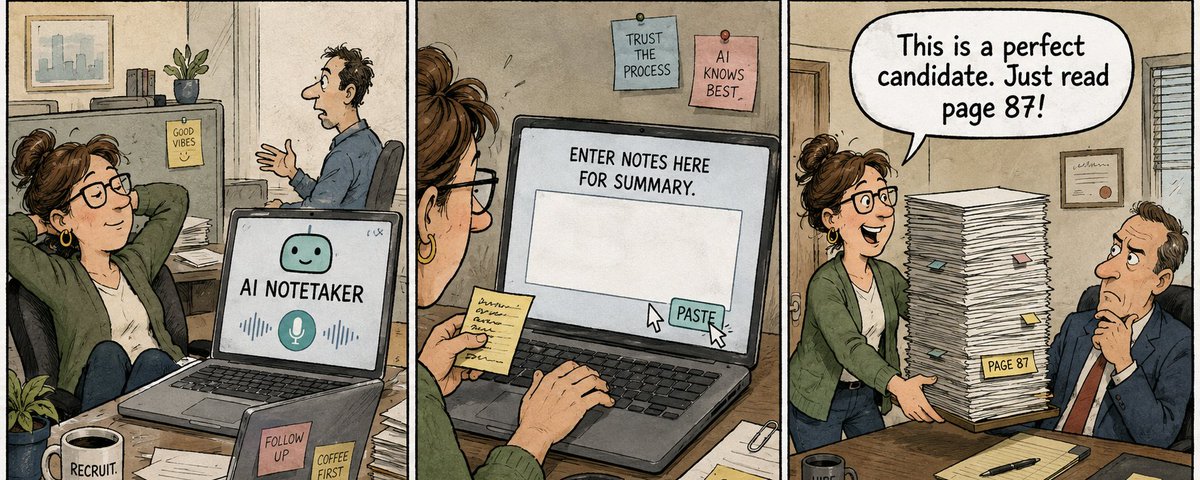
AI summaries of AI Notetakers are the dumbest thing to hit recruiting since video resumes on VHS.
1
1
76
One of the things I really like about AI is how I can take ideas and create images. I don't worry about the design tools - because I like to stretch my creative muscles, and if you let AI design for you, you get... just good enough.
The best designs are simple images. And that, believe it or not, is really hard to do.
The image below is the process I run when working with a new client. It's a very simple image, right? Easy to make.
Except, I gave very detailed instructions to make it look this way. i could have just drawn it and uploaded a picture, but writing design makes me think through they "why" of each moment. When presenting, I put this image forth, and then follow it with more detail. I literally create the presentation words live, which means I'm locking in my script as part of the design.
It's like standing up in a meeting to write on a whiteboard. You do that to concentrate attention and clarify definitions. It works great, as long as you have something useful to say. The image supports a narrative consistency that proves you actually do know what you're talking about.
AI allows me to merge my ideas and my deliverables because I am present in both of their creation. The bad side of this is when you use AI to design deliverables without understanding why. Yes it's fast. Yes, it's good enough.
But then what? You're not expanding on what you know. You're just reading what AI told you. That's not going to inspire confidence.
This image? It matters to me. I understand why I created it, and what I'm going to say. It focuses attention. It does all of these things because it is my thinking brought to life.
That attitude, not a mastery of models or a library of prompts, is what makes human work meaningful.
🤖 Made with AI

43
Call reluctance is easy to identify when someone refuses to pick up the phone.
That is also probably the least common version of it.
In staffing firms, call reluctance usually looks productive. The recruiter is updating records, cleaning up job orders, reviewing resumes, researching accounts, sending messages. Busy all day.
Just not talking to the people who can change the outcome.
That is what makes it hard to coach. It hides inside legitimate work.
A few of the ways it shows up:
The long, pleasant call with a candidate you cannot place, instead of the difficult one you need.
The general office number dialed at 4:55 on a Friday, because you know the voicemail will answer.
The research block at 9 a.m. that is still going at 11, when the account was never that complicated.
The email sent as a permission slip, so the call feels less aggressive later.
"Sorry to bother you" as an opening line, which tells the other person the call probably is not worth their time before they have decided that for themselves.
None of those activities is wrong. The pattern is what matters.
🤖 Made with AI

37
JimDurbinTX retweeted

This is absolutely insane and beautiful. 2500 drones putting on a jaw dropping show over North Richland Hills Texas for America 250. Bald eagle, rocket, Uncle Sam saying I Want USA, George Washington, astronauts on the moon, and more.
Texas knows how to celebrate freedom. This is next level patriotism.
Happy 4th of July yall! God bless America!
🔥🇺🇸
I was driving today and told my phone, "Hey Siri, play I'm So Ronery from Team America World Police."
Siri said, "I can't find that for you, but it sounds like you need to talk to a real person. We have many resources for people who are suffering..."
I started cursing. I'm not depressed. I'm funny.
But now, I'm worried my phone thinks I'm depressed, and who is it going to be reporting to?
30
Back in my day, we didn't have the best candidates. They were just, pretty good.
And we liked it!
25
I pulled all my LinkedIn posts from 2012-2024. Some of them make me very happy.
"Did a webinar yesterday on Advanced LinkedIn Recruiting. Woke up to an email forwarded to me from the host, Kathy Simmons "Just to let you know... this was one of the best webinars I've ever attended." That's going on the wall. Hello Thursday!"
42
Dodgeball has a warning on Hulu saying it is intended only for mature audiences.
That's not remotely true.
BlueBloods. Now that's for
Mature audiences.
21
JimDurbinTX retweeted

My wife and I own Forest Park Pharmacy, and we don't accept insurance. None of it. That decision is exactly why we could fix what happened to a patient today.
A family came in wanting to transfer their kid's antibiotic to us. The child had already STARTED the course. Then, mid-treatment, the insurance company decided the last 14 tablets suddenly needed a "prior authorization" before the other pharmacy could hand them over. A sick kid, halfway through an antibiotic, and the answer was "please hold."
The drug is linezolid. It's a generic. It's been generic for over a decade. It treats serious gram-positive infections — the kind you do NOT want to stop antibiotics in the middle of, because an interrupted course is how you breed resistant bugs and end up right back where you started.
So why the hold-up on a cheap, common generic? Follow the fake math.
Insurance and the PBMs behind them price drugs off a number called AWP — "Average Wholesale Price." People in my industry have another name for it: "Ain't What's Paid." It's a benchmark number, not a real-world cost. On paper, the AWP for just those last 14 tablets is about $2,500.
My cash price for the same 14 tablets? $18.
Read that again. The system that's supposedly "protecting" this family from cost is the same system that inflated an $18 medication into a $2,500 line item, then slapped a prior auth on it to "review the expense" THEY invented. They manufactured the problem, then billed everyone for the privilege of solving it — and made a sick kid wait while they did it.
This is the whole game. When a drug is priced honestly, there's nothing to "manage." When it's priced off a fantasy benchmark, you get spread pricing, PA paperwork, pharmacy phone trees, and delayed treatment — all dressed up as cost control.
Here's the part nobody tells you: roughly 90% of prescriptions are low-cost generics. For the vast majority of what people pick up every day, running it through insurance does two things — raises the real cost and risks delaying your care. That's it. That's the value-add.
That's why we fired the insurance companies. No middleman deciding your kid can't finish their antibiotics on schedule. No fake prices. Just the real number, on the shelf, today.
The medication was always cheap. The insurance was the expensive part.
MARK:
Can I offer some conductive criticism?
JEN:
Conductive criticism?
MARK:
Yeah.
JEN:
You mean constructive criticism.
MARK:
No. Conductive criticism.
JEN:
That’s not a thing.
MARK:
It is now.
JEN:
Constructive criticism helps build things.
MARK:
Sure.
JEN:
So what’s conductive criticism?
MARK:
Different category.
JEN:
How?
MARK:
Constructive criticism helps build something better.
JEN:
Right.
MARK:
Conductive criticism keeps the lights on.
7
Wham's Last Christmas has been in my head for two hours.
I need to replace it with that TikTok song about bananas in uncomfortable places (what, like the back of a volkswagen?)
9

