

Consultant specialising in Business Development, Team Building, Motivational Speaking, Sales & Acquisitions.
London, England
Joined March 2011
- Tweets33.8K
- Following203
- Followers1.7K
- Likes30






You can't build real trust in a Slack thread the way you build it in a room, it doesn't matter how good your video setup is. Remote work is fine for getting tasks done. It's a bad tool for the kind of relationship where someone tells you the truth when things go wrong.
Big changes rarely come from one big decision. They come from the small choices you repeat: what you eat, who you call back, whether you follow up today or tomorrow. Don’t underestimate the compounding effect of boring consistency. bit.ly/4rKNrJ9

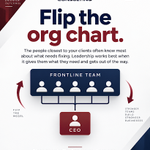
Draw your org chart.
CEO on top, frontline team at the bottom holding everything up. Now flip it upside down. That's closer to how we actually try to run things.

Hot take: the more digital everything gets, the more valuable face-to-face becomes. Buyers are drowning in fake reviews, spoofed emails and AI-written content. Showing up builds something harder to fake: trust. More here:
eawconsulting.co.uk/the-trus…
Most founders say they want their business to run without them. Most are lying, not on purpose. If it actually didn't need you, that's not relief, it's a threat to the identity you built around being needed. That's usually why the systems never quite get finished.

The skills that moved the needle most in my career weren’t learned in a classroom. Communication. Confidence. Listening. Ownership. Presence. Consistency. Empathy. Hard to build. Easy to ignore. Hugely valuable. Which one’s your weak spot? bit.ly/3VyLc0H

Twenty-five years in business teaches you this: the fear never fully disappears. The stakes just change. Early on, it’s paying bills. Later, it’s complacency and falling behind. Feeling uncertain doesn’t mean you’re doing it wrong. It means it still matters.

Had a few founders ask if they should be “battening down the hatches.” Stop asking Google. Look at your own numbers. Cash buffer. Client risk. Plan B. You don’t need to predict the economy. You need a business that can survive being wrong about it. What are you seeing right now?

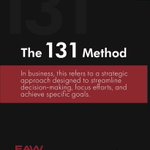
I used to think good leadership meant being available for every decision. Turns out, that was the problem. The 131 Method: 1 problem. 3 possible solutions. 1 decision. It gets your team solving problems without you, and gives you your time back. bit.ly/4iS2FuQ

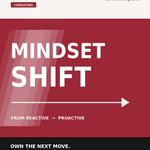
There's a mindset shift between waiting to be told what to do and deciding what needs doing. An employee mindset asks “what's my job description.” An entrepreneur mindset asks “what does this business need right now.” That has nothing to do with your job title.

Every investment decision looks like it's about the numbers. It never starts there for me. It starts with one question: will they still be doing this the hard way in year three, when nobody's watching. Numbers change every quarter. Character doesn't.

You don't need capital to start thinking like an investor. You need a habit of asking one question before every decision: what does this actually return, and over what timeframe. Think like an investor long before you have anything to invest.

A full calendar isn't the same as a productive one. Busy tells you the day was occupied. Effective tells you the day moved something forward. Busyness feels like proof of effort. It isn't proof of anything except that your time got spent somewhere.
Saying nothing feels safe. It rarely is. The problem you didn't raise doesn't disappear, it just gets more expensive while it waits. Silence isn't the absence of a decision. It's one.
Ask most business owners who their biggest competitor is, they'll name another company. The honest answer is usually comfort. Other companies don't beat you. You quietly stop competing with yourself, and they catch up.

AI can draft the email, build the deck, summarise the report in seconds. It can't tell you whether the idea inside any of it is worth backing. That judgment call is still entirely yours. AI can accelerate your output. It can't replace your conviction.

You can't out-work an unclear niche. Trying to be relevant to everyone is usually why a business is remembered by no one. Scaling before you know exactly who you're for doesn't build a bigger business. It builds a louder, confused one.

AI can draft the email, build the deck, summarise the report in seconds. It can't tell you whether the idea inside any of it is worth backing. That judgment call is still entirely yours. AI can accelerate your output. It can't replace your conviction.
No hidden agenda, that's the rule we built this business on. If something isn't working, we say so before the client has to ask. Trust isn't built by getting everything right. It's built by never needing to hide anything when you get something wrong.

