

Content and Product Marketer || Simplifying and Positioning Tech Products to Drive Adoption || AI . SaaS . Web3
Global Citizen
Joined June 2016
- Tweets7.8K
- Following442
- Followers3K
- Likes25.7K





Suno users were reportedly generating roughly 7 million songs a day in late 2025...
And some of the songs shared with a visible @Suno link might have served as free promotion for the platform.
While many consumer AI teams build distribution outside the product itself…
Suno’s investor, "Menlo Ventures," mentioned that most users discover the platform as listeners after someone in their community shares a song.
I call this pattern ‘output-as-distribution’, and Suno enables it via these product mechanics:
-> Every generated song is playable and can easily be used on social platforms, thereby reducing the effort required to present the output to others.
-> Finished songs are readily accessible via a ‘Copy Link’ button and other sharing options, which make it easy for creators to share songs with friends or their audience.
-> Shared Suno links take listeners back to the platform, while visible credits on externally shared songs help listeners identify the platform behind them.
Together, these mechanics turn shared songs into product demonstrations that can build awareness and bring new users into Suno.
To be clear, this design wasn’t solely responsible for Suno’s growth…
But the product creates a clear distribution loop, in which:
Users create songs => Share some of them => Expose new listeners to Suno => Some of those listeners become creators who repeat the process.
Your product doesn’t need to be at Suno’s scale before you can apply this principle.
You just need to ensure your product has an output that users will want to share, so recipients have a clear route back to your platform.

Joshua O. retweeted
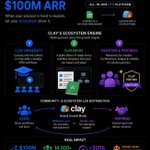
By the time @clay crossed $100 million in ARR in December 2025...
It already had an ecosystem of users, creators, and partners who showed prospective buyers what could be built with its product suite.
Clay started as a no-code spreadsheet and evolved into a Go-To-Market (GTM) platform that combines data enrichment, AI research, outreach, and workflow automation.
As Clay expanded the platform, it deployed the following initiatives, which made its power users a key component of its marketing engine:
-> Clay University: Offers courses and free LIVE cohorts that cover everything from Clay fundamentals to workflows like CRM enrichment and outbound prospecting.
-> Claybooks: A public library of step-by-step workflow guides with templates that prospective users can copy and adapt to their own use cases.
-> Empowerment: Clay helped selected creators to build and share workflows, while giving its Solutions Partners a way to demonstrate their expertise through certifications, tiered badges, and a public directory.
Together, these programs created community- and ecosystem-led distribution around Clay’s hybrid growth model that combines Product-Led Growth with Sales-Led Support for larger enterprises.
In its January 2026 tender-offer announcement, Clay reported about 14,000 customers and enterprise net revenue retention above 200%.
Other B2B teams can implement this strategy by converting a workflow used by their customers into a template that can be replicated by prospects.
After this, they can test whether that visibility improves product understanding, activation, or conversion.
Joshua O. retweeted
A team of seven people took CAL AI to 15 million downloads in under two years, and the AI model powering it is just one part of the story.
CAL AI is an app that returns a calorie estimate within seconds of users pointing their phone camera at a plate of food.
While dozens of apps also do the same thing, many of them compete mainly on AI accuracy.
Instead, the CAL AI team chose to compete on how quickly someone reached a usable result and how easily it became a daily habit.
Their rapid growth can largely be attributed to compressing one repeatable moment into a loop that users wanted to return to.
The loop follows this sequence:
-> Users point the camera and get a number back before their curiosity fades, so the recurring action feels like a quick win, not a manual chore.
-> That win is anchored to something users already do every day, so the trigger to return lives in their routine, not a notification.
-> The logged history is kept visible, so leaving the app means abandoning a streak they have already built.
This design is "Retention-Led Growth" that combines a low-friction, repeatable product experience with conversion testing.
In consumer AI, a retained daily habit drives engagement and customer relationships that competitors find difficult to replicate.
MyFitnessPal acquired Cal AI in a deal that was finalized in December 2025, and the retention power of CAL AI wasn't necessarily the model powering it...
But the fast, repeatable behaviour it enabled around every meal.
Some other camera-native apps have run similar playbooks to no avail, so one breakout story is not complete proof that it always works.
The key lesson here for an early consumer AI team is to design the smallest repeatable win before trying to scale their reach.

Joshua O. retweeted
Rental income and fixed-interest payments still dominate the conversations surrounding cash-flow tokenization in the RWAs industry.
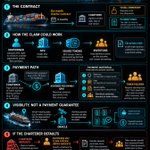
I think a unique type of cash flow that needs to be tokenized is “charter hire income”…which is the money a shipowner earns from leasing out a single container ship.
Imagine a mid-size container vessel on a six-month charter, under which that charterer agrees to pay a fixed daily rate to use the ship.
The shipowner can tokenize its right to receive those payments and allow investors to buy a fractional claim on the income generated during the six-month period.
The structure would resemble tokenized private-credit deals, where off-chain contractual payments are converted into on-chain investment vehicles.
In this case, the shipowner can assign its right to receive payments under the contract to a Special Purpose Vehicle (SPV)…
Which would issue tokens that give investors a defined claim on that income rather than ownership of the vessel.
An oracle can also represent vessel-tracking data and verified payment records on-chain, and this would give investors a clearer view of the ship’s activity and the payments flowing into the SPV.
For this example, the charterer would pay the shipowner at the start of each agreed billing period, such as every 15 days or once a month.
The SPV would then distribute the charter payments it received to token holders after deducting any reserves, fees, or senior claims required under the investment terms.
In the event that the charterer fails to pay, the shipowner may be able to claim money still owed to the charterer by companies using the vessel or paying it to transport cargo.
However, this remedy is only useful if a contract allows the shipowner to enforce it and those payments remain outstanding.
If the contract terms entitle token holders to any money recovered through this process, it would give them a route to recoup their investment after the charterer defaults.
This combination of factors makes “charter hire income” an interesting yield case that RWA stakeholders should pay more attention to.
For illustration, a six-month charter at $20,000 a day could generate about $3.6 million over 180 days, before costs, reserves, and prior claims are deducted.
As Hamilton Lane pushes deeper into tokenization…
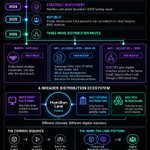
It repeatedly pairs product launches with distribution relationships and, in some cases, strategic investments in the platforms carrying those products.
This distribution pattern first became visible in October 2022, when Hamilton Lane and Securitize announced tokenized feeder funds for qualified U.S. investors.
Fast forward to May 2024, and Hamilton Lane deepened that relationship by participating in Securitize’s $47 million strategic funding round.
The next major expansion came in March 2025, when Hamilton Lane launched its Private Infrastructure Fund on Republic and opened access to non-accredited U.S. retail investors with a $500 minimum.
Republic gave Hamilton Lane a distribution channel for reaching non-accredited U.S. retail investors, a segment it had not previously served directly.
That distribution-first strategy has accelerated in 2026, as Hamilton Lane deepens existing platform relationships while adding new institutional and blockchain distribution channels.
In March, Hamilton Lane made an undisclosed strategic investment in Republic, just one year after partnering with the platform.
Two months later, it partnered with Allfunds Blockchain and Apex Group to launch a tokenized share class of its Global Private Assets fund.
For this partnership, BBVA Asset Management also came in as the first investor and initial exclusive distributor for institutional portfolios.
That same month, Securitize launched “HLSCOPE” on TRON, which made it the fifth blockchain through which eligible investors could access Hamilton Lane’s Senior Credit Opportunities Fund.
While some of the firm’s partnerships in 2026 do not involve ownership, they all share a distribution-first logic.
Hamilton Lane is using investment platforms, institutional distributors, and multiple blockchains to place its products closer to distinct investor channels.
Instead of launching products and looking for demand afterward, the firm keeps pairing its funds with channels that can help distribute them.
Unfortunately, many RWA teams do the opposite. They build the product first and only start looking for distribution partners once it is ready to be released.
When that happens, even a strong tokenized product can struggle to grow beyond the audience it launched with.
The key lesson here for smaller RWA teams is to design distribution alongside the product, instead of waiting until after launch to find eligible investors.


Joshua O. retweeted
Many tokenized-stock products give their holders exposure to a share’s price without actually making them shareholders of the underlying company.
This gap between economic exposure and legal ownership is well known, and several stakeholders have treated it as an acceptable trade-off for the speed and global access provided by tokenization.
To close this gap, Nasdaq announced plans for a new equity-token design that would give public companies more control over their tokenized shares…
And it also revealed a partnership with Payward (Kraken’s parent company) to help connect the design with the xStocks ecosystem.
On September 10th, Nasdaq Ventures agreed to invest $100 million in Payward, in a deal that Bloomberg reported would value Payward at $21 billion.
The investment deepens their work on Nasdaq Equity Tokens (NETs), which the companies expect to launch in the second quarter of 2027.
Nasdaq says NETs are designed to properly represent securities and preserve the same ownership rights as the equivalent traditional shares…
Including any voting rights attached to those shares, rather than merely tracking their price.
Kraken is expected to distribute NETs through the xStocks ecosystem, while Nasdaq and Payward jointly develop the trading, settlement, and distribution functions.
The legal structure behind NETs makes Nasdaq’s approach different, since it will connect tokens to the official ownership record and preserve the rights of the corresponding shares.
NETs haven’t gone LIVE yet, and the Q2 2027 launch date is still on the table, so the final distribution and voting mechanics will need to be checked against the actual product documents.
I will closely observe whether NET holders can receive the same company notices and proxy statements as traditional shareholders…
And whether they can also exercise the same voting and corporate-action rights through legally recognized systems.
These factors will determine if the tokens actually preserve shareholder rights, rather than just claiming to.
If you are currently holding tokenized equities or you have plans to, how much do these shareholder rights matter to you, or is price exposure enough?

Joshua O. retweeted
When retail investors buy U.S. stocks through a brokerage app, their ownership rights are recorded across a multi-layered recordkeeping system that remains largely invisible to them.
At the issuer level, a transfer agent maintains the official register of shareholders, while the Depository Trust Company (DTC) records the positions held by its participating firms.
However, for most investors holding U.S. stocks through brokerage accounts, their names do not appear on the issuer’s register as the owners.
Instead, Cede & Co. is identified as the registered owner of securities held through DTC, while brokers record their customers’ entitlements to the shares.
Beyond maintaining issuer registers, transfer agents may also process share transfers, distribute dividends, and replace lost certificates.
As of June 2026, there were an estimated 327 registered transfer agents, with 272 under the SEC's oversight.
Interestingly, most of the rules governing these agents have not been updated since the late 1970s, but that may change soon.
On September 1st, 2026, the U.S. SEC proposed a broad update to its transfer-agent regulatory framework, which includes revisions to Forms TA-1 and TA-2.
These proposed changes matter for tokenization because they would require transfer agents to provide more detail about the tokenized securities they service.
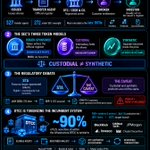
The U.S. SEC currently separates tokenized securities into issuer-sponsored and third-party-sponsored models, with the latter further divided into custodial and synthetic structures.
The issuer-sponsored model integrates the token into the issuer’s official ownership register, which is the structure Securitize supports for BlackRock’s BUIDL.
Within the third-party-sponsored model, a custodial token can represent a security entitlement in shares held by an intermediary, while a synthetic token provides exposure through a separate instrument without giving its holder rights in the referenced security.
In July, the Securities Transfer Association (STA) urged the SEC to favor issuer-sponsored tokens in a letter arguing that both custodial and synthetic third-party products can weaken shareholder rights and introduce counterparty risks.
While the investor-protection concern is valid, the letter overstates its case by treating custodial entitlements and purely synthetic tokens as one category.
The position of the STA aligns with the industry’s commercial interests since issuer-sponsored tokenization keeps transfer agents within the official ownership infrastructure.
The distinction raised by the STA appears in the proposed Form TA-2, which would require transfer agents to report tokenized issues separately under issuer-sponsored and third-party-sponsored models.
Although there is a notable overlap here, it doesn't necessarily prove that the STA’s lobbying shaped the proposal.
Despite this debate, institutional momentum has been building around tokenization, and the major players are backing different legal structures.
The Depository Trust & Clearing Corporation (DTCC) is one of such players. It sits at the center of U.S. post-trade infrastructure, and safeguards assets that account for roughly 90% of all U.S. securities.
Its upcoming tokenization service was developed in collaboration with a network that had grown to more than 100 members and partners by July.
On July 15th, 2026, DTCC processed transactions in a production environment using tokenized versions of securities held at DTC.
More than 30 firms participated, including BlackRock, Goldman Sachs, JPMorgan, Invesco, and Citadel Securities, with DTCC targeting October 2026 for the service’s launch.
The initial service is deliberately limited to Russell 1000 securities, bonds & notes, U.S. Treasury bills, and ETFs tracking major indices.
Its tokens can move only through registered wallets on DTC-supported blockchains that meet its technical and compliance standards.
This modernizes the incumbent infrastructure while preserving DTC’s control over eligible assets, registered wallets, supported networks, and transaction reversibility.
However, this tightly controlled model can still create new risks once it starts operating at scale.
An IMF Financial Counsellor recently warned that around-the-clock settlement and automated collateral calls could make liquidity demands continuous and allow failures or market stress to spread faster than institutions or supervisors can respond.
I predict that the models preserving clearly defined ownership rights will gain more traction than purely synthetic products over the next two to three years.
If you currently hold tokenized securities, do you know whether you own the issuer’s security, a custodial entitlement backed by it, or a separate instrument that only tracks its value?
Many tokenized-stock products give their holders exposure to a share’s price without actually making them shareholders of the underlying company.
This gap between economic exposure and legal ownership is well known, and several stakeholders have treated it as an acceptable trade-off for the speed and global access provided by tokenization.
To close this gap, Nasdaq announced plans for a new equity-token design that would give public companies more control over their tokenized shares…
And it also revealed a partnership with Payward (Kraken’s parent company) to help connect the design with the xStocks ecosystem.
On September 10th, Nasdaq Ventures agreed to invest $100 million in Payward, in a deal that Bloomberg reported would value Payward at $21 billion.
The investment deepens their work on Nasdaq Equity Tokens (NETs), which the companies expect to launch in the second quarter of 2027.
Nasdaq says NETs are designed to properly represent securities and preserve the same ownership rights as the equivalent traditional shares…
Including any voting rights attached to those shares, rather than merely tracking their price.
Kraken is expected to distribute NETs through the xStocks ecosystem, while Nasdaq and Payward jointly develop the trading, settlement, and distribution functions.
The legal structure behind NETs makes Nasdaq’s approach different, since it will connect tokens to the official ownership record and preserve the rights of the corresponding shares.
NETs haven’t gone LIVE yet, and the Q2 2027 launch date is still on the table, so the final distribution and voting mechanics will need to be checked against the actual product documents.
I will closely observe whether NET holders can receive the same company notices and proxy statements as traditional shareholders…
And whether they can also exercise the same voting and corporate-action rights through legally recognized systems.
These factors will determine if the tokens actually preserve shareholder rights, rather than just claiming to.
If you are currently holding tokenized equities or you have plans to, how much do these shareholder rights matter to you, or is price exposure enough?
Joshua O. retweeted
Crypto natives often view the institutional adoption of a crypto project as a form of validation for both the protocol and its token.
However, Centrifuge's recent governance proposal (CP172) argues that institutional growth has turned its CFG token into a constraint on future partnerships and fundraising.
CP172, which was first published on August 17th, proposed allowing eligible CFG token holders to subscribe for one share of Centrifuge Inc. stock for each CFG token surrendered.
Eligible holders with at least 100,000 CFG would enter the shareholder register directly, while those below 100,000 would participate through a trust structure that Centrifuge intends to develop with CoinList.
Centrifuge’s stated reason is that the token structure has become a constraint on the partners it can work with and the capital it can raise...
Which is quite surprising, because it presented CFG as its sole value-accrual mechanism and said it had no equity business less than a year ago.
Since then, Centrifuge has added significant institutional momentum, with Coinbase designating it a preferred tokenization infrastructure platform and also making a strategic investment.
Ethena also selected it as a strategic tokenization partner, and New York Life Investment Management partnered with it on a tokenized U.S. high-yield bond strategy.
CP172 now argues that this progress has exposed a new constraint, with the public-token structure limiting the partners and capital Centrifuge can pursue.
I don’t think this represents a complete retreat from onchain finance...
Rather, I view it as a proposed change in the instrument through which economic ownership would be represented.
This is because Centrifuge’s institutional traction came from its infrastructure, legal structures, operating performance, and partnerships, not from the CFG token alone.
If the public-token structure can be shown to materially block strategic investment and partnerships, it may be reasonable to replace CFG tokens with equity.
However, CP172 does not establish that it is the only logical path, and Centrifuge’s own FAQ acknowledges that a dual token-and-equity structure remains possible.
After its 14-day comment period, which closed on September 1st, CP172 moved to a Snapshot vote that opened on September 3rd and is scheduled to close on September 10th at 12:00 p.m. ET.
Even if the vote passes, implementation will still depend on board approval and the completion of the legal restructuring, so I am treating this as a live proposal, not a settled outcome.
Moving forward, the RWA community needs to ask this question:
"Can the institutional adoption of a protocol cause the token that built its early community to become a constraint on its next stage of growth?"
Joshua O. retweeted
Fasset is a stablecoin-powered neobank building payment rails primarily across Asia, Africa, and the Middle East.
In 2026 alone, it has raised $119 million across two funding rounds while focusing on markets where access to financial services remains limited.
Fasset announced the $68 million Series C round on August 24th, with Japan’s SBI Group leading the round at a $1 billion valuation.
This raise followed a $51 million Series B round in May, in which SBI participated alongside Investcorp, Arz Portföy, and a host of other investors.
Between the May and August announcements, Fasset said its network expanded from roughly 50 to over 100 banking corridors…
While its annualized transaction volume rose from around $32 billion to more than $40 billion.
Those company-reported figures suggest that the financing coincided with operational expansion, although they do not establish what drove the valuation exactly.
What matters more than the headline number is how SBI plans to extend the relationship beyond the capital deployed.
SBI says it plans to acquire further interests so that Fasset becomes an equity-method affiliate of the group.
The two companies also plan to jointly operate a digital bank in Malaysia and distribute Fasset-issued tokens.
In addition, SBI Remit, a group subsidiary already partnering with Fasset, supports remittances to bank accounts, wallets, and cash pickup points across more than 200 countries through its network.
The same capital-plus-distribution pattern also played out in BlackRock’s investment into Securitize and Hamilton Lane’s investment into Republic.
BlackRock led Securitize’s $47 million round, and the investment brought the BlackRock executive Joseph Chalom onto Securitize’s board.
On the other hand, Hamilton Lane invested in Republic after using its platform to distribute the Hamilton Lane Private Infrastructure Fund to retail investors.
Compared to these deals, the Fasset-SBI relationship is distinct in how it combines a planned expansion of SBI’s ownership with a jointly operated digital bank and token-distribution plan.
However, none of this makes the arrangement risk-free.
If SBI completes the planned additional acquisitions and Fasset becomes an equity-method affiliate…
The closer ownership and accounting relationship could give SBI significant influence over Fasset’s direction.
For the RWA founders building products for markets outside the U.S. and Europe…
Fasset’s 2026 fundraising shows that an emerging-market-focused company can attract more than $100 million in institutional and strategic capital in a single year.
The more important lesson I think founders should take from this deal is that fundraising can be structured to pursue operating and distribution advantages alongside capital.
Founders can also negotiate for concrete commercial commitments, such as joint market entry or access to an investor’s distribution network…
But those advantages can only materialize if the plans are eventually executed.
Joshua O. retweeted
Securitize has become the first securities-focused tokenization platform with publicly available financials, and its first earnings report as a listed company showed that revenue fell 5 percent YoY to $14 million, while GAAP net loss increased from $6.1 million to $12.7 million.
The market interpreted this report as a sign that the platform is struggling, and investors reacted quickly by sending its stock price down to around $6.26 on the day, which was roughly a 20 percent decline.
I think this interpretation misses the bigger picture because it treats a single quarter’s earnings of a newly listed company as a verdict, when it should be viewed as the first public data point that other tokenization platforms have never had to produce.
A better interpretation would sit somewhere in between the company’s growth metrics and its income statement.
Tokenized assets under management (AUM) reached a record $4.3 billion in Q2 (up by 16 percent YoY) and aggregate transaction volume climbed 147 percent to $5.3 billion. Yet, revenue still slipped, and adjusted EBITDA swung from a $1.8 million profit one year ago to a $5.5 million loss.
The platform’s Q1 revenue was also a record $19.5 million, and Q2 came in at $14.4 million, which is a 26 percent decline quarter-over-quarter, even though first-half revenue was still up 16 percent to a record $33.9 million.
Securitize management says tokenization revenue is uneven because it depends heavily on protocol integrations, new issuances, and third-party launch schedules, so one soft quarter is insufficient to establish a sustained business decline.
What makes this matter bigger than Securitize is that many private RWA platforms heavily emphasize AUM, TVL, transaction volume, and partnerships, even though those metrics do not reveal how much revenue or profit the platform captures.
A private company can promote those numbers indefinitely, while a public one has to reconcile them against revenue every ninety days, and Securitize just showed the market what that reconciliation looks like when AUM is climbing but the top line isn’t.
The company has lowered its full year 2026 revenue outlook to $70-80 million from an earlier expectation of approximately $85 million, which still implies over 20 percent annual growth, so the initial stock-price reaction is the market repricing the timing of that growth, rather than writing it off.
For allocators and builders watching the space, this is the clearest public-market test of the “securities-focused tokenization business model” ever and I find it to be more insightful than any TVL milestone.
None of this diminishes the product, since Securitize remains the largest platform by tokenized AUM and the only one above $4 billion. It is only a reminder that “scale in tokenized assets” and a “working revenue model” are not the same achievements.
When you evaluate an RWA platform, how much weight do you give AUM and transaction volume versus revenue quality, recurring fees, and margins?

Joshua O. retweeted
Every crypto cycle so far has been led by assets with good stories and no cash flow behind them, which is why the money always leaves the moment sentiment reverses.
However, I think the next bull run will finally break this pattern since it will most likely be led by real-world assets.
The value of distributed RWA has climbed from around $5.4 billion in January 2025 to roughly $37 billion by July 2026 even as Bitcoin traded well below its late-2025 highs and speculative capital was drained out from the rest of the market.
This is growth moving in the opposite direction of the cycle, and the reason comes down to what the capital is actually seeking.
Money sitting in tokenized treasuries and private credit is there for real yield backed by off-chain cash flow, not for price momentum, so it behaves nothing like the money that chases a narrative and flees at the first drawdown.
The rails that were missing in earlier cycles finally arrived in 2026, with BlackRock, Franklin Templeton, and more than fifty firms in the DTCC's tokenized settlement pilot building the infrastructure that lets institutions hold these assets at scale rather than test them.
In my view, this is what changes the nature of the next market expansion, since a cycle led by underwritten assets carries a floor that a purely speculative cycle never had, and institutions pulled in by real yield are far slower to leave when the mood turns.
I also want to be clear about the part of this argument that might get twisted, since a growing RWA market is not a valid reason to buy RWA governance tokens.
This is because six of the seven top RWA project tokens fell by roughly 45 to nearly 99 percent from early 2025 to early 2026, even as the underlying market grew several times over.
My prediction is that the next bull run will be carried by the real-yield narrative that will pull institutional capital on-chain and keep it there, not by the speculative wrappers built on top of it, and that distinction is my entire argument.
