

all in on memecoins // prediction markets // ex Bet365
@Joying_eth
Joined September 2008
- Tweets254K
- Following464
- Followers49.9K
- Likes5.8K


Joying.eth retweeted

$44.82 in, $11,643.21 out by morning on a six-agent desk I never wrote a line of code for.
I loaded the Grok Bot terminal last night, dropped $44.82 into it and stopped asking the AI what to trade.
Woke up to $11,643.21. Six agents logged every single fill.
For the past year I kept going back to agents for picks, rereading the same chat threads over and over.
Last weekend I wired up a full trading system on Grok Bot. No hand-written code, ready to run on deploy.
Six agents on one control panel, each with a clear job:
1. Scanner hunts fresh pairs, flags volume spikes.
2. Rug check filters high-risk coins before any order fires.
3. Sizer scales position size with the live balance, never a fixed ticket.
4. Executor opens and closes every position, tracks slippage in real time.
5. Logger writes the reasoning behind each trade into the log.
6. Equity curve refreshes the second a position closes.
Funded the account with $44.82 before bed. Laptop stayed on the dashboard all night.
Opened it in the morning. $11,643.21.
Every order had its reasoning attached, all saved in the log.
That part surprised me more than the balance did.
I stopped agonising over whether to enter. Now I just read the fill log.
Starting balance: $44.82
Current balance: $11,643.21
The whole terminal, the agent stack and the dashboard were built inside Grok Bot.
One deploy and the system runs on its own.


15 official commands baked into Claude Code, every one in the docs
15 tools to get more from Opus 5.5:
less manual work → parallel agents → faster shipping
all 15 with their docs page:
01 /goal → keep pushing toward a set target
code.claude.com/docs/en/goal
02 /batch → break large changes into parallel agents
code.claude.com/docs/en/agen…
03 /subtask → hand off work while keeping full context
code.claude.com/docs/en/sub-…
04 /deep-research → pull research backed by cited sources
code.claude.com/docs/en/work…
05 /design → build artboards for mockups and layouts
code.claude.com/docs/en/comm…
06 /plan → lock in the plan before touching code
code.claude.com/docs/en/perm…
07 /memory → manage session instructions and notes
code.claude.com/docs/en/memo…
08 /compact → squeeze context down to key decisions
code.claude.com/docs/en/cont…
09 /branch → open a side conversation without losing yours
code.claude.com/docs/en/comm…
10 /rewind → roll back to a saved checkpoint
code.claude.com/docs/en/chec…
11 /mcp → wire up and manage external tools
code.claude.com/docs/en/mcp
12 /loop → repeat checks while the session runs
code.claude.com/docs/en/sche…
13 /schedule → automate recurring tasks from the cloud
code.claude.com/docs/en/rout…
14 /simplify → clean code through parallel review agents
code.claude.com/docs/en/comm…
15 /remote-control → pick up your terminal session on the phone
code.claude.com/docs/en/remo…
begin with /plan → then /goal → then /simplify
save this

Joying.eth retweeted

$105 in, $3,657 out in 12 hours. I should have left this off.
I handed Grok 5 GitHub repos and a GMGN wallet. It trades better than I ever have.
152 trades. 62 winners from 76 closed positions. 34.8x.
-6% is the one number that matters. A hard stop locked on every trade.
Worst trade: ZELDA, -$12.
Best trade: LEEROY, +$345.
That spread is the entire edge. 5 years of trading showed me most blown months trace back to one loss you refuse to close.
This bot carries no ego.
It scanned 1,840 launches and filtered out every token with an unrevoked mint or a dev stacking 12%. Every wallet runs through scoring before any SOL leaves. Fill time: 34ms.
Every entry logs a reason. One buy fired because gmgnAgent was tailing a smart wallet. Another from gmgn-market catching a top gainer. 912 agent actions total. Not a single revenge trade.
7 hours in, the balance sat at $703. Then compounding kicked in. $2,605 by 21:15, $3,657 an hour after.
Built on:
GMGN Skills: github.com/GMGNAI/gmgn-skill…
PumpGrok: github.com/JohnDoeNull/PumpA…
GMGN Trading Bot: github.com/tr4m0ryp/GMGN_Tra…
gmgnAgent: github.com/0xilbiscione/gmgn…
Kaiser.Charon: github.com/kaiserern/Kaiser.…
Every repo free. Barely anyone runs the full set.


Joying.eth retweeted

TypeSafe AI just stripped agent stacks down to one frontier call
A 26-year-old in Berlin clears $3,200 a month wiring Jev and Claude into one harness.
Jev is a judgment model from TypeSafe AI that takes program state and returns typed decisions. No free-form text, no reasoning.
Five gates wrap every agent step:
1. score files, keep 3 of 22
2. pick model tier: cheap, mid, frontier
3. write and run code
4. keep or drop the output
5. halt if the action is destructive
Only gate 3 calls Claude. The rest are judgment calls at p50 44 ms, p95 61 ms.
Jev scores the files, picks the tier and gates every output. Claude writes the code, runs it, passes tests.
Confidence drops below 0.7 and Claude takes over. It rechecks whether the task is done.
Splitting judgment from reasoning drops four of five calls off the frontier tier.
That split used to cost a team. Now it costs one config.


Straight up deranged, someone packed a whole finance back office into 10 repos
QuickBooks bills from $38 to $340 a month. These 10 repos cover the same pipeline.
orchestrate. track. bill. sign. books. archive.
01 n8n → Trigger every back-office step, from timesheets to the final receipt
github.com/n8n-io/n8n
02 Kimai → Track billable hours per client, API and custom fields built in
github.com/kimai/kimai
03 Invoice Ninja → Send invoices and take payments, MCP feature just landed
github.com/invoiceninja/invo…
04 Lago → Meter AI usage and bill by the call, agentic SDK with sub-5 ms overhead
github.com/getlago/lago
05 DocuSeal → Collect e-signatures on contracts, 12 field types across 14 languages
github.com/docusealco/docuse…
06 Akaunting → Run small-business books online without a monthly accounting seat
github.com/akaunting/akaunti…
07 ERPNext → Keep accounts, stock and orders in one open-source ERP
github.com/frappe/erpnext
08 Actual → Budget locally and sync across devices, hosts for about $1.50 a month
github.com/actualbudget/actu…
09 Firefly III → Import and categorize every transaction with rules and API
github.com/firefly-iii/firef…
10 Papra → Archive receipts and signed contracts in one document vault
github.com/papra-hq/papra
orchestrate → track → bill → sign → book → archive
Three of the ten are source-available, not open source. Check each license before you deploy.
Which stage still costs you the most every month?

Joying.eth retweeted

Most dangerous filter a memecoin bot can carry.
I wired a seven-gate checklist and fed it 50 launches. 41 orders died before signing.
1. Authority. Both mint and freeze read null, or the order never fires.
2. Sell simulation. Dry-runs the full exit before a dollar moves. Revert means honeypot.
3. Liquidity. LP burned or locked 30+ days, order capped at 2% of pool.
4. Holder concentration. Top-10 wallets over 30% after stripping pool and burn kills it.
5. Creator history. Two rugs from the deployer in ten launches, coin rejected.
6. Price impact. Chase over 15% or impact above 3% at the moment of signing.
7. Freshness. Any gate older than 10 seconds stops the entire chain.
One fail kills the trade. No overrides.
50 in → 41 refused → 9 through. Score-only wallet: down 34%. Gate wallet: up 9%.
The 6x runner got blocked at one gate. That is what 41 refusals cost.


Joying.eth retweeted
holy sh*t. one memory field feeds ChatGPT, Claude and Codex. re-explaining is dead.
3,948 memories in a single field. ChatGPT, Claude and Codex all pull from the same store.
1. Nine signals feed one field
2. Clusters link every memory
3. Three models read same pool
4. One bad entry hits all three
5. No wall between any layer
Telegram, GitHub, files, CRM, sales calls, email all pour straight in. The blast radius is not one wrong answer. It is every agent hallucinating off the same poisoned entry.
Adding another pipe takes minutes. Adding a permission layer between them takes the rest of the quarter.
The cluster map drifts and every thread tightens around its node ↓

MOST PEOPLE STILL CLICK CRYPTO TRADES BY HAND WHEN A GROK BOT CAN RUN A WHOLE DESK 24/7.
You don't have to build any of it from zero.
10 GitHub repos that wire up a fully automated crypto trading system:
01 Cryptofeed → Pull live trades, pricing and order book feeds from exchanges so the system catches every market move.
github.com/bmoscon/cryptofee…
02 CCXT → Plug into dozens of exchanges with one unified API. Pull market data, read balances, route orders.
github.com/ccxt/ccxt
03 Freqtrade → Design, backtest and launch crypto strategies with dry-run testing, position tracking and a built-in control panel.
github.com/freqtrade/freqtra…
04 VectorBT → Throw thousands of entry-exit setups at historical data. Rank returns, trade counts and drawdowns.
github.com/polakowo/vectorbt
05 TA-Lib → Compute RSI, MACD, moving averages and other indicators. Convert raw price data into ready signals.
github.com/TA-Lib/ta-lib-pyt…
06 skfolio → Tune portfolio weights with built-in limits on transaction costs, turnover and exposure.
github.com/skfolio/skfolio
07 QuantStats → Produce tearsheet reports with drawdown curves, win rate, volatility and benchmark comparisons.
github.com/ranaroussi/quants…
08 DuckDB → Log every market snapshot, signal and trade record. Investigate any session down to the tick.
github.com/duckdb/duckdb
09 APScheduler → Automate data refreshes, balance checks and scheduled reports. No need to keep pinging an AI agent.
github.com/agronholm/apsched…
10 TradingView Lightweight Charts → Spin up a lightweight trading dashboard showing live prices, indicator overlays and trade markers.
github.com/tradingview/light…
Tie it together with Python, APIs or MCP.
Grok Bot orchestrates. Your code controls execution and risk.
Always backtest. Always dry-run. Never hand an AI full control over real capital.
Market feeds → signals → order execution → automated reporting.
Assemble the whole AI trading desk from open-source parts.
HE PICKED UP A LEVITATING POOL OF WATER FROM A DIRT ROAD AND OFFERED IT TO A GOAT
400k views. 72k likes. 950 comments. 12 seconds.
fisheye POV walking down a dusty dirt road, a floating disk of water suspended in the air. he reaches out, plunges his hand through the liquid surface, scoops up water, and holds it out. a curious goat walks right up, dips its head into the floating pool, and drinks
why it works:
→ the camera angle mimics a natural first-person walk: low, fisheye lens, shifting perspective, and a dusty boot stepping at the bottom of the frame
→ surreal physics made to look mundane. the way the water ripples, distorts the sun, and splashes feels completely tangible against the dry, barren landscape
→ flat midday lighting with no artificial fill. the harsh sun catching the edges of the floating water disc makes the impossible look like raw phone footage
→ the sequence unfolds naturally: discovering the anomaly, interacting with the liquid, and sharing the moment with the animal. the absurdity arrives effortlessly, never forced
→ one hand, one road, one surreal mechanic. almost nothing to keep consistent
the takeaway: realism comes from what you leave in. tactile physical interactions and natural camera imperfections do more than any high-end render setting
single-event surreal shots like this are what Seedance 2.5 does best, and you can run it inside
I TOLD GROK BOT:
“Create the most insane viral AI vehicle stunt video that could make me my first $500.”
I expected something stupid.
I definitely didn’t expect this.
It gave me a scene where a futuristic supercar literally launches off a ramp on the Golden Gate Bridge, plunges straight into the water, activates vertical jet thrusters, flies back up, and lands smoothly on the road.
It looks weird and interesting enough to make you stop scrolling.
And that’s basically the whole strategy:
> make the first frame impossible to ignore
> use one idea people understand instantly
> keep the environment realistic
> make something progressively weirder happen
> end before people get bored
The funny part is that you don’t need some huge cinematic story.
You need one visual idea that makes someone think “WTF am I watching?” and keeps them there for another 5 seconds.
Grok handled the concept.
AI handled the scene ↓
picsart.go.link/31F4Z
I just turned the insanity into a video people would actually stop for.
One weird prompt. One 45-second clip.
Now I want to see how far I can push it toward that first $500.
Joying.eth retweeted
Absolute f*cking gold
One of the strongest setups sitting in Anthropic's Claude Code docs since April.
The play: stack Sonnet, Haiku and Opus 5.5 in a single session, each model pinned to what it does best.
Opus-tier reasoning on every high-stakes call, zero Opus spend on the routine turns.
One line to launch it:
claude --model sonnet --advisor opus
the split:
→ Sonnet 5.5 drives the session and handles all code
→ Haiku 5.5 scouts files and docs in parallel
→ Opus 5.5 waits on standby as advisor for the big decisions
→ no more burning Opus tokens on work that never needed them
Add one rule to CLAUDE.md and Opus steps in at three points:
→ before locking a plan
→ when the same error fires twice
→ before marking a task done
Sonnet codes. Haiku reads. Opus decides.
JEV works the same way one layer deeper: lightweight forks like file picks, tool calls and retries go through JEV in milliseconds, and only the choices that matter reach the big models
the full tree:
> Sonnet 5.5 on the main session, writing and editing code
> search crawls the codebase on Haiku 5.5
> grep tracks down call sites on Haiku 5.5
> docs grabs the API reference on Haiku 5.5
> Opus 5.5 as advisor, absorbs the full transcript when called
> JEV picks up micro-forks in milliseconds
Worth keeping on hand.
Joying.eth retweeted
Pure insanity. for 20 years you searched other people's thinking, karpathy drops one concept, 5 minutes of wiring gives you a search engine that only finds your own notes, and you never once built it
andrej karpathy got 16M views on one post: spend more of your LLM budget building a second brain than writing code
every article you read, every podcast you caught, every meeting you sat through, every dm thread you kept, every tweet you drafted. all searchable in one query, forever
the ones already on it stopped opening chatgpt. they go to their own search bar now. that bar carries 11 years of their own thinking
the stack:
→ brew install obsidian, mkdir ~/vault, cd ~/vault
→ open claude code in that folder, init CLAUDE.md as the rulebook, /raw for sources, /wiki for your pages
→ drop any file into /raw. transcript, pdf, screenshot, meeting notes. one word: ingest
→ claude writes a wiki page, links it to 5 existing ones, updates CLAUDE.md with every new pattern it catches in how you think
→ no blank chats anymore. every question runs through the vault. every answer pulls from your own sources with dates and links
5 minutes to set up. runs forever on the laptop sitting in front of you right now
the alpha most skip:
> query your vault in one line and the answer pulls 5 of your own past notes with dates. google returns strangers. your vault returns you
> every ingest cross-links to 5 past pages on its own. after 90 days the vault answers questions you forgot you ever asked
> CLAUDE.md learns how you reason, what you flip on, what you dodge. by month 3 it drafts posts in your voice better than you manage at 2am
> flip two flags and the whole thing runs on local llama. zero API cost, zero vendor lock, your thinking never leaves the machine
> compounds over 10 years. by year 3 your vault knows more about what you believe than you do. by year 5 recruiters ask to see parts of it
the part most will scroll right past:
a coworker wired this on a saturday in february
by august his posts landed 4x the engagement on the exact same topics
by october his first draft of any doc was already stronger than your third
the gap is one 5 minute install and 90 days of feeding in what you already consume for free
bookmark this
I CAN'T SLEEP, MY GROK BOTS PASSED ON A 7X AND A SPACEX COIN THAT RUGGED 92%, BUT STILL FLIPPED $22,418 INTO $48,506 IN ONE NIGHT
the day before i pulled out $40,000. people called it luck, so i left my bots with $22,418
this time i ran them on a Bloomberg terminal clone, the $32,000 a year Wall Street screen
Jev, the bot that picks the coin, went with startupSI. its fees fund an AI that builds a startup in public
before midnight the coin hit 4x, then 7x. my bots bought neither
my spider's night:
→ 11:45pm grabbed the calm after the rockets, +$2,073
→ 1:15am in $5.28M, out $6.47M, +$5,153
→ 2:45am one red ticket, -$1,237
→ 3:30am a coin named after SpaceX, Tesla and Boring goes live at $171K
→ 4:05am $994K, nearly 6x in 40 minutes, pool 43 minutes old, my bots pass
→ 5:10am one candle sends it to $84K
→ 5:20am bought the floor, $4.58M
→ 6:20am sold $6.72M, +$12,323
→ 7:50am last trade, +$7,244
4 wins, 1 loss. the coin moved +46% from the pick, my bots pulled 2.16x
my spider watches one screen the entire night, fomo. it spotted the SpaceX coin 8 minutes after launch. same screen, 10% off fees
the 2 rules behind it:
→ never enter a coin mid-rocket, wait for the calm after
→ any pool under an hour old is a skip
honestly i'd have jumped on the SpaceX one at 4am myself. my Grok bot desk had to say no for me
which one would you have gone for, the 7x or the SpaceX coin?
Claude Code just set up my smart agents for post analysis and information filtering...
1 prompt + 10 min = total control: 10x faster post analysis, zero info noise, instant filtering and that's just the beginning
here's full guide step by step:
step 1 → open your terminal and connect Claude Code to your workspace directory
step 2 → paste the prompt below along with your data sources and target feeds
step 3 → spin up your multi-agent cluster with a single command — Claude handles the routing and parsing
step 4 → hit "authorize" on the API access — it's the last time you touch anything manually
step 5 → say yes to the smart setup: no content noise, deep post analysis, instant filtering — all fully customizable
step 6 → deploy custom tracking and monitoring straight from GitHub — no clunky third-party tools needed
the result: now any chaotic feed is instantly filtered and structured for your work...
p.s: works on any system setup. Mine in the video runs locally on a Mac
Try it now


Joying.eth retweeted
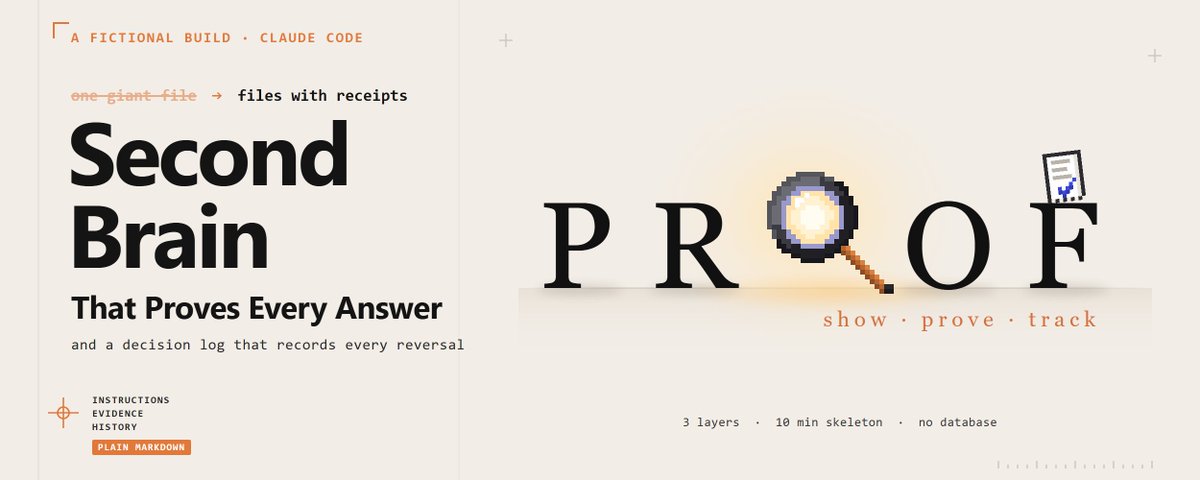
Claude Code just replaced every knowledge tool with 9 Markdown files.
3 layers, zero services.
1. 9 entries. 4 files, 4 folders, one skills directory. Plain Markdown.
2. CLAUDE.md holds my 6 answer rules and 4 edit rules in about 16 lines.
3. 8 percent of the 200-line ceiling. One import pulls HOME.md at launch, 4 hops deep.
4. notes/ keeps one idea per file. sources/ keeps one proof per outside claim.
5. No source file means no trust.
6. decisions.md logs every reversal I make. Old calls stay superseded, never deleted.
7. The agent reads the log and stops recommending what I already dropped.
8. The review Skill runs only when I call it. Never on its own.
9. No database. No vector store. No API. Obsidian sits on top without changing a file.
10. Auto memory lives outside the folder and ranks lower than my reviewed files.
Watch all three layers fold into one locked grid
NIGHT. I AM LOSING MY MIND, A QUANTUM COIN DROPPED 55% WHILE I WAS OUT AND JEV AND MY GROK BOTS CAUGHT THE BOTTOM, MY $100 NOW AT $60,472
nine nights ago i gave my bots $100. the number to hit is $100,000
tonight they cleared 60% of the way
the coin:
QUBIT, one day old, address supposedly pulled from an IBM quantum machine, $327K by 10pm
everyone bought the science angle
my crawler skipped the narrative. scanned the chart and replies instead
its catches that night:
• a silk tornado pulling in 214 bot replies
• a fishing line that hooked an $84K whale buy
• an x-ray lens that spotted a dev stashing 38% in a separate coin
• a net stretched across 11 bots mirroring my trades
• a lasso stripping $2.1M of wash volume off the book
i figured the quantum angle was the entire story
wrong. it began at 11:35pm, coin sitting 55% below the open with no bids
→ 11:35pm bought $146K
→ 12:20am sold $373K, +$5,209 on one trade
→ 1:20am a floor broke, -$692
→ 2:20am $188K to $270K, +$1,596
→ 4:50am $191K to $269K, +$1,384
anyone holding from 10pm lost 27%
my bots pulled 15.3% on the same coin, the same night
i will take a flat 15% over a quantum hype story every single night
$100 → $2,197 → $23,879 → $60,472
$39,527 to $100K, about 4 more nights at this pace
one move stays with me. the crawler hooks a whale and my bots flip the top a second later
❗️Insane
One Grok Bot did this in 48 hours flat.
$50 → $5,875
I opened the walkthrough the moment I saw it.
I wanted the full picture: how it scans, what triggers an entry, and what keeps it from running after every blip.
The screenshot grabs you. The process shows whether anything behind it is worth testing.
Starting balance: $50.
Reported ending balance: $5,875.
Time: 2 days.
A single run is never proof. But I'd rather pull the workflow apart now than let it collect dust in my bookmarks.
Study the rules. Test on paper before putting real money behind it.
Holy sh*t. Cities have been digging up streets blind for decades, smashing cables with excavators and wasting billions on emergency repairs because utility companies still run on last-century blueprints...
But everything is shifting now. I hooked up a local geodetic model and RTK tracking straight to a smartphone to scan underground utilities in real-time right through the camera.
Right under the asphalt in real-time, you can see everything:
1. power cables -> exact position
2. hidden pipes -> depth down to the centimeter
3. underground voids -> in AR mode
4. GPS error -> fixed via RTK Fixed
Now this thing highlights the utility grid right under your feet in real time, eliminating any surprises during excavation.
Remember, urban infrastructure was built on paper maps from fifty years ago. Your roads deserve precision.
The real race in tech right now is integrating digital twins of the physical world into augmented reality. Massive databases surprise no one anymore, so software now needs to see straight through walls and asphalt.
So check yourself, it takes only a few minutes. Full step-by-step below, save this.

F*ck YES... I made an AI vision & gesture-control web app with Claude Code without a single line of manual code
the shift: Claude Code + vision-tracking libraries turn bare-hand gestures into a real-time interactive 3D particle physics engine in minutes
here’s 3 step guide:
step 1 → fire up your terminal and launch Claude Code with your project workspace.
step 2 → drop your gesture reference spec or UI wireframe into the chat and tell it to build the vision pipeline + Three.js particle system (it starts writing the full component repo).
step 3 → run the local server, test the hand tracking against your webcam, and tweak behavior with Claude Code by saying something like:
"The hand pinch and open gestures look sick, but let's make the particle explosion smoother and add custom neon color gradients when tracking multiple fingers!"
the result: you can build complex, interactive vision-controlled web apps instantly...
Paste it now. Then read article below to master AI-driven development:
A developer spent 3 months coding a custom terminal because he was tired of staring at 10 different trading tabs and missing every major market move.
10 minutes later, a complete visual edge.
Then he packed his laptop, disconnected from high-speed internet, and went to work from a local café with zero distractions. On his screen: a live automated pipeline streaming real-time liquidity, structural order blocks, and multi-asset price action into a single unified grid. One glance. The whole market mapped out instantly.
Somewhere in the middle of a busy day, zero noise, he pulled up a custom risk scanner. It filtered out 95% of market garbage, tracked smart wallets entering early, and mapped out exact entry zones across dozens of assets without lagging.
Executed the orders right from the terminal. Green numbers rolling in before lunch. Real edge built from a clean setup with zero bloat.
Then he scaled the system.
The terminal now tracks every order flow shift as it happens, filters out market noise, calculates risk ratios, and plots real-time price action automatically. Zero clutter, zero missed setups, nobody else sees his custom algorithms.
Month one -> steady profits from a streamlined system.
Month six -> it runs his entire trading workflow on autopilot.
Most people still use generic charts and stare at standard indicators all day.
A custom trading terminal gives you speed, cuts out the noise, and prints money before the crowd even wakes up and almost nobody has built one yet.
