

Co-founder and Chief Scientist @lanyon_ai. Closing the gap between the intelligent sand's output and production science. Orange cat dad+Taekwondo coach. He/Him
Princeton, NJ
Joined December 2009
- Tweets3K
- Following902
- Followers728
- Likes2.3K





If you're going to be at the @apsdpp annual meeting in Chicago next week (or the sister Gaseous Electronics Conference happening concurrently in the same venue!), stop by our booth for demoes, talks, and a contest for coolest simulation with the pre-release version of Lanyon!

At @lanyon_ai, we’re completing Hilbert’s (other) dream.
From November 1st, we’re rolling out pre-release versions of Lanyon to early customers and testers, and will be hosting simultaneous public demos of Lanyon capabilities in San Francisco and Chicago.
From moon bases to modular reactors to atomic-scale programmable matter, we're on a mission to make the abstract concrete, to make the digital physical, and to formally verify reality. Join us!


One of the things I wanted to emphasize in this study is just how seamless Lanyon makes these kinds of analyses. Fusion is a complex problem. One whose history is filled with new challenges in each generation as we assembled a variety of different ways to bottle a star. But with Lanyon we can simulate these systems reliably with code and proofs generated by Lanyon's symbolic layer, with all the flexibility in post-processing of the data provided by Lanyon's neural layer. It's positively addictive to be able to interact and iterate with Lanyon on these problems.
I am already excitedly working on the next part of this series and other physics deep dives. Looking forward to showing y'all everything Lanyon can do as our domain specific language gains more vocabulary and grammar, and the neural layer gets smarter and smarter for responding to precise queries to evaluate the results of our formally verified simulations.

Why is fusion hard? In the first in our series of “physics deep dives”, Chief Scientist @JunoRavin shows how Lanyon can be used to autonomously rediscover and analyze some of the fundamental physics difficulties underlying magnetic confinement fusion: the sausage instability that killed the Z-pinch device, and the interchange/flute instabilities that continue to plague magnetic mirror devices.
This deep dive shows the true power of Lanyon’s neurosymbolic architecture for applied physics research, combining formally verified 3D MHD simulations produced by Lanyon’s symbolic layer, with highly flexible AI-driven physics analyses enabled by Lanyon’s neural layer.
Stay tuned for further additions to this series, where we will dive deeper into field-reversed configurations, tokamaks, stellarators, and all of the new physics difficulties that emerge at these new ranges of timescales. Post below 👇

I strongly agree with this perspective. Ultimately we are moving into an era where we are going to make rapid progress on numerous fronts, and what we will need to do as scientists is distill that progress into something intelligible. In fact, I want to distill this progress!
There is enormous creativity to leverage from these systems we have built. Experiments which would have taken weeks or months accessible in an hour in an afternoon. The real tension is that we must not lose our own ability to express and distill that creativity; we must not let our own communication skills atrophy under the instant gratification of letting a large language model distill its own ideas (sometimes inaccurately, or with important context missing).
I don't think this is true: it will just select for a very particular kind of mathematician: the G. H. Hardy.
If you read C. P. Snow's foreword to the Apology, it becomes clear that Hardy's most substantive mathematical contributions came about from taking the highly creative and technically impressive (but otherwise utterly inexplicable) accomplishments of Littlewood and Ramanujan, and figuring out how to explain, interpret, and communicate them in a manner that was simultaneously rigorous, precise, and beautiful.
It's ironic given his derogatory comments about mathematical exposition in the Apology, but Hardy's real skill lay in the beauty and clarity of his prose and his explanation. He was always the one who wrote up the final manuscript for publication, but he was almost never the one who provided the underlying results or ideas. (Again, Snow's foreword makes clear that the Apology is, amongst other things, a work of immense self-hatred.)
In a world where Littlewoods and Ramanujans are commodified, be a Hardy.
Jimmy Juno retweeted

Last night was the first night I genuinely couldn't sleep because I was so excited to get back to reading an AI-generated proof (of the Grothendieck homotopy hypothesis).
Hard not to feel shellshocked, of course, but the feeling of "touching the infinite" is pretty palpable.

We’re releasing a broad range of new mathematical results produced by an internal frontier model.
We’ve been consulting with the independent Advisory Group on Mathematics and Artificial Intelligence at the Institute for Advanced Study, and we have drawn on their advice and public recommendations to inform how we release these results.
github.com/openai/math

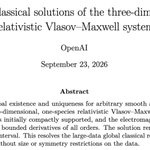
Many people are going to be talking about results like Hilbert's 10th problem or the quasi-Riemann hypothesis, but this is the result that hits the closest from OpenAI's release. Every time someone would ask me "why do discontinuous Galerkin methods work so well for kinetic problems when we struggle in fluid dynamics?" I would joke that if I could prove that the solutions to Vlasov always stay smooth (no phase space shocks) I would win a Fields Medal, but all I can say is that I never see shocks in our simulations.
And well.. guess my joke needs to change now that the agents have indeed proved what I always observed empirically.

So proud to be working with @getjonwithit here at @lanyon_ai on the grand challenge of a physics compiler. Every day is a dizzying array of excitement as we combine just how far the neural part has come with our own deep knowledge of the symbolic part.

Math has a proof checker. Can physics get one? Jonathan Gorard @getjonwithit, an applied mathematician and the cofounder and CEO of Lanyon AI, joins to explain why AI took off in math and coding but not yet in physics. We discuss an AI finishing the formal check of a Fields Medal proof and why it scared him, why he thinks “I detected a particle” rests on 20 to 50 levels of theory, and what Alan Turing’s PhD student Robin Gandy tried to build for physics. The conversation also covers his push to make physics executable, why he thinks mysteries are artifacts of description languages, and whether there is still a place for the physicist.
youtu.be/oQypVVv1u1o
Jimmy Juno retweeted
Always a great pleasure to chat with my friend @TOEwithCurt. Over the course of 2+ hours, we discuss the Hilbert-Gandy program, existential worries, the limitations of language and cognition, how to connect AI to the physical world, and why we left Princeton to build @lanyon_ai.
Math has a proof checker. Can physics get one? Jonathan Gorard @getjonwithit, an applied mathematician and the cofounder and CEO of Lanyon AI, joins to explain why AI took off in math and coding but not yet in physics. We discuss an AI finishing the formal check of a Fields Medal proof and why it scared him, why he thinks “I detected a particle” rests on 20 to 50 levels of theory, and what Alan Turing’s PhD student Robin Gandy tried to build for physics. The conversation also covers his push to make physics executable, why he thinks mysteries are artifacts of description languages, and whether there is still a place for the physicist.
youtu.be/oQypVVv1u1o
Jimmy Juno retweeted

Our CEO @getjonwithit was recently interviewed by the excellent @TOEwithCurt podcast about Lanyon's mission to complete the Hilbert-Gandy program of mechanizing scientific reasoning, and what it means for the future of AI, science, research, curiosity, and everything else.
Math has a proof checker. Can physics get one? Jonathan Gorard @getjonwithit, an applied mathematician and the cofounder and CEO of Lanyon AI, joins to explain why AI took off in math and coding but not yet in physics. We discuss an AI finishing the formal check of a Fields Medal proof and why it scared him, why he thinks “I detected a particle” rests on 20 to 50 levels of theory, and what Alan Turing’s PhD student Robin Gandy tried to build for physics. The conversation also covers his push to make physics executable, why he thinks mysteries are artifacts of description languages, and whether there is still a place for the physicist.
youtu.be/oQypVVv1u1o
The equation systems we can produce verified numerical models for are getting pretty sophisticated over here. And when you have these continuum mechanics models for everything from elastoplastics to rarefied gases, well.. that's a lot of physics right there!
Using Lanyon to autonomously discover and verify new models and algorithms for continuum mechanics.
Simulating high-energy impact of a copper projectile on an elastoplastic plate, plus the resulting damage profile. The discovered model matches the experimental value for the effective plastic strain to within 5%.
Model discovery, formal verification, software implementation, and numerical simulation all completed in less than 5 minutes, from a single prompt.

Listening to this, this morning and really excited for everyone else to hear @getjonwithit talk about what we're build here at @lanyon_ai
The dream of a physics compiler is in reach and it's a whirlwind of excitement every day over here.
Math has a proof checker. Can physics get one? Physicist Jonathan Gorard @getjonwithit, cofounder of the Wolfram Physics Project and now CEO of Lanyon AI, thinks so: “We want to make physics executable in the same way that software is executable and that now increasingly mathematics is executable.” He also says, “I’m in a continual process of grief.” What does it mean to grieve a way of doing physics? And is there still a place for the physicist?

Jimmy Juno retweeted
Very proud to be sponsoring this fantastic event, and we’ll be providing early access to the @lanyon_ai API and CLI (plus unlimited compute) to all participants.
Should be great fun - see you there!

We’re organizing Vibecheck, a formal methods hackathon with some of the best folks in the space - @maxvonhippel, @qd_forall, @nolanlwin, @jessemhan, @emiyazono, and @workersio.
You’ll get a weekend to build real production software, and formally verify it.
We’ll have people who really know their stuff around to help, and you can come with a team, find one there, or just hack on something yourself.
We are glad to have a phenomenal group of sponsors, including @harmonicmath, @mathematics_inc, @theoremlabs, @thegp, @omnicom, @primeintellect, @astriolabs, @buildwithparty, @wearerandomlabs, and @lanyon_ai, as well as some more we will announce in the coming days!
If you’re a hacker, a formal methods person, or just someone who thinks “how do we know it works?” is an interesting question, we’d love to have you.
Signup Now: fmxai.org/vibecheck/
Jimmy Juno retweeted
It’s our pleasure to welcome Andrew "Tasman" Powis to the Lanyon AI team as Founding Member of Technical Staff, specializing in AI model development and advanced numerical algorithms.
Tasman joins us from the Princeton Plasma Physics Laboratory and brings deep expertise in artificial intelligence, algorithm design, and high-performance computing, with a particular interest in kinetic simulations, spacecraft propulsion and semiconductor manufacturing. Welcome Tasman!

Jimmy Juno retweeted
It’s our pleasure to welcome Aanya Bhandari to the Lanyon AI team as a Research Fellow, specializing in frontier model architecture and training.
Aanya joins us following a research fellowship at Princeton University working with our CEO Jonathan Gorard on formal verification for transformer and recurrent neural network architectures. She brings expertise in frontier AI architectures, financial technology, and quantum computing. Welcome Aanya!

Jimmy Juno retweeted

Navier-Stokes Millennium saga continues. Here are my slides and a summary from a recent talk. Disclaimer: this is a physicists view of the problem & solution! 🧵

Jimmy Juno retweeted
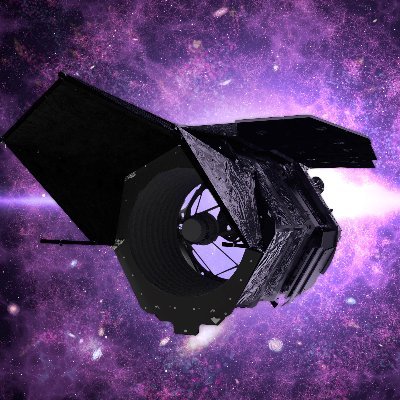
Achievement unlocked!
Reward: More years of fuel!
We have completed Roman's first course correction so accurately that it conserved years of fuel for the mission!
Learn more: go.nasa.gov/46qdvRj
Jimmy Juno retweeted

I am very excited to work with Chris and @getjonwithit on building a type system for all of the physical universe!
It’s our pleasure to welcome Chris Rugenstein to the Lanyon AI team as Founding Member of Technical Staff, specializing in type systems and formal verification.
Chris joins us from the Institute for Defense Analyses and the Department of Energy, and brings deep expertise in pure mathematics, theoretical computer science, and formal methods for type theory. Welcome Chris!


Jimmy Juno retweeted
It’s our pleasure to welcome Chris Rugenstein to the Lanyon AI team as Founding Member of Technical Staff, specializing in type systems and formal verification.
Chris joins us from the Institute for Defense Analyses and the Department of Energy, and brings deep expertise in pure mathematics, theoretical computer science, and formal methods for type theory. Welcome Chris!
