

Former BLK analyst. Perpetual learner. 0dte SPX expert. Sharing options flow, charts, & trades. Founder @nightglasstrade
San Francisco
Joined April 2025
- Tweets13K
- Following120
- Followers7.7K
- Likes7.7K




Pinned Tweet
When I first started trading off options flow, I never knew what to actually pay attention to.
Every platform showed me the same thing: thousands of trades, and I had no way to tell which ones were real bets.
Most traders who use flow run into the same wall. So I spent the last year building something that filters this out first, then tells you what to do with what's left.
Instead of 250k options flow alerts a day, Nightglass gives you 50-75.
Instead of guessing which alerts hold up, Nightglass grades every one in public.
Instead of guessing where to enter or exit, Nightglass gives you the trade plan.
Introducing Nightglass — it cuts the 98% of flow that's noise and shows you the 2% worth noticing.
It's available now.

Introducing Nightglass — the options flow platform built to filter out the noise and show you the 2% of trades worth noticing.
Hedge funds and institutions place bets through options every day, and their trades are public. You just have to know how to spot them.
The problem: 98% of options flow is noise. That's why we built Nightglass — it doesn't show you more flow, it shows you less. Then it gives you the plan to trade it.
-Institutional support and resistance levels on any US-listed stock
-Real-time flow alerts
-Pre-market report of the prior session's institutional positioning
-Live SPX gamma exposure levels
-Earnings setups with defined trade structures
-A morning brief before every open with key news, sell side research, top flows, and more.
Live today.
Can chase gold here or follow @nightglasstrade call out from last week....
Everyone is talking about $GLD and $SLV today. We saw this setting up a week ago.
How?
Our models flagged a bullish setup in gold a week ago.
We shared the call then—not after the move like everyone else on X.
Gold has climbed since, and previous metal miners are ripping.
That’s the point of our data and research: spot the setup before it becomes the conversation.
We're releasing access to our research later this week.
Look out for the announcement.
3
986
Well plaid sir
Breaking news: the person who leaked the NYT story about Jensen’s affair has been identified.
They just wanted a better entry on this MASSIVE $NVDA trade.

922
Cool tool for $SPX


4
859
Thank you for the free alpha my friend $AMPX

$AMPX — a fintwit darling that’s been all but forgotten.
Our flow filters have mostly ignored it, too. Until now.
After three quiet months, our models flagged unusual bullish activity that could point to renewed institutional interest:
→ Nov 13 $9 calls — bullish sweep $255k
→ Dec 18 $8 puts — bullish flow · $347K
Is $AMPX is officially back? We think so.


It’s happening.
First, chip stocks ripped the week following this post.
Now the longer term trend I called is starting to gain steam: money is pouring into ex-US stocks.

Two interesting themes emerging, one short-term and the other long-term (2027).
Short term: AI infrastructure is due for a meaningful bounce into month end. The bottom is probably in, at least through October 30.
The last two weeks have been confusing. Funds have been aggressive buying the AI dip, and the dip kept dipping. Sometimes they get it wrong. But a few things are lining up that make me think this time is different.
1. The flush last Thursday (15th) got bought, even though it wasn't the low. The volume that day was in the names that led the selloff: $CRWV traded its busiest day of the year, $WULF its 4th busiest, $WGMI, $NBIS and $IREN all more than double their normal volume, $SOXX almost double. They opened down hard and reversed, CRWV from down 9.5% to up 5.9%, MU from down 6% to up 2%, and the response was unusual bullish activity, very unique to @nightglasstrade.
81 bullish bets against 9 bearish, the busiest options day in our records. We've gone lower since, so that wasn't the bottom. But the behavior is what I'm watching.
2. Nightglass daily bullish flow picked up in the second half of the month. The first half wasn't that bullish. Since the 15th we're seeing about 49 bullish alerts a day versus 37 before, and the put buying in AI names, which was $73M the day before the top and $55M on the 14th, dried up to $3M and $6M on Monday and Tuesday. The hedgers are done.
3. Yesterday's flow looked different: shorter dated, further out of the money, more aggressive. $MU November $900 calls and $SNDK November $1,500 calls both bought by sweep, $CLS October 30 $290 calls, all new positions. Many more but these were just a few.
4. The floor. Last week we spotted a $94M put sale in $SMH five minutes before that day's low. $61M of it was cashing in puts they'd bought near the top, a $50M win on the hedge. The other $32M was brand new: 28,000 of the October 30 $530 puts sold. That trader makes money as long as SMH holds above roughly $518 into month end. Thursday's low was $520.53, and the position has only grown since. That's the likely floor.
5. Korea is getting the same type of flow. On Tuesday someone put on a synthetic long in $EWY: sold the June 2027 $160 puts and bought the June 2027 $160 calls, 500 lots, new position. That's a bet Korea is higher a year and a half from now, not a trade for the week.
Last Monday a 24,000-lot block of $EWY December $185 calls was bought at the ask on the tape, plus a December 180/210 call spread, and puts have been getting sold under the market all the way down, at 190, 160, 158, 156.
Then yesterday $KORU, the 3x Korea fund, printed its first alert since September: 2,000 December $11 calls bought by sweep, with another 4,758 March $15 calls behind it on the tape.
6. Technically looks like a low/support for the Kospi. It's pushing into key demand zones and the 21-month EMA right as that flow shows up. People don't really know why the 21-month EMA matters. Look at extension across timeframes, 1 minute, 10 minute, hourly, daily, weekly, monthly. The further out you go, the more you're looking at the long-term trend. Most stocks don't stay extended from their monthly EMAs for long. They break out above, then consolidate back into them. At the May high the Kospi was 98% above its 21-month EMA, the most stretched it's ever been. Today it touched it. Foreigners have dumped nearly 8 trillion won of Korean stocks this month, and the export data just printed chips up 222% to a record.
Bigger picture: something odd is happening in international flows. Which makes me cautious US equities medium term.
We're getting flows into Germany, Mexico, Korea (noisy, given the memory trade) and Brazil. Brazil is obviously the election. But Germany and Mexico? These are names we basically never see. $EWG had never triggered an alert on our filter before this month. $EWW, first time since June. $EFA printed its first bullish alert ever. And $KORU yesterday, which we last saw in September, and before that in April, right before the Kospi ran 28% in a month. Small tickets, but all bullish, and super unusual for @nightglasstrade to capture flow in these names, all in the last ten days.
Two things that could mean.
One, the dollar has potentially peaked and is coming down. It just failed at an 18-month high, and the Fed is one hike from done.
Two, and this is the one I find super interesting, US stocks are no longer going to be in favor come the midterms. I don't know if the midterms is actually the cutoff. But Democrats are about 90% to take the House, which changes the outcome of US politics, and therefore capital markets, regulation and the stock market. The question I keep coming back to: is investor appetite, medium to long term, through 2027, rotating into international and away from the US? In 2025 international beat the S&P by about 15 points. 2026 might have been the pause.
So that's the thesis. Near term, very bullish AI stocks, big bounce expected, bottom in at least through the end of the month. Then the midterm risk, and why investors are positioning so uniquely into international. Is it the start of a broader rotation through 2027? I think it might be.
2
1,294
It’s hilarious how many people are shocked by the cheating allegations against Jensen.
That’s probably the tamest thing anyone could uncover about him.
You don’t get to the top of a multitrillion-dollar company by being a saint. You get there by being ruthless, taking risks, and going after exactly what you want.
9
16
4,649

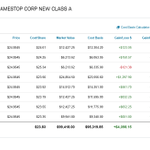
4,000 shares $GME ~$100,000
Wake me up in 20 years when this is $27,000,000

Growing up, I met a lot of older people who had made millions from a single stock they bought in the ’70s.
Berkshire Hathaway.
$1,000 invested at the end of 1970 would be worth roughly $21 million today.
But Warren Buffett didn’t found Berkshire.
It was an existing textile company. He started buying shares in 1962 and took control in 1965. He entered as an outsider—an investor—and eventually turned a struggling textile business into one of the world’s greatest conglomerates.
Everyone knows what Berkshire became.
The hard part was recognizing the opportunity while the story was still being written.
So is it possible to find the next Berkshire?
Yes, and I believe it’s hiding in plain sight.
How do you find it?
Start with the person. Look at their decisions, their track record, and what they do with their own money.
Buffett had vision.
He didn’t let Berkshire’s textile roots define its future. In 1967, Berkshire bought National Indemnity and its sister insurer for approximately $8.6 million, moving into insurance and laying the groundwork for a much bigger business.
He was thrifty.
He bought his Omaha house for $31,500 in 1958. Decades after becoming a billionaire, he was still living there. He understood the difference between having money and needing to spend it.
He had a track record.
Before he ever bought Berkshire, his investment partnerships were already delivering results. In 1960, they gained 22.8% before his profit allocation, while the Dow, including dividends, lost 6.3%.
He could make hard decisions.
At Dempster Mill, he brought in Harry Bottle, who cut inventory from more than $4 million to less than $1 million, freeing capital to invest elsewhere.
Buying the business was only the beginning. Improving how its money was used was the real work.
And he cared about ownership.
Buffett called out nine Sanborn Map directors who collectively owned just 46 shares while collecting board fees. His own investment group built a substantial stake and pushed for change.
He understood the difference between overseeing someone else’s money and having your own on the line.
Now, what if I told you the person I believe could become our generation’s Warren Buffett is right in front of us?
Someone who took on an online retail market that already included Amazon, selling something as unglamorous as pet food—and co-founded a business PetSmart bought for $3.35 billion.
Someone who understands cost discipline.
At the company he now runs, annual selling and administrative expenses fell nearly 20% in fiscal 2025, from $1.13 billion to $910.2 million.
Roughly $220 million cut in a year.
Someone with results beyond his first company.
That same year, the company went from a $26 million operating loss to a $232 million operating profit.
Read that again.
Sales declined, but operating profitability improved by more than $250 million.
Someone willing to make moves that sound outrageous.
In May 2026, GameStop proposed acquiring eBay for approximately $55.5 billion in cash and stock.
eBay rejected the offer. But making that bid tells you something about what Cohen wants this company to become. His ambition extends well beyond running a chain of video-game stores.
And most importantly, someone with ownership.
Like Buffett, Cohen didn’t found the company he now runs.
He came in as an outside shareholder. Built a substantial stake. Became chairman, then CEO. And started changing how the business was run.
And he’s still buying, owning 9% of the company. A stake higher than most other public CEOs.
Vision. Cost discipline. A track record. Hard decisions. Ownership.
Buffett didn’t found Berkshire. Cohen didn’t found GameStop. Both entered as outside investors before taking leadership roles.
One transformed what the business could become.
My bet is Ryan is about to do the same.
Long $GME


