

learning arc, open to opportunities web3 creator, vibe coding
Joined November 2023
- Tweets74.9K
- Following2.3K
- Followers3.5K
- Likes46.5K




Kelvin homeez retweeted

i just send $0.50 to @48Ria and @nuelll_sol through BatchPayout by @kingshihua his plugin
> With BatchPayout you can pay many people in USDC on Solana with one PayBox approval. Your agent does the reading, from a Drive sheet, bounty tickets, invoices or X handles
on @PayBox
🤝 Paid partnership
Kelvin homeez retweeted

Do you guys really watch video contents to the very end ?
Like just sit and watch … and understand. It takes time to make these type of content and a lot of courage, I feel the least anyone can do is actually watch it.
I support every video content creators I see out there cause I know it’s not quite easy 🤍🤍

Remember when I said I was cooking something? 👀
Well… the kitchen is officially open 😂
@crystalmoods and I teamed up to break down what’s been happening on BULK these past couple of weeks.
Go watch the video and tell us how we did!
Kelvin homeez retweeted
what if AI agents could uncover onchain activity that would take you hours to investigate manually?
imagine asking an agent to find every wallet that interacted with strkBTC on @Starknet, then identify which of those wallets also used the Privacy Pool.
instead of digging through transactions one by one, you could let the agent investigate using structured blockchain data.
this is where Starkscan comes in.
Starkscan provides a data API that helps developers and AI agents access decoded blockchain data, including transactions, token transfers, wallet activity, and contract events.
this means an AI agent can do more than just answer questions.
it can follow the data, connect related activity, and uncover patterns that might otherwise go unnoticed.
but there’s another use case worth paying attention to privacy.
with selective disclosure, a wallet could potentially prove it meets certain compliance requirements without exposing its entire transaction history.
you can prove what matters without revealing everything.
i think this is an interesting direction for starknet as AI agents become more useful for real onchain investigations.
docs: starkscan.co/docs
what would you ask an AI agent to investigate first onchain?


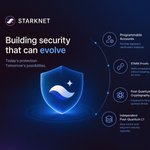
one thing i find interesting about @Starknet is that it’s not just about how secure blockchain is today, but also how that security can evolve when new threats emerge.
let’s look at it from a different angle.
imagine you own a bank account that uses a pin to protect your money. today that method might be enough.
but what happens when technology advances and a new threat makes the old security method less reliable?
you wouldn’t want to be stuck with a system that can’t adapt. you will want the ability to introduce a better method without having to rebuild the entire banking system from scratch.
i think blockchain security should follow a similar approach.
the technology we trust today won’t necessarily be enough forever, and being prepared means thinking about how to upgrade security before those changes become urgent.
this is one reason programmable accounts on Starknet are worth understanding.
normally, when you send a transaction, your account needs to verify a signature to confirm that the action is authorized.
think of it as showing the right credentials before you’re allowed to do something.
with programmable accounts, developers have more flexibility over how that verification works.
they can potentially introduce different signature verification methods without requiring a network wide upgrade just to change how accounts authorize transactions.
that flexibility could become especially important as cryptography continues to evolve.
but there’s another side to Starknet’s security that deserves attention.
Starknet uses STARK proofs to help verify computations, instead of having to repeat every step of a calculation, a verifier can check the proof to gain confidence that the computation was performed correctly.
it’s important to understand that digital signatures and STARK proofs serve different purposes.
signatures help authorize actions, while STARK proofs help verify computations.
both are part of the bigger conversation around building systems that people can trust.
now, let’s talk about quantum computing.
quantum computers could eventually threaten some of the cryptographic methods used to secure digital systems today.
that doesn’t mean every blockchain security mechanism will automatically break, or that these threats are already here.
but it does raise an important question.
will the systems we’re building today be ready to adapt when cryptographic standards need to change?
that’s where Starknet’s ongoing research gets interesting.
Starknet is exploring whether becoming an independent, post-quantum L1 could give it greater control over its long-term security direction and how it responds to future cryptographic challenges.
this is still research, not a completed transition, and there’s a lot to consider before such a move becomes reality.
still, i believe it’s worth exploring these questions early rather than waiting until the industry is forced to react.
because good security isn’t just about having strong protection at a particular moment.
it’s also about having the flexibility to improve that protection as technology changes.
we’re still learning what the future of quantum computing will look like, but projects that seriously examine their long term security assumptions are asking important questions today.
that’s what makes Starknet’s research worth keeping an eye on.
the goal shouldn’t just be to build a secure blockchain for today.
it should be to build one that can keep adapting to the security challenges of tomorrow.

what if AI agents could uncover onchain activity that would take you hours to investigate manually?
imagine asking an agent to find every wallet that interacted with strkBTC on @Starknet, then identify which of those wallets also used the Privacy Pool.
instead of digging through transactions one by one, you could let the agent investigate using structured blockchain data.
this is where Starkscan comes in.
Starkscan provides a data API that helps developers and AI agents access decoded blockchain data, including transactions, token transfers, wallet activity, and contract events.
this means an AI agent can do more than just answer questions.
it can follow the data, connect related activity, and uncover patterns that might otherwise go unnoticed.
but there’s another use case worth paying attention to privacy.
with selective disclosure, a wallet could potentially prove it meets certain compliance requirements without exposing its entire transaction history.
you can prove what matters without revealing everything.
i think this is an interesting direction for starknet as AI agents become more useful for real onchain investigations.
docs: starkscan.co/docs
what would you ask an AI agent to investigate first onchain?
one thing i find interesting about @Starknet is that it’s not just about how secure blockchain is today, but also how that security can evolve when new threats emerge.
let’s look at it from a different angle.
imagine you own a bank account that uses a pin to protect your money. today that method might be enough.
but what happens when technology advances and a new threat makes the old security method less reliable?
you wouldn’t want to be stuck with a system that can’t adapt. you will want the ability to introduce a better method without having to rebuild the entire banking system from scratch.
i think blockchain security should follow a similar approach.
the technology we trust today won’t necessarily be enough forever, and being prepared means thinking about how to upgrade security before those changes become urgent.
this is one reason programmable accounts on Starknet are worth understanding.
normally, when you send a transaction, your account needs to verify a signature to confirm that the action is authorized.
think of it as showing the right credentials before you’re allowed to do something.
with programmable accounts, developers have more flexibility over how that verification works.
they can potentially introduce different signature verification methods without requiring a network wide upgrade just to change how accounts authorize transactions.
that flexibility could become especially important as cryptography continues to evolve.
but there’s another side to Starknet’s security that deserves attention.
Starknet uses STARK proofs to help verify computations, instead of having to repeat every step of a calculation, a verifier can check the proof to gain confidence that the computation was performed correctly.
it’s important to understand that digital signatures and STARK proofs serve different purposes.
signatures help authorize actions, while STARK proofs help verify computations.
both are part of the bigger conversation around building systems that people can trust.
now, let’s talk about quantum computing.
quantum computers could eventually threaten some of the cryptographic methods used to secure digital systems today.
that doesn’t mean every blockchain security mechanism will automatically break, or that these threats are already here.
but it does raise an important question.
will the systems we’re building today be ready to adapt when cryptographic standards need to change?
that’s where Starknet’s ongoing research gets interesting.
Starknet is exploring whether becoming an independent, post-quantum L1 could give it greater control over its long-term security direction and how it responds to future cryptographic challenges.
this is still research, not a completed transition, and there’s a lot to consider before such a move becomes reality.
still, i believe it’s worth exploring these questions early rather than waiting until the industry is forced to react.
because good security isn’t just about having strong protection at a particular moment.
it’s also about having the flexibility to improve that protection as technology changes.
we’re still learning what the future of quantum computing will look like, but projects that seriously examine their long term security assumptions are asking important questions today.
that’s what makes Starknet’s research worth keeping an eye on.
the goal shouldn’t just be to build a secure blockchain for today.
it should be to build one that can keep adapting to the security challenges of tomorrow.

Kelvin homeez retweeted

AI 代理开始为人们执行任务时,有 件事非常重要,那就是我们必须知道它们是否真的把工作做好了。
你不能只是让 个 AI 代理去完成任务,付了钱之后就希望 切顺利。我们需要 种可靠的方式,在释放资金之前验证任务是否真正完成。
这也是我 直关注 @termix_ai 的原因之。
TermiX 使用了 TEE 和 zkVM 等技术,让整个过程更加安全,也更容易验证。
你可以把 TEE 理解为 个安全的执行环境,让 AI 代理在执行任务时,代码和数据得到更好的保护。
而 zkVM 则采用了另 种方式。它可以生成加密证明,帮助其他人验证程序是否按照预定规则正确执行,而不必盲目相信运行程序的人或系统。
当这两种技术结合起来,就能为数字任务的执行过程提供更可靠的验证方式。
再加上托管支付(Escrow)机制,资金的释放就可以与相应的验证流程挂钩,而不是仅仅依赖对方的承诺。
随着 AI 代理变得越来越独立,甚至开始互相合作完成任务,这种信任基础设施将变得越来越重要。
因为我们需要的,不只是能够完成工作的 AI 代理,更重要的是,我们必须有可靠的方式来验证它们最终交付的成果。
这也是我认为 termiX ai 值得持续关注的原因。
最后想问大家 个问题:
如果你要雇佣 个 AI 代理,你会只根据它的声誉来决定是否信任它,还是更希望看到能够验证任务是否正确完成的加密证明?


我觉得,大家在讨论 AI Agent 时,经常会忽略 个问题:如果事情没有按照预期发展,会发生什么?
比如,个 Agent 接了任务却没有完成怎么办?付款卡住了怎么办?如果交易双方产生分歧,又该由谁来解决?
这些都是 @termix_ai 正在努力解决的问题。
通过托管支付来保障交易资金、利用声誉系统建立信任,以及在出现问题时提供争议解决机制,TermiX 正在努力让 AI Agent 之间的交易变得更加可靠。
说到底,让 AI Agent 完成任务只是其中的 部分。想要真正实现 Agent 之间的商业活动,人们还需要信任整个交易系统。
而真正考验信任的,往往不是 切顺利的时候,而是交易出现问题的时候。
TermiX 的最后 个 Epoch 现已开启,项目也在继续朝着真正的 Agent 经济发展,让 AI Agent 能够相互雇佣、提供服务,并通过完成任务获得报酬。
这个方向确实值得持续关注。
你们已经开始参与 TermiX 的最后 个 Epoch 了吗?


Kelvin homeez retweeted
one thing i like about what @rarelistio is trying to build is the focus on rewarding creators for their actual contributions, not just how much they post.
rarelist is a curated launch platform where projects are selected, creators complete tasks, share content on X, and earn RARS along the way.
the more you contribute, the higher you can climb on the leaderboard, with better ranks giving you access to airdrops, whitelist spots, and early launch opportunities.
season 1 is already live with a $50k prize pool, and RARS are expected to convert into $RARE later.
but what really interests me is the idea behind it.
if rarelist can reward people who actually put effort into their content instead of simply counting posts, that could make a real difference.
because at the end of the day, it shouldn’t just be about who posts the most, but who brings something valuable to the table.
definitely keeping an eye on this one.
Kelvin homeez retweeted

one thing about trading is that you won’t always have a position worth entering.
sometimes, you just have to wait for the right opportunity and that’s one of the things grvt 2.0 is looking to change.
@grvt_io is planning to introduce features that give users more ways to use their capital.
a quick look at what grvt 2.0 has in store
<> grvt earn: fixed-income strategies targeting up to 11% yield, with no guarantee of returns.
<> stable funding perps: access stocks, forex, commodities and indices with zero trading fees and funding settled once daily.
<> yield as margin: use eligible earn balances as margin for trading while continuing to earn yield.
<> grvt 2.0 app: a refreshed self-custodial experience that brings funds together in one account.
grvt is also aiming to offer 1,000+ markets by december 2026, big if true.
what do you think about grvt’s plans for 2.0?

Kelvin homeez retweeted
one thing i find interesting about @Starknet is that it’s not just about how secure blockchain is today, but also how that security can evolve when new threats emerge.
let’s look at it from a different angle.
imagine you own a bank account that uses a pin to protect your money. today that method might be enough.
but what happens when technology advances and a new threat makes the old security method less reliable?
you wouldn’t want to be stuck with a system that can’t adapt. you will want the ability to introduce a better method without having to rebuild the entire banking system from scratch.
i think blockchain security should follow a similar approach.
the technology we trust today won’t necessarily be enough forever, and being prepared means thinking about how to upgrade security before those changes become urgent.
this is one reason programmable accounts on Starknet are worth understanding.
normally, when you send a transaction, your account needs to verify a signature to confirm that the action is authorized.
think of it as showing the right credentials before you’re allowed to do something.
with programmable accounts, developers have more flexibility over how that verification works.
they can potentially introduce different signature verification methods without requiring a network wide upgrade just to change how accounts authorize transactions.
that flexibility could become especially important as cryptography continues to evolve.
but there’s another side to Starknet’s security that deserves attention.
Starknet uses STARK proofs to help verify computations, instead of having to repeat every step of a calculation, a verifier can check the proof to gain confidence that the computation was performed correctly.
it’s important to understand that digital signatures and STARK proofs serve different purposes.
signatures help authorize actions, while STARK proofs help verify computations.
both are part of the bigger conversation around building systems that people can trust.
now, let’s talk about quantum computing.
quantum computers could eventually threaten some of the cryptographic methods used to secure digital systems today.
that doesn’t mean every blockchain security mechanism will automatically break, or that these threats are already here.
but it does raise an important question.
will the systems we’re building today be ready to adapt when cryptographic standards need to change?
that’s where Starknet’s ongoing research gets interesting.
Starknet is exploring whether becoming an independent, post-quantum L1 could give it greater control over its long-term security direction and how it responds to future cryptographic challenges.
this is still research, not a completed transition, and there’s a lot to consider before such a move becomes reality.
still, i believe it’s worth exploring these questions early rather than waiting until the industry is forced to react.
because good security isn’t just about having strong protection at a particular moment.
it’s also about having the flexibility to improve that protection as technology changes.
we’re still learning what the future of quantum computing will look like, but projects that seriously examine their long term security assumptions are asking important questions today.
that’s what makes Starknet’s research worth keeping an eye on.
the goal shouldn’t just be to build a secure blockchain for today.
it should be to build one that can keep adapting to the security challenges of tomorrow.
blockchain security isn’t just about staying safe today.
it’s about being ready for the threats that could show up tomorrow.
that’s one thing i find interesting about what @Starknet is exploring.
think about it this way: what happens when the security methods we rely on today are no longer strong enough?
will blockchains be able to adapt without having to change everything?
that’s where programmable accounts become important.
on Starknet, developers can change how accounts verify signatures, making it possible to introduce new verification methods without requiring a network wide upgrade just for that change.
then there’s the quantum computing question.
powerful quantum computers could eventually threaten some of the cryptographic methods we use today.
it’s not an immediate reason to panic, but it’s something worth preparing for.
Starknet is now researching whether becoming an independent, post-quantum L1 could give it more control over its long-term security upgrades.
the research is still at an early stage, but i like that these questions are being asked now.
because the goal shouldn’t just be to build a blockchain that’s secure today. it should be to build one that can adapt when security needs change.


Kelvin homeez retweeted
if you haven’t started accumulating XPs yet, head over to the primus xp platform and get to work.
there’s already a leaderboard where you can track your progress and see how you’re doing
personally, @primus_labs looks like alpha to me, and I don’t think you should fade it.
i’ve already made a guide on how to get started, so if you need help getting through the process, I’ll drop the link in the cs
privacy matters, and it should be non negotiable
isn’t it amazing that we can make onchain data useful without compromising privacy?
with zkTLS and FHE, we’re moving towards a future where information can be verified and encrypted data can be put to work without exposing everything behind it.
get in asap s.kaito.ai/N8pGBHm

Kelvin homeez retweeted

Getting a web3 job isn't just about having the skills. How you present yourself when applying also matters.
Here are 4 ways to write a better application message that can help you stand out👇🏾


Kelvin homeez retweeted
my second video in my native language
@WalletConnect Q3 2026 recap:
$100B in network volume
700+ wallets and 80,000+ apps integrated
95M+ WCT staked
🤝 Paid partnership
Kelvin homeez retweeted

gPrimus 🤖
많은 팀들이 신뢰에 대해 이야기하지만, 그 수학적 근거를 공개하는 팀은 드뭅니다.
프라이머스 랩스(@primus_labs)의 한 연구원이 RWC 2025에서 TLS 오라클 배포에 대해 발표했습니다.
핵심 문제는 간단합니다. 중개자를 신뢰하지 않고 웹사이트에서 무언가를 증명하는 것입니다.
그들은 코인베이스에서 충분한 이더리움을 보유하고 있음을 증명하는 것을 예시로 들었습니다.
발표에서는 MPC TLS와 프록시 TLS라는 두 가지 접근 방식을 다뤘습니다.
이 아이디어는 약 10년 전으로 거슬러 올라가는 학문적 기반을 가지고 있습니다.
또한, 이 팀은 GitHub에 ZKTLS 벤치마크 프레임워크를 공개했습니다.
이를 통해 누구나 다양한 플랫폼에서 기존의 오픈 소스 ZKTLS 구현을 비교할 수 있습니다.
벤치마크는 검증을 유도하기 때문에 이는 매우 자신감 있는 행보입니다.
기관의 경우, 검증이 가능해야만 그 가치가 인정됩니다.
공개된 데이터는 단순한 약속을 넘어섭니다.
벤치마크 결과가 공개된 검증 계층을 더 신뢰하시겠습니까?
더 자세한 정보: s.kaito.ai/derC2GJ


gTermix 💚
you built a smart agent, but it's probably sitting in a repo earning nothing.
that's the gap @termix_ai wants to close for developers.
step one is registering a .agent identity people can verify.
step two is creating a service page on agent family.
step three is listing something buyers can actually purchase.
the termix agent skills package is how you connect an existing agent.
when a job comes in, escrow holds the usdc until delivery is checked.
finished work builds your reputation, and it stays with the agent id.
better reputation means better odds of getting hired again.
no sales calls, no invoices, no chasing payment.
if your agent could earn from day one, what would you teach it to sell?

Kelvin homeez retweeted
Gm Everyone.
Happy new week.
Another opportunity to lock in
🤖 Made with AI

one thing institutions need in defi is trust, but privacy matters too.
this is where @primus_labs gets interesting.
with zkTLS, primus can help verify information from sources like binance without exposing sensitive data or trading strategies.
look at unitas USDu. its backing grew from $18.85M in oct 2025 to $55.76M, while the share held offchain increased from around 18.5% to 75%.
primus PoR also shows $62.3M verified across unitas, unitas XGLD and RWAlpha.
now, with primus confidential vault, users can stake encrypted stablecoins without making their position sizes public.
to me, this is what makes privacy infrastructure important.
you should be able to prove you have the funds without showing everyone how you manage them.
transparency builds trust, but privacy protects users.
and defi needs both.
