Technology and motorcycle enthusiast. Nature & photography lover. Long form thoughts on Substack.
Dallas, TX
Joined June 2007
- Tweets7.5K
- Following1.2K
- Followers890
- Likes356






PHP released fixes on October 21 for two critical flaws that can let an attacker with no login run code on a server. And the AI stories from the last week.

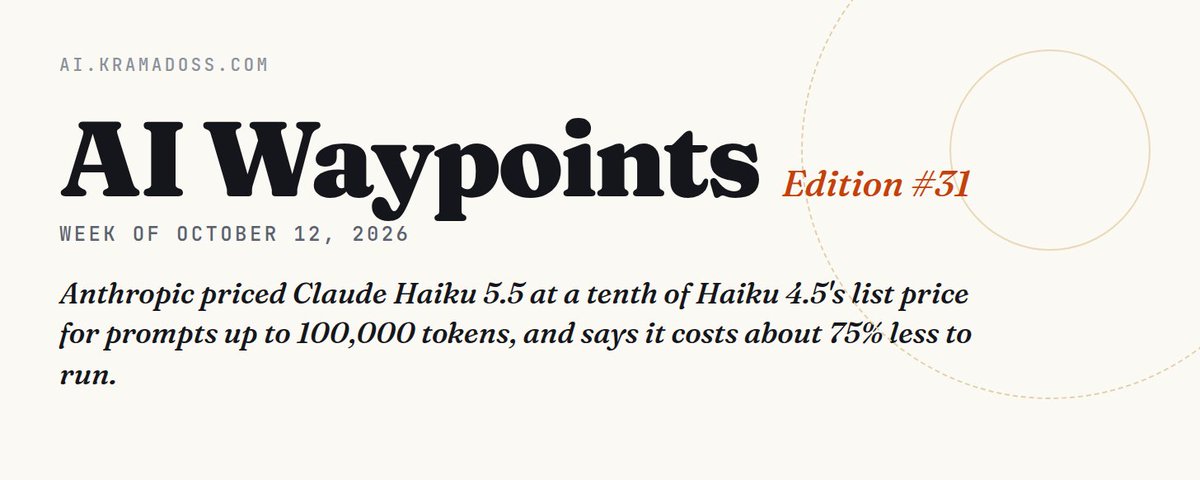
The largest computing confirmed in orbit today is about a kilowatt: one Nvidia H100 and four of Google’s TPU chips. Filings at the FCC, the US communications regulator, ask for up to a million satellites. Grab a coffee and lets dive in!

Are you worried about agent swarms and its potential token usage in your Enterprise? It might not be as bad as you image. Read on..
xitter.cf/KIntheHouse/status/211…

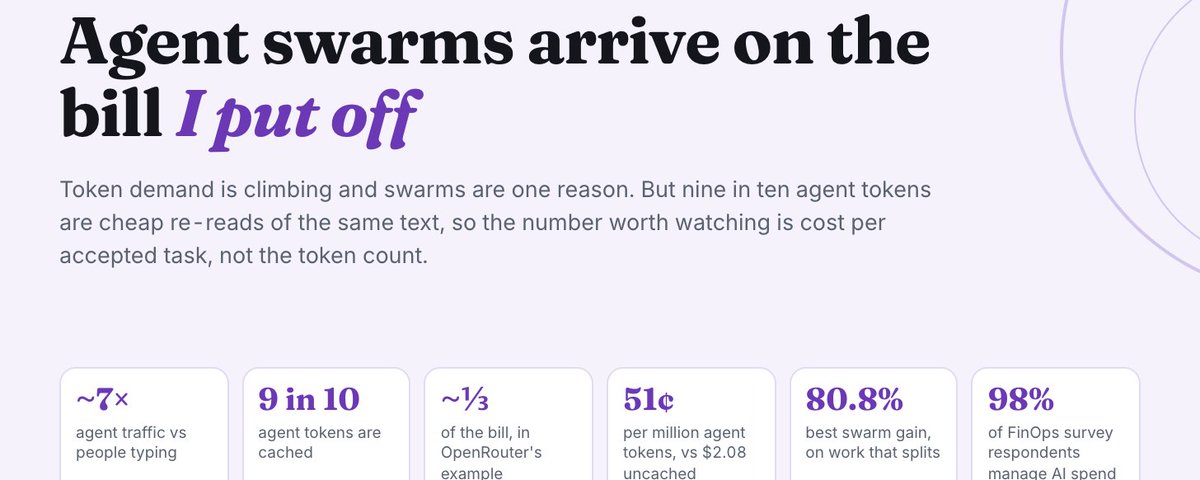
Token demand is climbing and swarms are one reason. But nine in ten agent tokens are cheap re-reads of the same text, so the number worth watching is cost per accepted task, not the token count.
Karthik Ramadoss retweeted

My new book, Co-Existence, is out today. It is a guide to how to live & work in a world where AI is sometimes, but not always, better than you.
(And, for the release, I worked with Opus 5.5 to make a quite interesting experience for the book's website: co-existence.ai/)

Whats new in AI for Enterprise Leaders this week
xitter.cf/KIntheHouse/status/211…
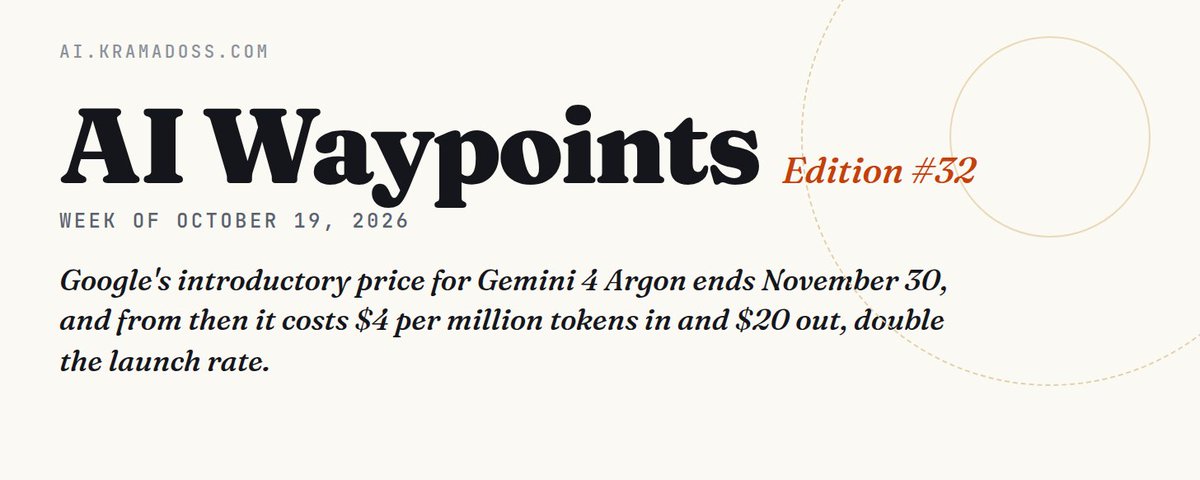
Anthropic priced Claude Haiku 5.5 at a tenth of Haiku 4.5's list price for prompts up to 100,000 tokens, and says it costs about 75% less to run.
Great update, Matt!

Hot off the press - @slashlast30days v3.28 - faster, smarter, and more honest. Last30Days - the world's #1 agentic search engine skill with ⭐64K stars.
Three days ago Grok Bot made X free. Now the engine got a big upgrade. NEW:
- Faster: identical searches now run once per run
- Ranking now trusts real engagement: a 380-point Show HN jumped from #29 to #3
- @ThePracticalDev: free, no key, turns on for any developer topic (thank you @iliaa)
- Grok Bot: the month's most-engaged on-topic X posts now make the report
- YouTube: thin results backfill from @ScrapeCreators, transcripts in English, Spanish and Portuguese (thank you @jeyhemnani9)
- Token usage reporting for Gemini, OpenAI, xAI and OpenRouter (thank you @iliaa)
- Security: a real SECURITY.md, HTTPS-only hosted API, private local files (thank you @iliaa)
FIXED:
- No more years-old YouTube videos padding your news reports
- Hacker News quotes link to the actual comment
- Pinned GitHub repos stop disappearing
- No more giant Sources list dumped at the end
- X search with "and" or "or" in the topic (thank you @clairernovotny)
- Windows X timeouts (thank you @iliaa)
30 commits from 7 people since the last release.
github.com/mvanhorn/last30da…

Karthik Ramadoss retweeted

Dusting off this tweet from April because this gap in shared understanding of LLM capability is *widening*. It's now less "two groups of people speaking past each other" and more a sharp funnel.
- Napkin math somewhere around 6B people (~75% of the population) have barely come in contact with LLMs at all.
- Around 1-2B (~20%) are casual and infrequent users of free-tier ChatGPT-like products. This group sees derpy chatbots and treats them a bit like a better Google search, a writing aid, or etc. Maybe an agent tries to book you a flight. I have non-tech friends who (reasonably, imo) say they have not much use for it at all. Even many professionals outside of math&code are in this tier. For example, execs and many other functions spend a lot of their time talking to other people, so while they understand what is happening intellectually, it is still second-hand and a bit abstract.
- Now we get to professional use of frontier-grade LLMs in math&code. Somewhere around 20M people (0.2%) see first-hand that large, complex projects that used to take them weeks/months can now be completed by agents with a prompt. Building apps, copying apps, translating apps, decompiling apps from binaries... This has all happened very quickly and recently - less than 1 year ago, I was writing code manually by hand, typing memorized computer code commands into a code editor character by character, occasionally pressing Tab to autocomplete a little chunk of code.
- And finally we get to the ~5,000 people (~0.00006%) with access to frontier-grade systems internally. The external world has seen the preview. It looks like swarms of thousands of agents collaborating over weeks on software mega projects: minting zero days, running cyber attacks and defenses at machine speeds, discovering new science, advancing the frontier of mathematics. Things that would have taken top professionals in the industry years of work. Meanwhile, human review and comprehension are starting to fall behind. For example, people are still involved in the "archeology" of the OpenAI-HF incident from many months ago. Mathematicians may be poring over the 722 manuscripts on frontier mathematics for a while.
The funnel is driven by a combination of factors:
1. The impact scales with ambition, problem size, and horizon. A question with a paragraph answer barely stresses the system. You need a reservoir of big, difficult problems that you really care about. This aspect drives the consumer / professional dimension of the funnel.
2. The jaggedness of the system (which I have written about a lot separately). Capability peaks in domains that are digital, verifiable and economically valuable. This is because LLM capability emerges from reinforcement learning on verifiable rewards on a curated environment mixture driven by revenue potential. This aspect primarily drives the area (e.g. math&code) dimension of the funnel.
3. Access. Free-tier, paid-tier, internal.
So this is the weirdness of the moment. The general public has mostly not interacted with these systems. When they have, it looks like a derpy chatbot. The majority of professionals still see only a modest uplift. And a small sliver of professionals are experiencing the vertigo of the curve going vertical. And it is all happening at the same time.

Judging by my tl there is a growing gap in understanding of AI capability.
The first issue I think is around recency and tier of use. I think a lot of people tried the free tier of ChatGPT somewhere last year and allowed it to inform their views on AI a little too much. This is a group of reactions laughing at various quirks of the models, hallucinations, etc. Yes I also saw the viral videos of OpenAI's Advanced Voice mode fumbling simple queries like "should I drive or walk to the carwash". The thing is that these free and old/deprecated models don't reflect the capability in the latest round of state of the art agentic models of this year, especially OpenAI Codex and Claude Code.
But that brings me to the second issue. Even if people paid $200/month to use the state of the art models, a lot of the capabilities are relatively "peaky" in highly technical areas. Typical queries around search, writing, advice, etc. are *not* the domain that has made the most noticeable and dramatic strides in capability. Partly, this is due to the technical details of reinforcement learning and its use of verifiable rewards. But partly, it's also because these use cases are not sufficiently prioritized by the companies in their hillclimbing because they don't lead to as much $$$ value. The goldmines are elsewhere, and the focus comes along.
So that brings me to the second group of people, who *both* 1) pay for and use the state of the art frontier agentic models (OpenAI Codex / Claude Code) and 2) do so professionally in technical domains like programming, math and research. This group of people is subject to the highest amount of "AI Psychosis" because the recent improvements in these domains as of this year have been nothing short of staggering. When you hand a computer terminal to one of these models, you can now watch them melt programming problems that you'd normally expect to take days/weeks of work. It's this second group of people that assigns a much greater gravity to the capabilities, their slope, and various cyber-related repercussions.
TLDR the people in these two groups are speaking past each other. It really is simultaneously the case that OpenAI's free and I think slightly orphaned (?) "Advanced Voice Mode" will fumble the dumbest questions in your Instagram's reels and *at the same time*, OpenAI's highest-tier and paid Codex model will go off for 1 hour to coherently restructure an entire code base, or find and exploit vulnerabilities in computer systems. This part really works and has made dramatic strides because 2 properties: 1) these domains offer explicit reward functions that are verifiable meaning they are easily amenable to reinforcement learning training (e.g. unit tests passed yes or no, in contrast to writing, which is much harder to explicitly judge), but also 2) they are a lot more valuable in b2b settings, meaning that the biggest fraction of the team is focused on improving them. So here we are.
Karthik Ramadoss retweeted
Microsoft's always-on agent reaches private preview with no price. The meter and admin controls around it already bill. Here's what to do now.

Microsoft's always-on agent reaches private preview with no price. The meter and admin controls around it already bill. Here's what to do now.
OpenAI released GPT-6 Sol and Luna on September 22 at half what GPT-5.6 cost at its promotional rate, with Sol at $2 per million tokens in and $10 out. Anthropic released Claude Opus 5.5 the same day at $4 and $20, 20% below Opus 5.
Full post ↗
Agree. Usage based billing is already an issue with the few agents that consume copilot credits. This could exacerbate the problem for enterprises.

Karthik Ramadoss retweeted
Microsoft seems to sell its own Claw now (I suspect they will not be the last), which may help spread personal agents in organizations
But using a router with mystery models behind it is a big problem. Routers underestimate work difficulty in many fields resulting in bad outputs


We’re building Copilot as a new OS for work that spans every model, every form factor, and every task. Today, we’re announcing our biggest update to Copilot to date, bringing four things together:
· Autopilot: proactive and long-running agent built for the enterprise
· Code: build apps with Copilot, hosted inside your company’s tenant
· Home: Chat + Cowork together
· Office: now fully embedded in Copilot (and Copilot embedded in Office, of course!)
Plus, you can invoke Copilot in Teams, and we’re introducing Today, a proactive experience that surfaces the most important information from across M365 without needing to ask for it.
The way we work is changing and so are our workflows. This update brings AI into that flow, from answering a question, to building an app, to getting work done on your behalf.
Karthik Ramadoss retweeted
Lifespan is how long you live. Healthspan is how many of those years you spend in good health. I’m interested in exploring the latter in this Science Sundays series.


Karthik Ramadoss retweeted

Too many AI personal assistants, too little time to assess all of them. Nice work here: assistantbenchmark.com