
Post-doc at UNC Chapel Hill - Vaccines & immunity to infectious disease
Chapel Hill, NC
Joined May 2021
- Tweets13
- Following104
- Followers24
- Likes11

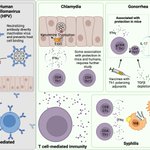
Excited to share our new publication in @JCI_insight! We used mass cytometry and machine learning to identify T cell signatures associated with resistance to Chlamydia trachomatis reinfection in women with high exposure.
insight.jci.org/articles/vie…
@natstann #Immunology #Chlamydia

Exciting progress in Chlamydia vaccine research! Intranasal immunization with CPAF & ADU-S100 shows promise in reducing infection duration and boosting immune responses in mice. @Els_Vaccine sciencedirect.com/science/ar…
2
2
152
Chlamydia trachomatis induces low-frequency, sustained CD4 T cell responses in most women, predominantly targeting chlamydial protease-like activity factor, CPAF @JIDJournal academic.oup.com/jid/article…

2
32
Kacy Yount retweeted

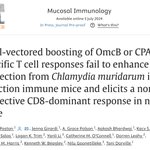
Chlamydia lacks a vaccine, and work here shows protection requires a strong CD4 T cell response:
mucosalimmunology.org/articl…

Our recent review "Immunity to Sexually Transmitted Bacterial Infections of the Female Genital Tract: Toward Effective Vaccines" @Vaccines_MDPI doi.org/10.3390/vaccines1208…

2
36

Kacy Yount retweeted

New Research: Systemic priming and intranasal booster with a BcfA-adjuvanted acellular pertussis vaccine generates CD4+ IL-17+ nasal tissue resident T cells and reduces B. pertussis nasal colonization: Introduction
Resurgence of pertussis,… #immunology frontiersin.org/articles/10.…
Kacy Yount retweeted

It’s Giving Tuesday or in UNC speak #TarHealTuesday. @UNC_Micro_Imm is raising funds to support travel of our trainees to scientific conferences. Hoping our successful alumni will lead the way by joining me in supporting this cause and by retweeting! give.communityfunded.com/o/u…
Kacy Yount retweeted

This hungry macrophage just macrophaging is amazing 👏🏻
#MedTwitter #biology
Kacy Yount retweeted

This new study constitutes a major methodological advance to the study of Chlamydia and furthers our understanding of the bacterial factors contributing to progression through the developmental cycle.
@IsabelleDerre
@@rclaytonbishop
@IsabelleCoppens
plos.io/3UfHLqP

Congratulations to @audra_fullen on her first first author manuscript!

This new paper from Fullen et al. provides new insights into how B. pertussis has evolved to survive in the mammalian respiratory tract.
Read the full article here: plos.io/3dPOpmR

3