

CPA | Associate at Orange Horizon Wealth, LLC, A division of Vista Investment Partners | Bitcoin is the hurdle rate.
Richmond, IN
Joined March 2018
- Tweets1.9K
- Following467
- Followers394
- Likes6.4K






Jonathan Kamps, CPA retweeted

I was in the right place at the right time, and lived the right life experiences to fully ingest the Saylor pill in 2024.
MicroStrategy buying Bitcoin in 2020 was an act of capital allocation, and a bold one at that. It will always seem more obvious as time goes on and as Bitcoin adoption continues to proliferate, but at the time it was a profound statement on the rational way to act during the age of fiat debasement.
But before capital is misallocated, human attention is misallocated, and that is the fundamental experience that allowed the Bitcoin/MSTR combo to hit me like a ton of philosophical bricks.
I was lucky enough to find Bitcoin during the prior decade, but I was even luckier when I worked in an unglamorous industry, where an almost unfathomable number of human hours and attention are spent to eek out additional basis points of profit.
A corporation might spend thousands upon thousands of employee hours reducing unit costs by 15 basis points, negotiating supplier contracts and optimizing labor schedules, improving inventory turnover, etc...
And in addition to that, a company will take out $40 million of debt to finance the build out a brick-and-mortar store in knife fight of a market, knowing it can take 10-15 years just to get the store to print a green quarterly P&L, let alone paying off the debt and ending up at breakeven before two decades pass by.
I worked 100-hour weeks and sacrificed all my freedom in my early 20's. My schedule changed whenever the business demanded it.
And it's funny because eventually I started noticing something peculiar. During the input process to acquire the cash flow, every penny gets scrutinized.
Then the output process. Scrutinized? Hardly.
The resulting profits accumulate on the balance sheet, and remarkably little intellectual labor goes to asking what that capital should own, how its purchasing power should be preserved, or even what risks the company is assuming by doing nothing.
I spent my adult life fighting the entropy of the debasement age in a business that optimizes the production of capital while totally neglecting the stewardship of capital after it's produced.
And then I heard about a man who was borrowing billions in fiat at near 0% rates to buy Bitcoin.
Arguing against the mispriced risks everywhere honestly isn't even necessarily a matter of criticizing an investment decision.
The real issue at hand is that there are entire industries with a total absence of a serious decision-making process.
Consider a hypothetical company with $100 million in treasury assets. A 1% annual difference in risk-adjusted returns represents $1 million. That's potentially more consequential than hundreds of operational improvements that receive orders of magnitude more of management attention.
There is an underlying economic principle that is blatantly ignored by many in this world, that attention itself is a scarce form of capital, and companies often fail to allocate enough of it to deciding how financial capital should be allocated.
This creates two layers of potential inefficiency, because first you have the opportunity cost of an inferior capital decision...
...but then you have the opportunity cost of never investing the time and labor required to discover a superior decision.
And that second cost is particularly insidious because it doesn't appear in accounting reports. Unfortunately, nobody books an expense for a capital allocation thesis that was never investigated.
There is too much intellectual horsepower devoted to microscopic operational decisions. Corporations will spend a million dollars figuring out how to save a penny, then spend virtually nothing figuring out what to do with the dollars they saved.
Another interesting thing I've noticed is how corporations have extensive processes for auditing how employees spend money. But at the same time they often devote far less comparable analytical effort to examining how the money they retain should be held over time.
Holding dollars is an economic choice with assumptions about inflation, interest rates, liquidity, and opportunity cost.
But the greatest inefficiency is always made before an investing decision is made, which is the decision to treat capital stewardship as something that doesn't deserve serious intellectual attention.
I admired Saylor for being willing to question an assumption that thousands of corporations continue to treat as settled. And I don't expect every corporation to arrive as his same answer.
But I do expect the question to deserve the same rigor we devote to earning money in the first place.
The greatest waste of human labor is earning capital that nobody ever bothered to think seriously about preserving.
Jonathan Kamps, CPA retweeted

Manifest Destiny, Man
A tribute to @americanhodl8 (lyrics from my Hermes agent reading transcripts of his interviews & talks.)
Astra + Opus 5.5 + Hermes + Suno + Higgsfield + Tesseract for editing + local model voice stack to make the singer have HODL's vocal characteristics.
Jonathan Kamps, CPA retweeted

Bitcoin rallying while rates are rising will change everything people think about it
youtu.be/q17L7wlbW7I

Jonathan Kamps, CPA retweeted

Watching @KampsJonathan explain the importance of the measuring stick when talking about growth. @MWBTCSummit


Jonathan Kamps, CPA retweeted

The scale of theft via debasement over the last 86 years is unfathomable.

Crazy but true stat of the day:
From 1800 to 1940 the annual inflation rate was just 0.2% per year
Prices were just 28% higher in a 140 year time frame
Since 1940 it's 3.7% annually or >2,200% in total
awealthofcommonsense.com/202…


Jonathan Kamps, CPA retweeted

Finally, Bitcoin has been on the move after holding the $60k support zone for almost a year. That’s how long a typical Bitcoin winter lasts, so I’m sensing that a new 4-year cycle bull market is underway. Note that the Z-score of BTC/gold has turned positive after being -100%. In the past that has generally been confirmation of a bottom.
What does all of the above suggest? We are in a new secular regime of a higher cost of capital, which suggests that governments will respond with that oldest trick in the book: financial repression.

Jonathan Kamps, CPA retweeted

WARREN BUFFETT STEPS DOWN AFTER 56 YEARS, LEAVING BEHIND A WARNING ON CURRENCY DEBASEMENT
“Father Time always wins.”
Warren Buffett has stepped down as chairman of Berkshire Hathaway, ending a 56-year run at the helm of the company.
The 96-year-old will remain on the board as chairman emeritus, with his son Howard Buffett taking over as chairman.
In one of Buffett’s final years running Berkshire, he warned that the biggest long-term threat investors face is something they cannot escape, currency debasement.
“The tendency of a government to want to debase its currency over time… there’s no system that beats that.”
“The natural course of government is to make the currency worthless over time.”

Jonathan Kamps, CPA retweeted

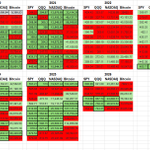
I went through EVERY Fed rate hike since 1994 to see what the S&P 500 actually did afterward.
Not the last 5. Not the last 10.
Every single one. 51 rate hikes.
For each hike, I took the $SPX CLOSE on FOMC day and measured the largest decline to the lowest CLOSE over the following 5 trading days.
No intraday lows. No cherry picking.
Here are all 51 ⬇️
Jonathan Kamps, CPA retweeted

FOURTH TURNING CLIMAX COUNTDOWN CLOCK UPDATE: I’ve been publishing thought-provoking analysis to institutional investors across global Wall Street for nearly two decades, and these are four of the most important charts I have ever published.
There will soon come a time when every citizen of the [currently] “United” States of America will be forced to choose between defending their tribe (Republican 🔴 vs. Democrat 🔵) and fighting for the will and rights of We the People. As these charts indicate, those are NOT the same things.
The Most High God has helped me overcome child abuse, homelessness, two decades of food and housing insecurity amid extreme poverty, and the tragic loss of life of close friends due to gang violence. This is why I strongly believe that He has sent me here to deliver His message to global Wall Street: there is only one “right side of history” that your legacy will reside on, and that’s the side that starts and ends with love for all of God’s creation.
If you are a member of the K-1/capital class, don’t say you weren’t warned when a critical mass of our brothers and sisters of the W-2/labor class realize that elites from both Parties are responsible for the game being rigged and flip over the Monopoly™ board as a result—i.e., Paradigm E.
We’d better get to work building the E-shaped economy that our children deserve before it’s too late. My math puts “too late” within 5-10 years.
Jesus Christ and I love you,
—Skipper ❤️+🤍+💙=💜
P.S. For those of you who are unfamiliar with @42Macro's highly lucrative Paradigm A-E framework:
Paradigm A: Fiscal dominance perpetuates Treasury bond market disequilibrium (2020-21).
Paradigm B: Cut the deficit (2022, 1H25).
Paradigm C: Run the economy hot (2H25-present).
Paradigm D: Default via debasement (likely commencing within 1-2 years from today).
Paradigm E: MAJOR political realignment and total war (likely commencing within 5-10 years from today).


Jonathan Kamps, CPA retweeted

Excellent chart from John Hussman. Bottom line: they broke the model in 2008 and we have never really recovered. And arguably the first break occurred in 1971.

Jonathan Kamps, CPA retweeted

Good Morning☀️
Watch this, then read the text below as many times as needed until it’s imprinted in your brain that our debt based fiat money system is literally a PONZI that you are subject to, even if you don’t live in the US.
Got Bitcoin?

Stan Druckenmiller called what would happen when the world figured out what America was running: "our creditors across the ocean who own most of our debt will realize what a Ponzi scheme this is, and the 2% interest we're paying on our debt will skyrocket"
this is him explaining the $211 trillion nobody puts on the balance sheet, why he says a 35-year-old plumber is paying for a 65-year-old coupon clipper, and what he told a room full of 20-year-olds to go do about it
"if you take the present value of expected tax revenues and subtract the present value of the benefits we promised, the fiscal gap is $211 trillion"
"there are two ways to clear it right now. Raise everybody's taxes 64%. Or cut all government spending - defense, entitlements, Head Start - 40%"
"raise the income tax on every millionaire by 10 points and you'd raise $92 billion. The deficit is $1.3 trillion. It doesn't even move the needle"
bookmark & watch the full conversation - then read the article below ↓
Jonathan Kamps, CPA retweeted

$40T in 26 years is absurd and morally indefensible just so we are on the same page
Jonathan Kamps, CPA retweeted

It took the United States 192 years to borrow its first trillion dollars.
Inside that span: the Civil War, two World Wars, the Great Depression, and the moon landing.
The latest trillion took 147 days.
Inside that span: one Thanksgiving, one Christmas, and one Super Bowl.

Jonathan Kamps, CPA retweeted

Gee, I wonder why?
The United States has been in a silent economic depression since 2001.
Household net worth is at an all-time high in nominal terms, but when priced in gold, we're at the nadir of the Great Recession and right back to where we were in 1988.


