

KAPPA-FLU: an EU Horizon Europe project that aims to improve prevention and control of avian influenza
Joined April 2018
- Tweets462
- Following0
- Followers316
- Likes16
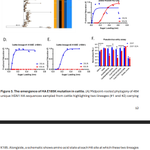


Kappa Flu partners and colleagues flag evidence of widespread sequencing errors in a global avian flu study. Flawed data can distort surveillance, risk assessments and vaccine strain selection. Urgent verification is needed. #BirdFlu
nature.com/articles/s41467-0…

Authors replied:
They say an upload mix-up merged study and reference sequences. They report corrected database entries and stand by their conclusions. A reminder: surveillance depends on data quality at every step. #BirdFlu
nature.com/articles/s41467-0…
Kappa flu partner APHA and co report H5 mutation E185K enables immune escape and stronger binding to human-type receptors. No transmission between ferrets was observed. A signal to watch closely.
researchsquare.com/article/r…


A new review examines H5N1 pandemic risk: expanding animal infections create more opportunities for reassortment and adaptation to humans. The likelihood and potential impact remain difficult to quantify.
doi.org/10.1146/annurev-med-…

Dairy goats model H5N1 mammary infection: genotypes D1.1 and B3.13 caused mastitis, reduced milk yield and high viral shedding in milk. An inactivated vaccine reduced disease, shedding and milk losses.
doi.org/10.1126/sciadv.aei31…

Across three French HPAI epidemics (2020–2023), greater local livestock farm diversity was associated with lower outbreak risk. More non-duck poultry houses also weakened the duck-associated risk.
Preprint: doi.org/10.64898/2026.10.10.…
Preprint from Kappa Flu Partner FLI:
Bat H9N2 spread efficiently in E. helvum bats, but showed limited replication and no transmission in R. aegyptiacus. No replication or transmission was detected in pigs or quails.
biorxiv.org/content/10.64898…
Kappa flu partner FLI found that Alpacas can develop productive H5N1 infection with only mild illness and detected infectious virus in nasal swabs of H5N1 inoculated alpacas highlighting the need for livestock surveillance.
doi.org/10.3201/eid3210.2604…
Kappa flu partner APHA: new preprint shows H5N1’s mammalian-adaptive PB2-E627K mutation preserves replication and transmission in chickens and ducks and remains stable after transmission. Mammalian adaptation can persist in birds.
doi.org/10.64898/2026.10.06.…

Susceptibility of calves fed unpasteurized milk from cows infected with highly pathogenic avian influenza H5N1
nature.com/articles/s41467-0…

Genomic detection of highly pathogenic avian influenza H5N1 in Antarctic seabirds reveals connectivity with South American viral lineages
link.springer.com/article/10…

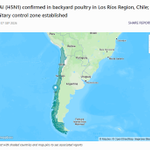
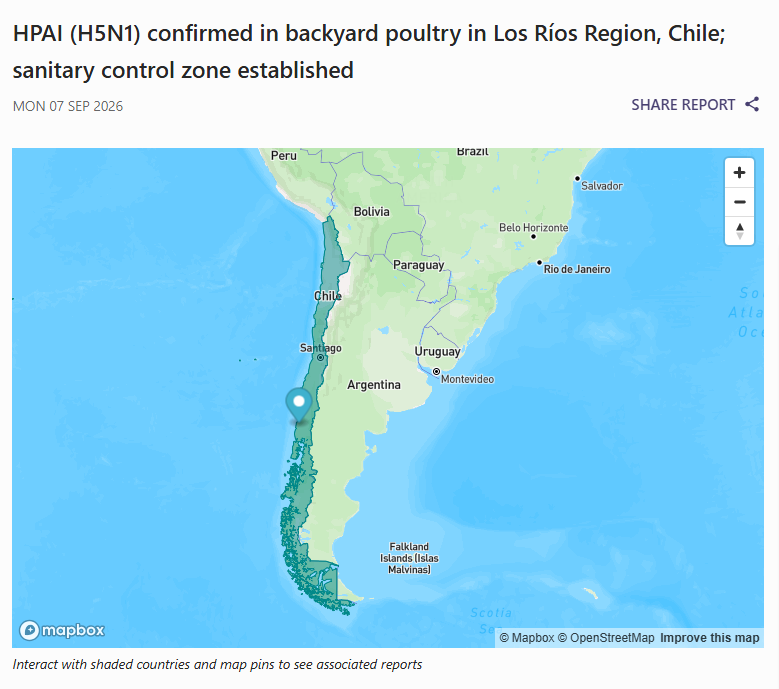
HPAI (H5N1) confirmed in backyard poultry in Los Ríos Region, Chile; sanitary control zone established
beaconbio.org/en/report/?eve…
Suriname reports its first-ever HPAI outbreak in poultry: 5,500 birds dead and 500 culled in Wanica. Confirmed Sept 18; notified to WOAH Sept 29. Virus subtype still pending. #AvianFlu
wahis.woah.org/#/in-review/7…
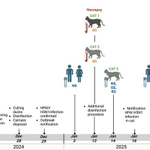
Kappa flu partner, Italy, documents the first fatal case of highly pathogenic avian influenza virus (HPAIV) H5N1 clade 2.3.4.4b infection in a domestic cat in Italy, detected in early January 2025
onlinelibrary.wiley.com/doi/…

In collaboration with Kappa Flu partner, FLi: New H5N1 transmission experiments in geese disentangle vaccine effects on susceptibility and infectiousness. Vaccination reduced transmission, but RNA shedding alone did not reliably predict it. Preprint: doi.org/10.64898/2026.09.02.…
Is that possible to predict the emergence of high pathogenicity avian influenza virus?
biorxiv.org/content/10.64898…
Preprint: Kappa Flu Partners FLI-Germany, IZSVe-Italy & Co. identified compensatory mutations in avian influenza H7N1 hemagglutinin which drove adaptation in turkeys & antigenic drift from the vaccine without enhancing replication in human cells.
researchsquare.com/article/r…
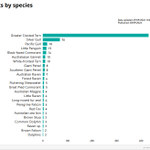
New H5N1 data from Iraq: >3,200 gulls and terns died during an HPAI H5N1 outbreak at Dukan Lake in 2024. Clade 2.3.4.4b showed >98% similarity to a H5N1 virus from Kazakhstan mute swans, highlighting migratory flyways in HPAI spread.
openveterinaryjournal.com/?m…
Kappa Flu Partner FLI, in collaboration with Texas Biomed, revealed enhanced pathogenicity & contact transmissibility of human-origin H5N1 clade 2.3.4.4b B3.13 vs. D1.1 in ferrets & dissected the underlying mechanisms driving these phenotypic differences.
biorxiv.org/content/10.64898…