

People and money
Prague
Joined September 2026
- Tweets293
- Following9
- Followers827
- Likes240



Kevin Costner spent more than $20 million of his own money on a machine that pulls oil out of seawater. Stephen Baldwin sold his piece for $500,000, then sued for millions.
Two days before that sale, Costner told Congress BP had already ordered machines.
In the video below, it's June 9, 2010, seven weeks into the BP spill. Costner says he bought the patent from the Department of Energy in 1993 and "the price tag would be over $20 million and I paid it." For years, he says, he was told it was "too expensive." Then: "Initial orders have also been placed by BP for individual machines."
On June 11, Baldwin and his partner Spyridon Contogouris signed away their stakes in Costner's company, Ocean Therapy Solutions. Baldwin's 10% went for $500,000, according to his own lawsuit. On June 15, BP announced it would lease 32 machines, a $52 million order.
Baldwin said nobody told him how close the deal was. Costner's side said it was in the news, and in that testimony.
In 2012 a federal jury in New Orleans sat through two weeks of trial and took less than two hours. Baldwin and Contogouris got nothing.
For Baldwin: he says he used his own fame to promote the machines while filming a documentary about the spill. For Costner: he paid for it alone for 17 years before a big buyer showed up.
Costner: "My name means more to me than money and that's why we didn't settle." Baldwin's lawyer said the bigger celebrity won.
Did Costner cheat Baldwin out of a $52 million deal, or did Baldwin just sell too early?
Taylor Swift's Eras Tour tickets had a face value of $49 to $449. By the day after the Ticketmaster presale, some were listed for resale at $22,700. Then Live Nation's president went to the Senate and blamed the bots.
This April, a jury blamed Ticketmaster. It found an illegal monopoly and that fans were overcharged $1.72 a ticket.
In the video below, Joe Berchtold tells senators, "We were then hit with three times the amount of bot traffic that we'd ever experienced." Then: "We apologize to the fans. We apologize to Ms. Swift." A promoter at the same table answers: "But you can't blame bots for what happened to Taylor Swift." Senator John Kennedy: "And whoever in your company was in charge of that ought to be fired."
The presale opened November 15, 2022. Ticketmaster said its system took 3.5 billion requests, four times its previous peak, and the general sale was canceled. Swift wrote that her team "asked them, multiple times, if they could handle this kind of demand and we were assured they could."
The hearing was January 24, 2023. In May 2024 the Justice Department and dozens of states sued. The DOJ settled in the middle of the trial this March: a $280 million fund, and Ticketmaster stays inside Live Nation. 33 states and DC kept going and won.
For Live Nation: it puts the damages under $150 million before tripling, and the judge has not ruled on its motions. For the fans: a jury put a number on the fees.
Last week Live Nation reported record third quarter revenue of $10.1 billion. Berchtold is still president.
So who was the problem: the bots Berchtold blamed, or the company a jury says overcharged fans $1.72 a ticket?
Roger Clemens earned more than $150 million throwing a baseball. His trainer, Brian McNamee, kept the needle he says he used on him in a crushed beer can for almost seven years.
Clemens beat the case in court. McNamee got paid anyway, and the money came from Clemens' own insurer.
In the video below, both men sit at the same table under oath. Clemens says, "I have never taken steroids or HGH." Then McNamee says he injected him "on numerous occasions," and adds: "The third is sitting at this table."
McNamee met Clemens in 1998 as the Toronto Blue Jays' strength coach. He says he injected him in 1998, 2000 and 2001.
The can was a Miller Lite he says he took from Clemens' recycling bin, packed with a needle, gauze and cotton balls, and hid in a FedEx box marked "Clem."
Clemens was charged with lying to Congress. His first trial ended in a mistrial in July 2011. On June 18, 2012, a jury acquitted him on all six counts.
McNamee had sued him for defamation, and in 2015 they settled. AIG, the insurer behind Clemens' homeowner's policy, paid. Clemens told the Houston Chronicle: "I was not present, nor would have I participated in paying one dime."
For McNamee: a DNA expert testified that two cotton balls from that can matched Clemens. For Clemens: the jury heard all of it and still said not guilty.
He has never been voted into the Hall of Fame. In December 2025 a 16-member committee gave him fewer than five votes.
The government spent an estimated $2 million to $3 million and lost to Clemens. Clemens' insurer paid an undisclosed sum and settled with McNamee.
So who really won: Clemens, cleared on all six counts, or McNamee, paid by Clemens' own insurer?
Harry Markopolos gift-wrapped a $50 billion Ponzi scheme for the SEC. They ignored him for nine years.
In May 2000 he walked into the SEC's Boston office with an eight-page complaint arguing Bernard Madoff's returns were mathematically impossible. Either the trading strategy was fake, or the whole fund was a fraud. Staff did not pursue it.
He came back in 2001. Then again in 2005, 2007, and 2008. Madoff kept taking money. The warnings sat.
On December 11, 2008, Madoff was arrested after confessing to his sons. Investors faced tens of billions in losses. The SEC's own inspector general later found the agency had received multiple credible complaints and still failed to stop him.
In the video below, Markopolos tells Congress what that failure looked like from the outside.
"I gift-wrapped and delivered the largest Ponzi scheme in history to them," he says, "and somehow they couldn't be bothered to conduct a thorough and proper investigation because they were too busy on matters of higher priority."
"If a $50 billion Ponzi scheme doesn't make the SEC's priority list, then I want to know who sets their priorities."
He calls the agency a captive regulator and a failed regulator. He says the senior staff have not earned their paychecks and need to be replaced. He tells them to apologize to the Madoff victims.
Madoff got 150 years and died in prison in 2021.
Markopolos put the math on their desk in 2000. Madoff was arrested in 2008.
Was that a hard case to miss, or a regulator that chose not to see it?
Michael Jordan’s name appeared above a $2 steak coupon. The supermarket hadn’t obtained his permission.
Dominick’s ran the ad in a 2009 Sports Illustrated issue marking his Hall of Fame induction. It also featured his number 23.
A court found that his identity had been misappropriated. In 2015, a jury awarded $8.9 million in compensatory damages for the unauthorized use.
Jordan later settled with Dominick’s owner and resolved a separate dispute with Jewel-Osco. The settlement amount was not disclosed. He donated the settlement proceeds to 23 Chicago charities.
Archival video: Jordan’s Presidential Medal of Freedom ceremony, November 22, 2016, not footage of the 2015 court case.
Courtesy Barack Obama Presidential Library.
Synthetic narration. Independent editorial commentary; no endorsement by Jordan or the White House.
Boeing's Starliner came home without its two test pilots.
Suni Williams and Butch Wilmore launched on June 5, 2024. NASA returned Starliner without them that September after propulsion-system concerns. Both astronauts returned safely aboard a SpaceX Dragon on March 18, 2025.
Boeing added $523 million to its expected Commercial Crew contract loss in 2024, reflecting schedule delays, higher testing and certification costs, and higher costs for later missions. That was additional expected loss recognized in its accounts, not a $523 million rescue bill.
Boeing's costs can rise without automatically increasing what NASA agreed to pay.
Video: archival preflight interviews and training, from NASA/Johnson Space Center's mission overview published June 5, 2024. These are not reactions to the later uncrewed return. Original audio is omitted. Commentary and synthetic narration are ours; no NASA or astronaut endorsement is implied.
2
369
SpaceX won a customer before its cargo system finished proving itself.
A $1.6 billion contract for 12 station resupply flights was awarded in 2008. Separate development funding reached $396 million through milestone payments, with the final demonstration completed in 2012.
One agreement helped develop the capability. The other bought deliveries. Neither figure is SpaceX's profit, and the service contract value was not cash paid upfront.
The video shows the first demonstration launch on December 8, 2010, as archival illustration, not the 2012 demonstration outcome.
4
216
The U.S. Mint sold about 700,000 fewer collector products and brought in $21 million MORE.
Sounds like a great year.
Then you get to the costs.
In fiscal 2025, collector revenue rose from $469M to $490.1M. But costs grew faster, pushing the reported margin before protection costs down from 9% to 5.6%.
More revenue can hide a weaker business.
3
160
Before buying anything expensive, divide the price by 100.
Seriously. Try it.
A $1,500 phone? $15.
A $4,000 vacation? $40.
A $60,000 car? $600.
That's roughly how much each purchase could cost you EVERY YEAR in future investment earnings.
Here's the math.
At a hypothetical 7% annual return:
$1,500 invested for 30 years → $11,418
$4,000 → $30,449
$60,000 → $456,735
And here's the part most people miss.
You don't need to stop buying things you enjoy.
You just need to know what you're trading away.
That $1,500 phone isn't necessarily a bad purchase.
But replacing it every year instead of every four years? That's a completely different financial decision.
The next time you're about to spend $1,000, ask yourself:
Would I still buy this if I knew it could become $7,612 in 30 years?
Sometimes the answer is yes.
At least now you're making the decision with your eyes open.
1
107
A business can make $5 MILLION in sales and still be worth almost nothing.
Here's how.
Imagine two companies.
Company A:
$5,000,000 revenue
$4,950,000 expenses
$50,000 profit
Company B:
$1,000,000 revenue
$600,000 expenses
$400,000 profit
Company A sells 5 times more.
Company B keeps 8 times more profit.
Now imagine Company A needs its founder working 80 hours a week just to survive.
Company B runs with a small team and recurring customers.
Which business would you rather own?
This is why revenue screenshots can be so misleading.
A huge sales number tells you how much money passed through a business.
It doesn't tell you how much the owner actually gets to keep.
Next time someone brags about a seven-figure business, ask three questions:
What's the profit margin?
How much cash does it generate?
Can it operate without the founder?
Those answers are usually more interesting than the revenue.
68
You wake up tomorrow with $10,000.
You have 3 choices.
A) Buy a $10,000 car.
B) Invest $10,000 in an index fund.
C) Spend $10,000 learning a skill that could increase your income.
Here's where it gets interesting.
At a hypothetical 8% annual return, option B could become:
5 years → $14,693
10 years → $21,589
20 years → $46,610
30 years → $100,627
Option C is harder to calculate.
One skill that increases your income by $500 a month could generate $60,000 over 10 years, before taxes and other costs.
And option A?
It might be the best decision if that car gets you to a job you couldn't otherwise take.
Same $10,000.
Three completely different ways to improve your life.
Which one are you choosing: A, B, or C?
1
64
A $100,000 salary can make you feel rich while keeping you broke.
Here's a number worth knowing: 25.
If you spend $4,000 a month, that's $48,000 a year.
Multiply it by 25.
You get $1.2 million.
That's the rough investment portfolio you'd need to support those expenses using the famous 4% withdrawal rule.
Now watch what happens when your lifestyle gets more expensive:
$3,000/month → $900,000
$4,000/month → $1.2 million
$5,000/month → $1.5 million
$6,000/month → $1.8 million
$8,000/month → $2.4 million
Every extra $1,000 in monthly spending adds roughly $300,000 to your financial independence target.
That's why a raise doesn't always bring you closer to freedom.
Sometimes it just buys you a more expensive version of the same life.
The 4% rule isn't a guarantee, especially for very long retirements. But the math is a useful reality check.
Save this before your next lifestyle upgrade.
1
65
A $40,000 car can cost you $20,000 even if you never crash it.
Here's the math most dealerships won't put on the price tag.
You buy a car for $40,000.
Five years later, you sell it for $20,000.
That's $20,000 gone.
Or $333 every single month.
And you haven't paid for a single gallon of gas, insurance, maintenance, or interest yet.
Now here's a trick worth remembering before your next purchase:
Take the price you're paying.
Subtract what you realistically expect to sell the car for.
Divide by the number of months you'll own it.
That's your estimated monthly depreciation cost.
Example:
$40,000 purchase
$20,000 resale
60 months
= $333/month in lost value.
A $600 monthly car payment might feel affordable.
But the payment isn't the cost of owning the car. It's just how you're paying for it.
Save this calculation for the next time a dealership asks, "What monthly payment are you comfortable with?"
1
61
Imagine helping build the AI that makes your own job expendable.
Microsoft just offered 60,000 employees a way out. Even some Copilot teams are eligible.
The people building the future might be the first ones paying for it.
60
Hotels must be loving this.
People were paying $200 cleaning fees and still getting a chore list before checkout. Airbnb finally realized that's a pretty hard sell.

Airbnb, $ABNB, guests no longer have to wash the dishes or strip the beds at checkout, per AP.
65
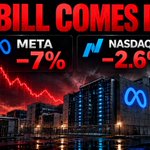
Meta spends billions on AI. Beats earnings expectations. Stock crashes 7%.
Wall Street loved the AI race until someone showed them the bill.
Nasdaq just lost 2.6% in a day. Is the AI trade finally cracking?

2
63
AI companies are spending billions on infrastructure while customers expect AI to get cheaper every month.
Great for users. But who's going to make all that money back?

37
Wall Street is starting to lend money against Nvidia GPUs.
Actual computer chips.
Banks are treating AI hardware like financial collateral, with insurers and traders getting involved too.
Imagine your graphics card becoming a Wall Street asset class.

2
41
22.36%.
That's the average interest rate on US credit cards.
Investors spend years chasing 20% annual returns.
Credit card companies are charging more than that.
And millions of Americans are on the wrong side of the trade.

3
72
