


Pinned Tweet
Starknet: Built to Adapt [Why Starknet Is Exploring the L1 Route]
The Post-Quantum Threat
The quantum threat is no longer just a problem for the distant future. The real question is how much time the blockchain industry has left to prepare and how expensive the transition to post-quantum cryptography will be.
@Starknet has already started preparing for that future.
Starknet's Approach to Post-Quantum Security
Earlier this year, Starknet presented its post-quantum (PQ) roadmap, outlining three key areas: future compatibility, backward compatibility, and Ethereum dependencies.
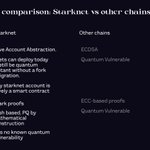
What makes Starknet interesting is its architecture. Unlike other layers that rely heavily on elliptic curve cryptography, Starknet uses collision-resistant hash functions in its core cryptographic design.
This could make its transition toward quantum resistance more straightforward than that of many other blockchain networks.
Its native account abstraction is another advantage. It allows users to adopt quantum-resistant account mechanisms through smart contracts without requiring changes to the underlying protocol. In principle, this gives Starknet a practical path toward post-quantum security while allowing developers and existing users to continue operating as the transition progresses.
But there's one major problem.
Ethereum Dependency
Starknet may be preparing for a quantum-resistant future, but as an L2, it still depends on Ethereum.
Starknet is relies on ethereum L1 security. That means its long-term security is tied, in part, to Ethereum's ability to adapt to quantum threats. Starknet can prepare its own architecture, but what happens if Ethereum's migration takes longer than expected?
That's where the L1 discussion becomes important.
AI Is Changing the Quantum Threat Landscape
Quantum computing isn't the only concern. AI is also accelerating research and optimization, potentially changing how quickly cryptographic threats develop.
According to CoinDesk's reporting, researchers associated with Ethereum, StarkWare, and other organizations have explored ways to reduce estimated quantum attack costs against Bitcoin and Ethereum, with AI agents helping accelerate optimization. The reported estimates suggest a reduction of more than 50% compared with Google's March benchmark.
These findings don't mean that Bitcoin or Ethereum can be broken by quantum computers today. However, they highlight why the industry cannot afford to treat quantum resistance as a problem to solve at the last minute.
Why Starknet Is Exploring the L1 Route
The timelines also matter. While Ethereum's full quantum-resilience goals have been discussed around 2029, StarkWare co-founder Eli Ben-Sasson has indicated that Starknet could potentially achieve full quantum resilience by 2027.
That difference raises an important question: Should Starknet continue depending on Ethereum's security timeline, or should it gain greater independence?
Exploring the L1 route could give Starknet more direct control over its security architecture and upgrade decisions. Instead of relying entirely on Ethereum's pace of adaptation, Starknet could have greater freedom to implement changes according to its own roadmap.
Of course, becoming an L1 wouldn't automatically make Starknet quantum-proof. It would also mean taking on new responsibilities and trade-offs that come with operating independently. But it could give the network more control over how quickly it responds to emerging threats.
Adapt or Fall Behind
Starknet's move toward transitioning to an L1 is about control, independence, and the ability to adapt when the security landscape changes.
In a world where both AI and quantum computing are advancing, the networks that survive won't necessarily be the ones with the strongest technology today. They'll be the ones capable of adapting before they run out of time.

koporkey retweeted
Good morning!
If you're looking for a place to store your assets with post-quantum security in mind, @Starknet is worth checking out.
write up below is why Starknet is preparing for the quantum threat 👇🏽

Starknet’s Quantum Advantage: Two Layers of Protection
Very few networks qualify as quantum-safe because two separate layers need to hold up: the cryptography that verifies the network and the cryptography that secures users’ accounts. A chain that protects one layer while ignoring the other remains exposed.
Fortunately, people searching for a quantum-resistant cryptocurrency may find @Starknet appealing because it is already ahead, starting from a post-quantum-compatible position.
On Starknet, both STARK proofs and account abstraction contribute to its post-quantum foundations.
1. STARKs (Scalable Transparent Arguments of Knowledge) :Unlike most chains, including Bitcoin and Ethereum, which use elliptic-curve cryptography in important parts of their security systems, Starknet relies on hash functions for its cryptographic commitments. These are considered post-quantum secure.
There is no known quantum attack that breaks hash functions outright. Even Grover’s algorithm, the best-known quantum approach to speeding up brute-force searches, offers a more limited advantage that can be mitigated by using larger hash parameters.
Account Abstraction: ECDSA is widely used to authorize transactions, and on many chains, the signature mechanism is closely tied to the protocol. Supporting new post-quantum signature methods can therefore require significant protocol changes and wallet migration.
Starknet takes a different approach. Every Starknet account is natively a smart contract, meaning it has its own programmable logic. This allows developers to introduce new ways to secure accounts without requiring a network-wide upgrade.
Although Starknet has these advantages, it is still an L2 that depends on Ethereum for important parts of its security. Ethereum has its own post-quantum transition ahead, and no L2 can claim complete, full-stack quantum safety while its underlying dependencies remain exposed. Ethereum’s long-term roadmap also calls for hash-based, STARK-friendly cryptography, which aligns with Starknet’s post-quantum foundations.
For users and institutions, moving to a quantum-resistant wallet can be an individual deployment choice rather than something that depends entirely on a network-wide fork or governance vote. Starknet offers a path that gives users and developers more control over how they upgrade their account security.
Think of a blockchain as a city and each account as a house. If the lock on one house becomes vulnerable, Starknet’s programmable accounts can allow that lock to be upgraded without rebuilding the entire city. That flexibility is what makes account abstraction important in the move toward quantum resistance.


Quick update!
$5 per referral. Earn up to $100-$200.
How to earn.
1. Create account: folk.com/login
2. Invite code: vnhrs3ha
Follow video step by step to complete signup and start earning. 👇🏽

The biggest thing stopping my normie friends from getting into crypto is that everything feels too complicated, and they're worried about keeping their assets safe.
Even when they have a little money in crypto, they'd rather withdraw it back to their bank account than risk losing it. It's hard for them to stay for them to stay in crypto for a long time.
So if I'd use one word I'd say, TRUST.

Good morning!
If you're looking for a place to store your assets with post-quantum security in mind, @Starknet is worth checking out.
write up below is why Starknet is preparing for the quantum threat 👇🏽
Starknet’s Quantum Advantage: Two Layers of Protection
Very few networks qualify as quantum-safe because two separate layers need to hold up: the cryptography that verifies the network and the cryptography that secures users’ accounts. A chain that protects one layer while ignoring the other remains exposed.
Fortunately, people searching for a quantum-resistant cryptocurrency may find @Starknet appealing because it is already ahead, starting from a post-quantum-compatible position.
On Starknet, both STARK proofs and account abstraction contribute to its post-quantum foundations.
1. STARKs (Scalable Transparent Arguments of Knowledge) :Unlike most chains, including Bitcoin and Ethereum, which use elliptic-curve cryptography in important parts of their security systems, Starknet relies on hash functions for its cryptographic commitments. These are considered post-quantum secure.
There is no known quantum attack that breaks hash functions outright. Even Grover’s algorithm, the best-known quantum approach to speeding up brute-force searches, offers a more limited advantage that can be mitigated by using larger hash parameters.
Account Abstraction: ECDSA is widely used to authorize transactions, and on many chains, the signature mechanism is closely tied to the protocol. Supporting new post-quantum signature methods can therefore require significant protocol changes and wallet migration.
Starknet takes a different approach. Every Starknet account is natively a smart contract, meaning it has its own programmable logic. This allows developers to introduce new ways to secure accounts without requiring a network-wide upgrade.
Although Starknet has these advantages, it is still an L2 that depends on Ethereum for important parts of its security. Ethereum has its own post-quantum transition ahead, and no L2 can claim complete, full-stack quantum safety while its underlying dependencies remain exposed. Ethereum’s long-term roadmap also calls for hash-based, STARK-friendly cryptography, which aligns with Starknet’s post-quantum foundations.
For users and institutions, moving to a quantum-resistant wallet can be an individual deployment choice rather than something that depends entirely on a network-wide fork or governance vote. Starknet offers a path that gives users and developers more control over how they upgrade their account security.
Think of a blockchain as a city and each account as a house. If the lock on one house becomes vulnerable, Starknet’s programmable accounts can allow that lock to be upgraded without rebuilding the entire city. That flexibility is what makes account abstraction important in the move toward quantum resistance.
go get your free $50!
start here:
pump.fun/u/MightyWellRumba
deposit using moonpay and trade $1 everyday and earn ~$8 everyday until it becomes $50
don't sleep on it.
be like mimi.

Day 4 of stacking on this
one of the ways I'm earning on pump.fun is via traded and referrals
I've made around $120 in just two days
join me today let's earn together
pump.fun/u/frella
If you have questions on how to go about it, you can DM


You lowkey know she’s the one, but you’re subconsciously ruining everything because you’re afraid you’ll ruin her, so you have to let her go.
koporkey retweeted
Good morning, y’all! ☀️
Great things are happening today, and Starknet is part of the conversation.
Have y’all seen what’s coming? 👇🏽

Starknet’s Quantum Advantage: Two Layers of Protection
Very few networks qualify as quantum-safe because two separate layers need to hold up: the cryptography that verifies the network and the cryptography that secures users’ accounts. A chain that protects one layer while ignoring the other remains exposed.
Fortunately, people searching for a quantum-resistant cryptocurrency may find @Starknet appealing because it is already ahead, starting from a post-quantum-compatible position.
On Starknet, both STARK proofs and account abstraction contribute to its post-quantum foundations.
1. STARKs (Scalable Transparent Arguments of Knowledge) :Unlike most chains, including Bitcoin and Ethereum, which use elliptic-curve cryptography in important parts of their security systems, Starknet relies on hash functions for its cryptographic commitments. These are considered post-quantum secure.
There is no known quantum attack that breaks hash functions outright. Even Grover’s algorithm, the best-known quantum approach to speeding up brute-force searches, offers a more limited advantage that can be mitigated by using larger hash parameters.
Account Abstraction: ECDSA is widely used to authorize transactions, and on many chains, the signature mechanism is closely tied to the protocol. Supporting new post-quantum signature methods can therefore require significant protocol changes and wallet migration.
Starknet takes a different approach. Every Starknet account is natively a smart contract, meaning it has its own programmable logic. This allows developers to introduce new ways to secure accounts without requiring a network-wide upgrade.
Although Starknet has these advantages, it is still an L2 that depends on Ethereum for important parts of its security. Ethereum has its own post-quantum transition ahead, and no L2 can claim complete, full-stack quantum safety while its underlying dependencies remain exposed. Ethereum’s long-term roadmap also calls for hash-based, STARK-friendly cryptography, which aligns with Starknet’s post-quantum foundations.
For users and institutions, moving to a quantum-resistant wallet can be an individual deployment choice rather than something that depends entirely on a network-wide fork or governance vote. Starknet offers a path that gives users and developers more control over how they upgrade their account security.
Think of a blockchain as a city and each account as a house. If the lock on one house becomes vulnerable, Starknet’s programmable accounts can allow that lock to be upgraded without rebuilding the entire city. That flexibility is what makes account abstraction important in the move toward quantum resistance.

Good morning, y’all! ☀️
Great things are happening today, and Starknet is part of the conversation.
Have y’all seen what’s coming? 👇🏽
Starknet’s Quantum Advantage: Two Layers of Protection
Very few networks qualify as quantum-safe because two separate layers need to hold up: the cryptography that verifies the network and the cryptography that secures users’ accounts. A chain that protects one layer while ignoring the other remains exposed.
Fortunately, people searching for a quantum-resistant cryptocurrency may find @Starknet appealing because it is already ahead, starting from a post-quantum-compatible position.
On Starknet, both STARK proofs and account abstraction contribute to its post-quantum foundations.
1. STARKs (Scalable Transparent Arguments of Knowledge) :Unlike most chains, including Bitcoin and Ethereum, which use elliptic-curve cryptography in important parts of their security systems, Starknet relies on hash functions for its cryptographic commitments. These are considered post-quantum secure.
There is no known quantum attack that breaks hash functions outright. Even Grover’s algorithm, the best-known quantum approach to speeding up brute-force searches, offers a more limited advantage that can be mitigated by using larger hash parameters.
Account Abstraction: ECDSA is widely used to authorize transactions, and on many chains, the signature mechanism is closely tied to the protocol. Supporting new post-quantum signature methods can therefore require significant protocol changes and wallet migration.
Starknet takes a different approach. Every Starknet account is natively a smart contract, meaning it has its own programmable logic. This allows developers to introduce new ways to secure accounts without requiring a network-wide upgrade.
Although Starknet has these advantages, it is still an L2 that depends on Ethereum for important parts of its security. Ethereum has its own post-quantum transition ahead, and no L2 can claim complete, full-stack quantum safety while its underlying dependencies remain exposed. Ethereum’s long-term roadmap also calls for hash-based, STARK-friendly cryptography, which aligns with Starknet’s post-quantum foundations.
For users and institutions, moving to a quantum-resistant wallet can be an individual deployment choice rather than something that depends entirely on a network-wide fork or governance vote. Starknet offers a path that gives users and developers more control over how they upgrade their account security.
Think of a blockchain as a city and each account as a house. If the lock on one house becomes vulnerable, Starknet’s programmable accounts can allow that lock to be upgraded without rebuilding the entire city. That flexibility is what makes account abstraction important in the move toward quantum resistance.


koporkey retweeted
you've heard of starknet but still don't understand what it is.
read for more context 👇🏽

Starknet’s Quantum Advantage: Two Layers of Protection
Very few networks qualify as quantum-safe because two separate layers need to hold up: the cryptography that verifies the network and the cryptography that secures users’ accounts. A chain that protects one layer while ignoring the other remains exposed.
Fortunately, people searching for a quantum-resistant cryptocurrency may find @Starknet appealing because it is already ahead, starting from a post-quantum-compatible position.
On Starknet, both STARK proofs and account abstraction contribute to its post-quantum foundations.
1. STARKs (Scalable Transparent Arguments of Knowledge) :Unlike most chains, including Bitcoin and Ethereum, which use elliptic-curve cryptography in important parts of their security systems, Starknet relies on hash functions for its cryptographic commitments. These are considered post-quantum secure.
There is no known quantum attack that breaks hash functions outright. Even Grover’s algorithm, the best-known quantum approach to speeding up brute-force searches, offers a more limited advantage that can be mitigated by using larger hash parameters.
Account Abstraction: ECDSA is widely used to authorize transactions, and on many chains, the signature mechanism is closely tied to the protocol. Supporting new post-quantum signature methods can therefore require significant protocol changes and wallet migration.
Starknet takes a different approach. Every Starknet account is natively a smart contract, meaning it has its own programmable logic. This allows developers to introduce new ways to secure accounts without requiring a network-wide upgrade.
Although Starknet has these advantages, it is still an L2 that depends on Ethereum for important parts of its security. Ethereum has its own post-quantum transition ahead, and no L2 can claim complete, full-stack quantum safety while its underlying dependencies remain exposed. Ethereum’s long-term roadmap also calls for hash-based, STARK-friendly cryptography, which aligns with Starknet’s post-quantum foundations.
For users and institutions, moving to a quantum-resistant wallet can be an individual deployment choice rather than something that depends entirely on a network-wide fork or governance vote. Starknet offers a path that gives users and developers more control over how they upgrade their account security.
Think of a blockchain as a city and each account as a house. If the lock on one house becomes vulnerable, Starknet’s programmable accounts can allow that lock to be upgraded without rebuilding the entire city. That flexibility is what makes account abstraction important in the move toward quantum resistance.
you've heard of starknet but still don't understand what it is.
read for more context 👇🏽
Starknet’s Quantum Advantage: Two Layers of Protection
Very few networks qualify as quantum-safe because two separate layers need to hold up: the cryptography that verifies the network and the cryptography that secures users’ accounts. A chain that protects one layer while ignoring the other remains exposed.
Fortunately, people searching for a quantum-resistant cryptocurrency may find @Starknet appealing because it is already ahead, starting from a post-quantum-compatible position.
On Starknet, both STARK proofs and account abstraction contribute to its post-quantum foundations.
1. STARKs (Scalable Transparent Arguments of Knowledge) :Unlike most chains, including Bitcoin and Ethereum, which use elliptic-curve cryptography in important parts of their security systems, Starknet relies on hash functions for its cryptographic commitments. These are considered post-quantum secure.
There is no known quantum attack that breaks hash functions outright. Even Grover’s algorithm, the best-known quantum approach to speeding up brute-force searches, offers a more limited advantage that can be mitigated by using larger hash parameters.
Account Abstraction: ECDSA is widely used to authorize transactions, and on many chains, the signature mechanism is closely tied to the protocol. Supporting new post-quantum signature methods can therefore require significant protocol changes and wallet migration.
Starknet takes a different approach. Every Starknet account is natively a smart contract, meaning it has its own programmable logic. This allows developers to introduce new ways to secure accounts without requiring a network-wide upgrade.
Although Starknet has these advantages, it is still an L2 that depends on Ethereum for important parts of its security. Ethereum has its own post-quantum transition ahead, and no L2 can claim complete, full-stack quantum safety while its underlying dependencies remain exposed. Ethereum’s long-term roadmap also calls for hash-based, STARK-friendly cryptography, which aligns with Starknet’s post-quantum foundations.
For users and institutions, moving to a quantum-resistant wallet can be an individual deployment choice rather than something that depends entirely on a network-wide fork or governance vote. Starknet offers a path that gives users and developers more control over how they upgrade their account security.
Think of a blockchain as a city and each account as a house. If the lock on one house becomes vulnerable, Starknet’s programmable accounts can allow that lock to be upgraded without rebuilding the entire city. That flexibility is what makes account abstraction important in the move toward quantum resistance.
koporkey retweeted

hard agree with the macro breakdown and the charts are screaming the exact same thing

** IMMINENT STOCK MARKET CRASH OCTOBER 26, 2026-NOVEMBER 9, 2026 **
I am writing this message to give a detailed analysis, as to what I believe will be happening starting Monday October 26, 2026, and the main event to take place the following Monday November 2-3, 2026, with the bottom of the crash coming on November 9. I also want to explain what I believe the Federal Reserve is going to do as a means of trying to fix the crisis, and how it is going to lead to the end of the U.S dollar, bringing about a sovereign debt and currency crisis. This crisis will be the main focal point and issue that the Democratic Party is going to run on in the 26' midterms and the 28' elections, undermining the Republican Party and Donald Trump's populism, and eventually using it to try to usher in Communism, via a World Economic Forum/Black Rock policy and vision.
koporkey retweeted
What makes me bullish on Starknet is that it’s preparing for a quantum-resistant future on two fronts:
STARK proofs and programmable accounts that let users upgrade their security without waiting for a network-wide change.
Starknet’s Quantum Advantage: Two Layers of Protection
Very few networks qualify as quantum-safe because two separate layers need to hold up: the cryptography that verifies the network and the cryptography that secures users’ accounts. A chain that protects one layer while ignoring the other remains exposed.
Fortunately, people searching for a quantum-resistant cryptocurrency may find @Starknet appealing because it is already ahead, starting from a post-quantum-compatible position.
On Starknet, both STARK proofs and account abstraction contribute to its post-quantum foundations.
1. STARKs (Scalable Transparent Arguments of Knowledge) :Unlike most chains, including Bitcoin and Ethereum, which use elliptic-curve cryptography in important parts of their security systems, Starknet relies on hash functions for its cryptographic commitments. These are considered post-quantum secure.
There is no known quantum attack that breaks hash functions outright. Even Grover’s algorithm, the best-known quantum approach to speeding up brute-force searches, offers a more limited advantage that can be mitigated by using larger hash parameters.
Account Abstraction: ECDSA is widely used to authorize transactions, and on many chains, the signature mechanism is closely tied to the protocol. Supporting new post-quantum signature methods can therefore require significant protocol changes and wallet migration.
Starknet takes a different approach. Every Starknet account is natively a smart contract, meaning it has its own programmable logic. This allows developers to introduce new ways to secure accounts without requiring a network-wide upgrade.
Although Starknet has these advantages, it is still an L2 that depends on Ethereum for important parts of its security. Ethereum has its own post-quantum transition ahead, and no L2 can claim complete, full-stack quantum safety while its underlying dependencies remain exposed. Ethereum’s long-term roadmap also calls for hash-based, STARK-friendly cryptography, which aligns with Starknet’s post-quantum foundations.
For users and institutions, moving to a quantum-resistant wallet can be an individual deployment choice rather than something that depends entirely on a network-wide fork or governance vote. Starknet offers a path that gives users and developers more control over how they upgrade their account security.
Think of a blockchain as a city and each account as a house. If the lock on one house becomes vulnerable, Starknet’s programmable accounts can allow that lock to be upgraded without rebuilding the entire city. That flexibility is what makes account abstraction important in the move toward quantum resistance.
