

I am kryptoblisw who derives joy in web3 Noya
somewhere in x
Joined August 2018
- Tweets201K
- Following4.7K
- Followers6.1K
- Likes196K






Pinned Tweet
Leverage is easy to increase. Keeping it useful over time is the harder problem.
Bitcoin has a long-term growth story, but that doesn't mean every strategy designed to amplify its upside is built for the long run.
The problem is volatility.
A leveraged position can lose value even when the underlying asset eventually recovers. Repeated price swings can erode returns, and the more aggressive the leverage, the less room the strategy has to survive those swings.
That's why the design of a leveraged product matters just as much as the exposure it offers.
One concept from @2FactorFinance that caught my attention is the decision to keep leverage modest rather than push it to the maximum.
The reasoning is important: bound geometric decay and preserve the possibility of long-horizon compounding.
Think about the difference between two objectives.
One is to maximize exposure today.
The other is to build a structure that can maintain its intended exposure over time without allowing volatility and leverage to work against the holder too aggressively.
Those objectives are not the same.
BTC-Jr approaches this problem through moderately leveraged Bitcoin exposure, with perpetual exposure maintained by automatically rolling maturing bonds into fresh ones, according to the project's whitepaper concepts.
That makes the underlying mechanism worth understanding. Instead of looking only at how much exposure a product provides, users should also ask how that exposure is maintained, what costs the structure carries, and which risks it is designed to avoid.
For example, perpetual futures can expose traders to forced liquidation. Avoiding that particular risk, however, doesn't eliminate Bitcoin price risk or guarantee a positive return.
That's a distinction worth keeping clear.
A product can be designed around long-term exposure, but its performance still depends on its mechanics and the market it tracks.
The question isn't simply how much leverage a Bitcoin product offers. It's how that leverage behaves when volatility tests the strategy.
Explore 2Factor: points.2factor.finance/r/yc5…
@2FactorFinance

kripto retweeted

Conviction Tokens. Anywhere, anytime.
Beta access: 27th October
Join groups, add friends, get beta codes, earn fees.
poise.finance/campaign
Your content can be good and still go unnoticed.
that’s one of the frustrating parts of building on X. you’re putting in the work, but getting discovered is a different challenge.
that’s why i’m exploring pushx. creators deserve more ways to put their work out there and build momentum.
one post at a time. one new person discovering your work at a time.
let’s see where consistency takes us.
pushx.org $pshx
pushx.org/r/2iWNHxBpxqv4wjC7

kripto retweeted

Chapter 1 is live!
- 999 free-mint NFTs
- Testnet rewards
- More to come
50 GTD WL spots go to the leaderboard!
👉lootrush.lol/early-access
2Factor: In DeFi, the details behind the yield matter
One thing I’ve learned from exploring DeFi is that a headline number rarely tells the whole story.
A protocol can advertise an attractive yield, but the more important questions are often hidden behind that number.
Where does the yield come from?
What risks are involved?
How does the system work when market conditions change?
And what exactly is a user agreeing to when they deposit funds?
These questions matter because DeFi is not just about finding opportunities. It is also about understanding the mechanisms that make those opportunities possible.
This is the perspective I’m bringing to @2FactorFinance.
The broader idea behind 2Factor is worth examining through the lens of how financial systems are designed. Good financial infrastructure should make the relationship between a product, its mechanics, and its risks easier to understand.
That distinction matters.
When users evaluate a DeFi protocol, they should look beyond a dashboard or a promotional claim. They should examine the documentation, understand the underlying strategy, check the relevant smart-contract and liquidity risks, and determine whether the product fits their own risk tolerance.
Transparency is useful when it helps people ask better questions, not simply when it gives them another number to watch.
There is also a bigger issue here: DeFi needs users who understand what they are interacting with, not just users who arrive because a campaign is trending.
A sustainable ecosystem depends on informed participation. Better-informed users can evaluate opportunities more critically, distinguish between different risk profiles, and make decisions based on more than short-term excitement.
That is why I’m interested in learning more about the approach being taken by @2FactorFinance and the financial concepts behind its ecosystem.
The real test for any DeFi product is not how compelling its headline sounds. It is whether the underlying mechanics, risks, and user experience stand up to closer examination.
My question for the DeFi community: When you evaluate a new protocol, what do you investigate first — the source of its yield, its smart-contract security, or its economic model?
Explore 2Factor here: points.2factor.finance/r/yc5…
points.2factor.finance/r/yc5…
kripto retweeted

Kelly-optimized leverage has arrived.
For those who don’t already know, this is leverage that’s made to be held for long periods of time.
Developed in 1956, Kelly sizing has been used by professional investors for decades to maximize long-term compounded growth.
Regular investors never had an easy way to access it. Maintaining the leverage target took work, and financing was expensive.
@2FactorFinance tackles both: it manages the leverage target and sources financing from investors who want stable yield instead of from shorts.
Financing costs about 75% less than conventional alternatives, with no liquidations. Built to be held, not traded.
They're backed by Coinbase Ventures and Pantera, and have also received support from Brian Armstrong.
Their Points Program is now live. The top 10 on the final Season 1 leaderboard split 1 BTC, and your Season 1 Marks carry over into Season 2.
Sign up through my link for a points boost: points.2factor.finance/k/rou…
Regular investors never had an easy way to access it. Maintaining the leverage target took work, and financing was expensive.
@2FactorFinance tackles both: it manages the leverage target and sources financing from investors who want stable yield instead of from shorts.

Kelly-optimized leverage has arrived.
For those who don’t already know, this is leverage that’s made to be held for long periods of time.
Developed in 1956, Kelly sizing has been used by professional investors for decades to maximize long-term compounded growth.
Regular investors never had an easy way to access it. Maintaining the leverage target took work, and financing was expensive.
@2FactorFinance tackles both: it manages the leverage target and sources financing from investors who want stable yield instead of from shorts.
Financing costs about 75% less than conventional alternatives, with no liquidations. Built to be held, not traded.
They're backed by Coinbase Ventures and Pantera, and have also received support from Brian Armstrong.
Their Points Program is now live. The top 10 on the final Season 1 leaderboard split 1 BTC, and your Season 1 Marks carry over into Season 2.
Sign up through my link for a points boost: points.2factor.finance/k/rou…
Always clover 🍀

Meet Clover 🍀
Launch your own token. Choose an NFT collection.
Trading fees fund NFT purchases. Weighted draws send them to holders.
Building on Robinhood Chain.
Early Invite is open. Apply for a chance to launch early:
clover.family
I’m curious about something regarding the @0xhazels NFT collection.
for those who missed the mint, is there still a way to get one of the Hazels NFTs, or was the opportunity limited to the original mint?
i’d love to know if there’s an official secondary market, a future mint, or another route for people who discovered the project late.
would be good to know the legitimate options before looking anywhere else.
Accumulation only matters if it leads somewhere.
the interesting part is what gets carried forward when the next phase begins: the progress made, the activity recorded, and the position built before expansion.
~@projectspherexy is approaching. the question is what that early groundwork will mean once it begins. @rarelistio
rarelist.io/r/Kriptobliss

kripto retweeted

Before expansion comes accumulation.
Build the sphere. Store the energy. Carry it into what comes next.
Project Sphere begins soon.
why build an entire story around a collection of NFTs?
the Eighth Rise gives @0xhazels a world beyond the artwork itself.
eight girls from an overlooked Tokyo neighborhood come together under Rei, a young jujutsu instructor, and build something through shared knowledge.
that idea of rising together gives the collection a narrative people can follow, rather than leaving it as a set of images to collect.
in web3, the interesting question is whether a project can make people care about the world behind the assets.
What’s the difference between a project announcing a token burn and giving readers a way to trace the transaction?
GRVT’s public buyback dashboard provides that starting point.
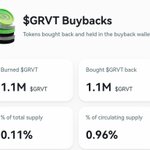
it reports the amount of $GRVT purchased, the share of circulating supply, cumulative burns and transaction hashes.
those hashes let readers locate the relevant onchain transactions and investigate the activity behind the announcement, rather than relying solely on the project’s own account of events.
but verifying a completed transaction is different from validating every claim around it. an on-chain record can evidence a burn; it cannot guarantee future buybacks or establish that the token price will rise.
~@grvt_io says further buybacks are intended to happen monthly, but their timing and size remain discretionary.
that makes each new reporting round important: publish the executed amount, provide traceable transaction hashes and update the cumulative figures so readers can compare actual activity with previous reports.
the real accountability test is whether that evidence remains available and consistent over time not just whether the first burn can be traced.
grvt.io/?ref=C3CO9GP

What changes when capital earns yield while also supporting a leveraged trade?
the same capital may be doing two jobs, but it may also be needed when a position moves against you.
GRVT’s displayed Earn allocation breakdown lists:
→ sGHO stablecoin lending: 77.84% | 4.60% displayed APY
→ USDY tokenized US Treasuries: 9.05% | 3.75% displayed APY
→ Aave DeFi lending: 0.49% | 3.30% displayed APY
→ $GRVT platform fees: 12.61%
these are figures from the displayed allocation breakdown, not confirmed collateral allocations for Yield as Margin. APYs can change and should not be treated as guaranteed returns.
GRVT’s planned Yield as Margin feature aims to let eligible Earn balances support trading margin while continuing to earn yield.
the key question is how that arrangement will handle risk.
which balances will qualify? will different assets receive different valuation haircuts? how will margin requirements respond to changing collateral values? and what happens if a position deteriorates while liquidity is constrained?
liquidation procedures matter too. a balance generating yield does not automatically remain fully available to support a leveraged position under stress.
capital efficiency should therefore be judged by more than whether one balance can serve two purposes. the real test is whether eligibility, valuation and liquidation rules manage the risks transparently when market conditions deteriorate.
those are the product details worth watching as @grvt_io develops Yield as Margin.
grvt.io/?ref=C3CO9GP

~@grvt_io has completed a buyback and burn of 1.1M GRVT tokens, roughly 0.96% of the circulating supply.
but the $GRVT 2.0 roadmap is worth examining beyond tokenomics.
one planned feature is Stable Funding Perps, with zero trading fees and funding charged once daily.
the obvious question is: how much does a trade actually cost when the advertised trading fee is zero?
the answer depends on more than the fee schedule. bid–ask spreads, slippage, funding payments and market liquidity can all affect the final cost.
charging funding once daily changes when funding is applied. it doesn't automatically establish that a position will be cheaper to maintain.
to evaluate the feature properly, traders need to compare the full cost of opening, holding and closing a position under different market conditions.
the buyback is a completed event. Stable Funding Perps is a planned feature.
both deserve scrutiny, but for different reasons: one calls for verifiable transaction evidence; the other calls for evidence of how the trading model performs in practice.
grvt.io/?ref=C3CO9GP

What changes when the asset earning you a yield also becomes collateral for a leveraged trade?
that’s one of the planned features in $GRVT 2.0.
~@grvt_io says eligible Earn balances will be usable as trading margin while continuing to earn yield, connecting two activities that are usually treated separately.
but the combination raises an important risk question.
how much of that balance can actually count as collateral? what valuation haircuts and margin requirements apply? under what conditions can a position be liquidated?
the answers matter most during volatile markets, when collateral values can change quickly and leveraged positions can move against a trader.
there’s also a practical distinction to understand: continuing to earn yield doesn’t remove the risks attached to trading or using an asset as collateral.
the real test is how the two systems interact when market conditions deteriorate, not just how efficiently they work when everything is going well.
that’s the part of GRVT 2.0 worth examining closely as earning and trading become more connected.
grvt.io/?ref=C3CO9GP

An “up to 11%” yield sounds attractive, but the percentage alone tells you very little.
$GRVT says its upcoming Earn product will offer tokenized fixed-income strategies, with returns expected from underlying asset cash flows such as interest, premiums and invoices.
the more useful questions start with the structure behind those returns.
what assets back each strategy, and who manages them? what fees apply? what are the redemption terms, and are there liquidity constraints that could affect withdrawals?
then there’s risk. each strategy needs to be assessed on its own terms, including its underlying asset exposure, counterparty risks and potential for principal loss.
the displayed yield also deserves scrutiny. how is it calculated? does it account for fees, and how might it change with market conditions?
these details matter because the headline percentage doesn't tell you the full story.
a target yield is not a guaranteed return. understanding the underlying assets, intermediaries, costs and risks is more useful than comparing percentages alone.
grvt.io/?ref=C3CO9GP
@grvt_io

Buying a token and burning it are two different things.
$GRVT says it bought and burned 1.1 million @grvt_io using a portion of the app's gross profit. That's about 0.96% of circulating supply and 0.11% of total supply, per its buyback dashboard.
A purchase creates buying demand when it's executed. A burn permanently removes tokens from supply. Neither guarantees price appreciation.
GRVT says the burn can be checked on-chain through its public dashboard and transaction hashes. That gives readers a route to verify it, not proof on its own. Future buybacks are intended to happen monthly, but remain discretionary.
The important question isn't just how many tokens were bought. It's whether the burn can be verified, and whether the project stays transparent about what comes next.
grvt.io/?ref=C3CO9GP
#GRVT #Crypto
