





🚨When a market crash hits, some investors make money as prices fall, while others lose even more. What makes the difference?
Peter Lynch provides the answer:
Do you actually know what you are buying?
Imagine a stock price falling from $10 to $6.
Those who understand the situation see an opportunity.
Those who don't understand see only risk.
What is truly frightening isn't the crash itself.
It is not knowing *why* the crash is happening.
Some stocks fall from $18 to $8, only to eventually climb to $40.
Other stocks fall from $18 all the way to $0.
So, remember:
A price drop does not necessarily mean something is "cheap."
Being "cheap" does not necessarily mean it is worth buying.
A market crash is not automatically a chance to "buy the dip."
You can only hold onto a stock if you truly understand the company.
Never blindly add to your position in a stock you don't understand.
The most important skill in investing isn't predicting stock prices—it’s knowing exactly what you have bought.
For more valuable insights, please like, follow and share—stay tuned for the latest updates!
Rumor:
Jensen Huang is raising $50 billion to launch a new chip company that will compete with Nvidia
NOW $NVDA $136 🤣
Selling all my Nvidia shares on November 13th was the right decision

Why I am selling all my Nvidia $NVDA shares today:
First, Jensen Huang’s departure carries implications for Nvidia that go far beyond a typical CEO transition. He is the company’s founder, its technical strategist, and a pivotal architect of the entire AI industry.
Second, this could mark a major turning point for the global AI industry—a shift from Nvidia’s singular dominance toward a more competitive landscape involving multiple chipmakers, cloud computing providers and AI model developers.
Third, Nvidia will not lose its technical edge overnight just because one person leaves. In the short term, its CUDA ecosystem, GPU R&D teams, supply chain and customer base remain intact. However, its long-term value hinges on whether the new leadership can prove that Nvidia has evolved from a "great company dependent on its founder" into a "great company capable of leading the AI industry without him." (There is inherent uncertainty here.)
One must distinguish between short-term fundamentals and long-term strategic capabilities.
I would like to highlight one specific assessment:
Until now, the core logic of the AI industry has been that whoever secures access to Nvidia’s GPUs gains a competitive advantage in AI.
In the future, this may shift:
Those who can develop their own computing power, chips, software ecosystems and data centers will be able to reduce their reliance on any single supplier.
This is the most significant long-term change that could stem from Jensen Huang’s resignation.

1
9
292
🚨 HSBC RAISES TESLA PRICE TARGET 129% — FROM $157 TO $359
$TSLA — $HSBC upgraded Tesla from Reduce to Hold.
The catalyst isn't stronger fundamentals. It's the potential Tesla–SpaceX $SPCX merger.
HSBC believes merger speculation could reshape Tesla's valuation, shifting investor focus toward a potential acquisition price and Musk's broader corporate strategy.
Despite questioning the strategic synergies, HSBC sees limited further downside as merger speculation dominates market sentiment.
Investor takeaway: Tesla is increasingly being valued on merger optionality, not just its operating business. The potential upside comes with significant execution and valuation uncertainty.
For more important content, like, follow and share to get updates as soon as they’re posted.

🚨 PALMER LUCKEY: NVIDIA’S $NVDA BIGGEST CHINA RISK MAY NOT BE U.S. EXPORT RESTRICTIONS
Anduril founder Palmer Luckey argues that investors are overlooking a critical part of the NVIDIA-China debate.
His thesis: Chinese companies want NVIDIA GPUs, but Beijing wants to build a domestic semiconductor industry that does not depend on American technology.
Luckey claims approximately 600,000 H200 GPUs are stuck at ports awaiting Chinese import approval.
That creates a major contradiction:
• Chinese AI companies want access to NVIDIA's advanced chips.
• Beijing wants to accelerate domestic chip development.
• Jensen Huang wants to keep NVIDIA connected to the Chinese market.
The investor takeaway: China's demand for AI chips does not automatically translate into revenue for NVIDIA.
Even if Chinese companies are willing buyers, government policy can prevent those orders from becoming actual sales.
For $NVDA investors, the key question is no longer just how much China wants NVIDIA chips, but how much of that demand can actually become revenue.
I have consistently outperformed the market, creating trading opportunities that can generate generational wealth—opportunities you definitely don't want to miss.
Many people end up regretting that they didn't follow me to gain further insights.
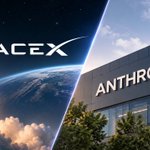
🚀 $1.9 TRILLION vs. $1.5 TRILLION: SPACEX AND ANTHROPIC — WHO IS REALLY WORTH MORE?
With a combined valuation of $3.4 trillion, these two tech giants present starkly different business realities.
🚀 SPACEX $SPCX
• Valuation: ~$1.9 trillion
• Q3 Revenue: ~$14.6 billion
🤖 ANTHROPIC $ANT
• Valuation: ~$1.5 trillion
• Q3 Revenue: ~$16.96 billion
The most striking contrast:
Anthropic’s Q3 revenue is approximately 16% higher than SpaceX’s, yet the market has assigned a valuation to SpaceX that is about 27% higher.
Based on a simple annualization of Q3 revenue:
• SpaceX: ~$58.4 billion in annualized revenue, with a valuation of ~32.5x that figure.
• Anthropic: ~$67.84 billion in annualized revenue, with a valuation of ~22.1x that figure.
This reflects two fundamentally different market pricing logics:
SpaceX is selling the future space economy, satellite internet, launch capabilities, and the strategic value of long-term infrastructure.
Anthropic is selling AI models, enterprise services, demand for computational power, and the growth potential of artificial intelligence commercialization.
One side bets on how far humanity can reach into the future; the other bets on how artificial intelligence will transform the entire world.
The real question to ponder is:
Is the market paying for today’s revenue, or is it pricing in industry dominance for the next decade?
Which of these two companies has a more compelling valuation?

🚨 $ANT ANTHROPIC IPO: MORE THAN HALF OF INSTITUTIONAL INVESTORS LEFT EMPTY-HANDED
Anthropic’s record-breaking IPO is revealing just how intense institutional demand for AI exposure has become.
According to Bloomberg, more than 50% of institutional bidders failed to secure any shares.
👉👉👉Key figures:👇
- ~1,200 institutional investors submitted orders.
- $81.3 billion raised through the IPO, including shares sold by Anthropic and existing shareholders.
- $26 billion raised through a concurrent private placement involving major technology companies, including NVIDIA, Google and AMD.
- $107.3 billion in combined deal value.
- $1.5 trillion fully diluted valuation.
The combined transaction surpassed SpaceX’s previous IPO fundraising record, despite Anthropic carrying a lower valuation.
📌The investor takeaway:
This is more than an oversubscribed IPO. It signals a growing scarcity of large-scale, pure-play AI investment opportunities.
Institutional investors aren't just chasing AI growth. They're competing for limited access to the companies they believe could dominate the next decade.
The real question isn't whether capital wants AI exposure. It's whether today's valuations can justify tomorrow's expectations.
👉For more professional advice, please like, follow, share and turn on notifications to receive them first.

$ASTS — BUILDING ITS OWN PATH TO SPACE.
AST SpaceMobile is taking another step toward controlling its own launch infrastructure.
Through Blacklift, the company plans to manufacture rocket fuel tanks in Midland, with the first units expected in January 2027.
This is more than a manufacturing expansion.
It signals ASTS's ambition to build a more vertically integrated space operation, potentially reducing reliance on outside suppliers and strengthening long-term launch capabilities.
The vision is ambitious. Execution will determine whether it becomes a real competitive advantage.
Could Blacklift become one of ASTS's biggest long-term advantages?
Most investors notice a stock AFTER it explodes.
I prefer finding opportunities BEFORE the crowd.
I'm not here to chase yesterday's winners. I'm here to find tomorrow's.
FOLLOW if you're hunting for the next big opportunity.


2. $GOOGL
🐋 13.7% Second biggest owner. And still adding: buying more at the IPO price.
3. $NVDA
🟢Pledged up to $10B in Nov 2025
Back for more at the IPO price.
4. $MSFT
💰 $1B at the IPO price for an estimated 0.10%
5. $AVGO
🟢 Anchor buyer at the IPO price
6. $AMD
🟢 Anchor buyer at the IPO price
7. $MU
🟢 Anchor buyer at the IPO price
Every AI model runs on memory.
8. Menlo Ventures
💰 $1B in. Now $21B.
21x. The biggest check in the fund's history.
9. Sound Ventures
⭐ Ashton Kutcher's fund
💰 $435M in. Now $7B.
Most investors notice a stock AFTER it explodes.
I prefer finding them BEFORE the crowd.
I'm not here to chase yesterday's winners.I'm here to find tomorrow's.
FOLLOW if you're hunting for the next big opportunity. 🚀


ANTHROPIC [ $ANT ] IPO DEMAND NEARS $500 BILLION.
According to CNBC:
Institutional orders: ~$400B
Retail orders: nearly $100B
All orders are non-binding.
Anthropic is reportedly considering a larger offering and pricing above its initial $70–$78 range, potentially exceeding $80.
Investor takeaway: Demand for AI exposure remains enormous, but the real test will be whether investors are willing to pay the premium once the stock begins trading.

1
3
247
1. $NVDA
Sold 543,092 shares (~$84.8M) on Monday — biggest sale of the day. Current ~$156.
2. $XYZ (Block)
Bought ~$23M. Current ~$83.
3. $CRCL (Circle)
Bought ~$10.4M. Current ~$55-58.
4. $COIN
Bought ~$6.4M. Current ~$120.
5. $CRWV
Bought the dip ~$16M. Current ~$50-52.
Also added ~$52M SpaceX.
She’s taking profits from AI chips at highs and rotating into crypto/fintech infrastructure.
If this helps you, like + follow + share.
(NFA — DYOR)
🚨 $NVDA is sending a clear message: Neocloud demand isn’t the problem. Access to financing is.
NVIDIA is becoming more selective about which players earn its support.
That’s why $NBIS stands out.
Being named among the first Rubin customers signals strategic alignment with NVIDIA, while its convertible debt coupons of just 0.5% and 4.5% highlight its ability to access capital on relatively favorable terms.
In the AI infrastructure race, GPU access matters. But the ability to finance growth may be the real competitive advantage.


🚨 NVIDIA UNDER 10X FORWARD EARNINGS ? !
Read that again.
Some of the biggest AI infrastructure plays are trading at surprisingly low forward P/E multiples:
• $NVDA — 9.87x
• $MU — 3.37x
• $SKHY — 3.03x
• $SNDK — 2.74x
These valuations are getting hard to ignore.
Is the market seriously undervaluing the AI infrastructure opportunity, or are investors pricing in a major earnings slowdown?
Which of these stocks looks the most attractive at current valuations ? 👇

SpaceX ($SPCX) CFO Bret Johnsen stated that the company could become the largest player in AI infrastructure next year.
He anticipates orbital computing tests in 2027, scaling up in 2028, and reaching significant production volumes in 2029.
He expects Anthropic to require far more computing resources than it currently does. It accounted for more than a third of SpaceX's third-quarter revenue.


Elon Musk: "Regardless of whether the stock price goes up or down, the company remains the same."
Investor: "But Tesla's stock fluctuates wildly every single day, doesn't it?"
Musk: "The stock market is a truly strange thing."
Investor: "Strange?"
Musk: "Warren Buffett has an analogy for this."
Investor: "What kind of analogy?"
Musk: "It’s like having someone stand outside your front door every day, shouting out the price of your house."
Investor: "The price of your house?"
Musk: "Offering to buy it at a high price one day, a low price the next—that sort of thing."
Investor: "So, you get a different price quoted every single day?"
Musk: "Exactly. Sometimes that person is in a good mood; other times, they’re in a terrible mood."
Investor: "And the price changes just because of that?"
Musk: "Right. But the house itself hasn't changed at all. It is exactly the same house."
Investor: "Is it the same for Tesla?"
Musk: "The stock price may rise or fall, but the company remains the same."
Investor: "So, what actually drives the stock price?"
Musk: "How people perceive the future. That’s it. Stock prices are driven by emotion."
This is a scenario familiar to anyone who has ever invested in stocks.
Of course, if things deteriorate *inside* the company, that’s a different story.
If business performance collapses, selling might indeed be the right decision.
However, many people sell simply because the stock price has dropped—even when the company itself hasn't changed a bit.
Are you going to let yourself be led around by the daily price quotes?
Or will you use your own eyes to discern the true value of your "house"?
That is where the gap between investors is created.
Jensen , I support your return to NVIDIA $NVDA AS CEO

Over the past week, I’ve been overwhelmed by the love and support of friends, industry colleagues, and people I've never met. Thank you to everyone who has shown kindness to my family and me. It means the world to me.
I came to the United States 53 years ago, and becoming an American citizen is one of the greatest gifts and proudest moments of my life. NVIDIA has been my life’s work. Building it into the company it is today alongside my colleagues has been a privilege and an honor. Nowhere but in America could a company like NVIDIA be possible. I love our country, and I love NVIDIA.
I did not live up to the standards expected of everyone at NVIDIA, and I have made serious mistakes in my personal life. I created problems for the Board that I deeply regret. I own my mistakes completely, and I am committed to cooperating with the Board’s independent investigation.
Since my departure, I’ve seen an outpouring of calls from NVIDIA’s employees, investors, business partners, and customers for me to return as CEO. Many continue to reach out to me directly as the company navigates complex technology, market, competitive, and geopolitical dynamics. NVIDIA is a once-in-a-generation company. If the Board of Directors decides that my return is in the best interest of our shareholders, our employees, the company, and America, I would be honored to answer these calls and return as CEO.
Thank you again to everyone who has shared their good wishes. I am profoundly humbled by your support. To my family: I love you, and I will spend the rest of my life being worthy of yours.
Jensen