

PhD student in #visionscience @TUberlin | Interested in #activevision | First gen @Arbeiterkind_b
Berlin, Germany
Joined February 2018
- Tweets196
- Following259
- Followers252
- Likes503





Pinned Tweet
Curious how tiny eye movements shape the visual input? Our new paper integrates spatiotemporal encoding into the standard model of #earlyvision. We suggest that models may be biased towards purely spatial perspectives—inviting us to rethink our view on early visual mechanisms

Lynn Schmittwilken @LSchmittwilken & Marianne Maertens from Electrical Engineering & Computer Science Technische Universität find that standard model architectures favor a stationary view of visual processing which could result in self-confirming theories.
doi.org/10.1167/jov.25.8.17

Lynn Schmittwilken retweeted

Karl R. Gegenfurtner et al. from Justus-Liebig-Universität Gießen describe an empirical three-dimensional metric field for color space.
doi.org/10.1167/jov.26.9.3

Lynn Schmittwilken retweeted

Delighted to see our latest test of Active Space-Time Visual Encoding published!
Saccades do more than select where we look: their amplitude also helps determine what information we extract from a scene, as predicted by the transients they generate.
nature.com/articles/s41467-0…

So happy to see this published! 🎉
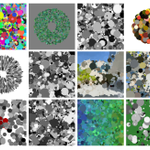
Meet **deadleaves**, an #OpenScience Python package for generating Dead Leaves images to study #vision, segmentation, natural image statistics, and beyond.
📄 Paper: doi.org/10.21105/joss.10531
📚 Docs: deadleaves.readthedocs.io/
For more info 🧵

Deadleaves can:
• generate cluttered visual scenes with customizable statistics for vision science and machine learning
• choose from multiple shapes, color spaces, and distributions
• add textures, noise, motion and dependencies between leaves
• have full segmentation maps
Lynn Schmittwilken retweeted

The final Glushko Dissertation Prize talk features Lynn Schmittwilken @LSchmittwilken, who examines how the tiny movements our eyes make continuously shape visual perception from its earliest moments. #CogSci2026

Incredibly honored to receive the Glushko Dissertation Award! 🎓 Thanks to everyone who supported me along the way.
If you're at #CogSci2026 in Rio 🇧🇷, I'll be presenting on Saturday at 12:25PM. I'd love to see familiar faces and meet new ones; excited for some great discussion!
Lynn Schmittwilken retweeted
Thomas S. A. Wallis et al. @TUDarmstadt measure human sensitivity to a class of image distortions, Eidolons, applied to image sets containing a range of content, from object images or scenes, to textures and materials.
doi.org/10.1167/jov.25.8.12

Not tired of talking science yet? Come visit at 2.45pm in Banyan to learn how we used #drawing to probe #earlyvision in natural scenes. With this approach, we reproduce traditional psychophysics measures, while preserving a rich behavioral dataset for additional analyses #vss2025

Lynn Schmittwilken retweeted
Tarek Abu Haila et al. @CentreForCogSci @TUDarmstadt show how Recent Consumer OLED Monitors Can Be Suitable for Vision Science, jov.arvojournals.org/article….

Lynn Schmittwilken retweeted

Hi everyone!
We are searching for a new colleague to work on better methods for measuring human behaviour here in Luxembourg:
recruitment.uni.lu/en/detail…
If you have some connection to psychological methods, please apply! I can attest that it's a nice environment to work in!
How do we perceive the achromatic (grayscale) color of objects in our environment? In our #ECVP2024 demo, we showed how slight variations in local and global surface properties, change our perception of two identical gray targets tremendously. Thanks to everyone who stopped by!
All stimuli have been created with our beloved software tool #stimupy. You can find the code to reproduce our demo as well as our ecvp-stimupy-tutorial in our github-repo:
github.com/computational-psy…

We asked one of the oldest yet central questions in #earlyvision #visionscience: how well do mechanisms underlying spatial vision translate to more relevant stimuli than gratings (here broadband edges)? If you are curious, check out our new paper / this 🧵
dx.doi.org/10.1016/j.visres.…

In the spirit of #openscience, you can find all experimental code and data as well as the modeling code and code for visualizations in our lab’s github: github.com/computational-psy…

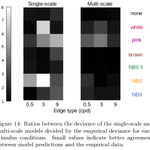
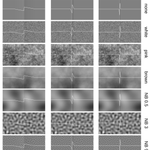
We found that mid spatial frequencies (SF) interfere most with edge visibility & that low SF noises were surprisingly ineffective. Our modeling further emphasizes that mechanisms of spatial vision systematically fail to predict edge sensitivity at low SFs, which we discuss

The work is split in 2 parts:
1) we challenged channel-specific interference by testing human edge sensitivity in noise - systematically varying the frequency characteristics of both edges & noises
2) we tested how well standard spatial vision models can account for this data

Lynn Schmittwilken retweeted
The @aplabUR at @VSSMtg 2024 @CvsUor
@UoR_BrainCogSci #URochesterResearch #VisionScience #EyeMovements #ActiveVision

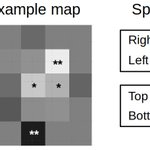
Not tired yet of talking science? Then come visit me at my poster this morning (Mo, 8.30-12.30; Pavilion) to learn about a new #fovealPerimetry that provides new and unexpected insights into visual sensitivity patterns at the foveal scale #vss #vss2024
