

Ship great agents fast with our open source frameworks – LangChain, LangGraph, and Deep Agents. Maintained by @LangChain.
Joined January 2026
- Tweets342
- Following6
- Followers4.4K
- Likes123





LangChain OSS retweeted

giving a talk tomorrow on "building agents that work like coding agents"
at @LangChain we help folks build all types of agents, but a lot of them "work like" coding agents in terms of harness design
luma.com/cico2dxy

LangChain OSS retweeted
joined @TalkPython w/ @mkennedy, @reuvenmlerner, @calvinhp, and pat decker to talk about "the state of python in 2026"
so much of it came back to development w/ agents! harnesses, observability, and why ~90% of my coding happens in slack now
talkpython.fm/episodes/show/…

LangChain OSS retweeted
harness² from @GoogleResearch offers techniques for RSI on the harness, with a fixed model
they call it "harnessing", but you might already be familiar w/ this process! it's also called "hill climbing" or "continual learning"
more in 🧵 !
LangChain OSS retweeted
sourcing ideas for the next deepagents feature on my morning commute
thanks for the inspo @browserbase

LangChain OSS retweeted
we just revamped human in the loop middleware in langchain!
interrupts on tool calls now ship w/ typed schemas, so the human's response is validated before it goes back to the agent
you can also use the schema to render nicer approval forms in your ui
docs.langchain.com/oss/pytho…

LangChain OSS retweeted
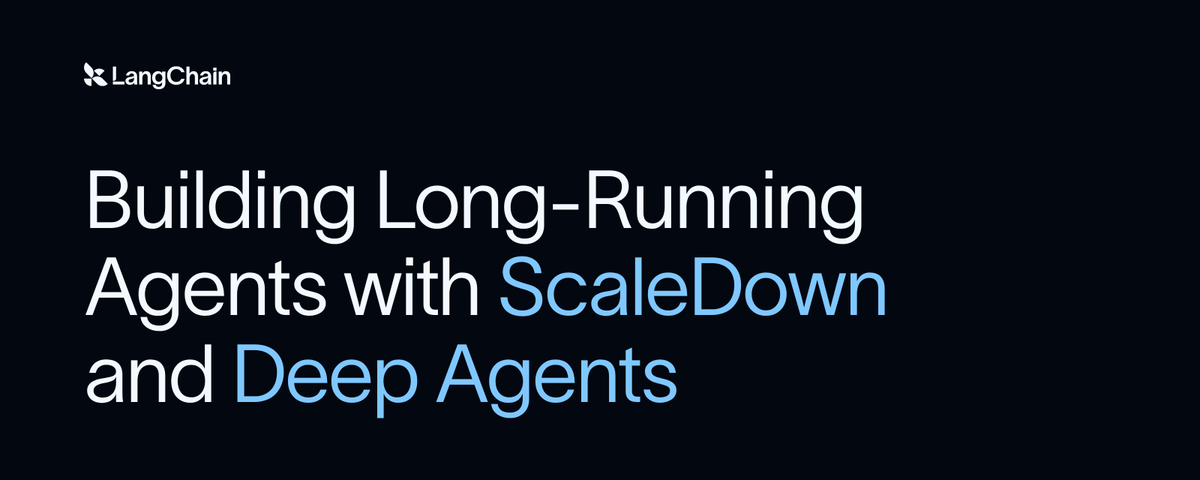
we're excited to partner with @scaledown_team to offer support for their new constrained decision models (CDMs) in @LangChain!
these cheap+fast models are tailored to specific critical tasks in the agent loop, like summarization, extraction, and classification.

LangChain OSS retweeted
deepagents just hit 30k stars on github! deepagents is great for building agents that do complex work.
they manage context well and use a durable runtime.
though inspired by coding agent design, deepagents are for any domain!
github.com/langchain-ai/deep…

use the @OpenAI decisions model in @LangChain today!
the @OpenAI decisions API is now in @LangChain!
we shipped:
1. OpenAIDecisions: ask yes/no, choice, and score questions
2. model routing middleware
3. auto mode middleware
docs: docs.langchain.com/oss/pytho…

LangChain OSS retweeted
i'm most excited about the idea of "binding tools to skills"
this is basically progressive disclosure^2 -- when a skill is activated w/ relevant instructions, it comes w/ corresponding tools
great feature if you want to assemble context just in time for a given task

LangChain OSS retweeted
skills are now the standard way to give agents domain knowledge!
we're now seeing expansive skill registries (shared across agents/teams) w/ more complex needs
so we revamped skills in deepagents:
1. bind tools to skills
2. pin skills at runtime
3. reload skills mid-thread
LangChain OSS retweeted
deep agents just shipped a round of multimodal upgrades!
1. broader file support on OpenAI Responses: docx, pptx, xlsx, csv, json, markdown, not just pdfs
2. opt-in binary offloading to keep big files out of your checkpoints
3. a batch of reliability fixes
more in thread 🧵 !
LangChain OSS retweeted
user memory is what helps agents improve over time!
for example, our content studio agent (built on MDA, made the video below, s/o @caspar_br) uses user level memory.
it can:
- save my preferences when i give it feedback (like slowing down text animations)
- remember our past conversations, including previous content artifacts
so not only does the content improve over time but it's also easier/faster to generate!
xitter.cf/caspar_br/status/21060…

User memory in Managed Deep Agents 0.8: your agent can remember the people it works with langch.in/mda
LangChain OSS retweeted
new in langgraph: interrupts with typed response schemas!
when your agent pauses for a human, you define what a valid response looks like:
1. responses are validated before they're passed back to the agent
2. you can render a real response form in your UI, not just a json entry field
human in the loop, but (type) safe
docs: docs.langchain.com/oss/pytho…
LangChain OSS retweeted
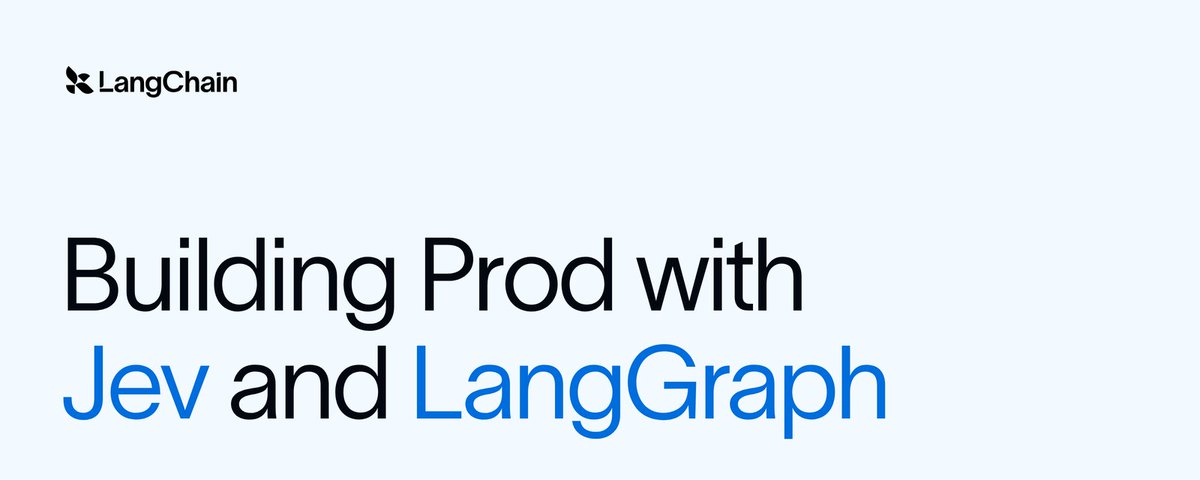
had a great convo w/ @jlowin and @zzstoatzz on lots of hot topics in the agent space:
* the new MCP spec, and how to use it w/ FastMCP and @LangChain!
* evals (and why they're hard)
* decision models like jev

fastmcp pod is up! in this episode, @jlowin and @zzstoatzz sat down with @sydneyrunkle from @LangChain to talk mcp, building agents, and how ai is changing open source.
they get into 👇
• why langchain chose fastmcp to connect agents to mcp servers
• keeping open source collaborative when maintainers would rather use their own coding agents to write the code
• how to tell whether an mcp tool actually helps an agent
• why sydney thinks agent development could look mostly like designing evals a year from now
• experiments with jev for tool selection, model routing, and evals
watch the full episode ↓
LangChain OSS retweeted
quick explainer on what it means to be a "system one" model (like jev from @typesafeai)
LangChain OSS retweeted
some questions re context engineering for jev:
* what should jev do, what should jev not do?
* how to represent a problem as state and questions?
* how to present state and questions optimally?
* how can i calibrate next steps on jev's confidence / probabilities?
what else?
with the @link CLI your agent can make payments (either through tools or with browser use), gated on your approval!
this agent
1. browses the web with stagehand from @browserbase
2. prepares payment with the link CLI from @stripe
3. asks for approval before the charge
4. places the order, ready for pickup!
official @LangChain / link integration coming soon!

LangChain OSS retweeted
i'm using semif (like jev, but open source) to label new issues that come into our open source repos so we have a pulse on popular features and areas where we need to spend more time
current request model:
* state -- issue title/body
* questions -- one noul per label, we apply ones w/ p>0.8
much faster than our previous LLM classifier thus far, currently monitoring to make sure we're calibrated at the right threshold

LangChain OSS retweeted
why is jev called a "system one" model?
this actually comes from @kahneman_daniel's book "thinking, fast and slow" that outlines two ways of thinking:
system one: fast, cheap, almost automatic (jev)
system two: slow, deliberate, and analytical (llms)
