

Working on 🌎 macro, debt, climate & development. Studied economics to not be deceived by economists. My opinions. 🇷🇴🇺🇸 in 🇬🇧
Joined October 2011
- Tweets1.2K
- Following938
- Followers1.9K
- Likes5K






Lara Merling retweeted

Britain is sending fighter jets to support Saudi Arabia's war on Yemen, in a move that will only further escalate conflict in the region.
The British public should not have to foot the bill for this brutal war, argues Kevin Cashman for @LBC 👇
lbc.co.uk/article/sending-je…

Lara Merling retweeted

Economics is fundamentally political. We cannot escape this fact.
The so-called “free market” is constructed by laws, maintained by institutions, and enforced by states.
The choice between austerity and stimulus reflects deeper beliefs about responsibility, fairness, and social obligation.
The mandates of central banks are products of political decisions. The emphasis placed on price stability in Western central banks rather than, say, regulating private finance reflects value judgments as well as political lobbying.
One of the biggest differences between mainstream economics and heterodox economics is that the former often disguises political choices as technical ones.
Economics has never been, and never will be, a value-free science, no matter how much today's mainstream economics tries to present it that way.
At its core, economics is shaped by ideologies, human morality, competing interests, social norms, and political priorities. Pretending otherwise does not make economics more rigorous. It just makes it more dangerous.
Lara Merling retweeted
When we're told the UK has had a ‘peace dividend’, we must realise that our military budget is higher in real terms than it was during the Cold War.
@KhemRogaly breaks down myths about Britain's soaring military spending on @novaramedia.
In the UK, there's apparently no money to fix crumbling public services, build housing or invest in climate action. But somehow there's money to double the military budget to project force around the world, even when it does little to make anyone safer.
Important new research from @cashmank_ and @KhemRogaly on where UK military spending actually goes.
theguardian.com/uk-news/2026…

Lara Merling retweeted
NEW: Keir Starmer declared last year that the “peace dividend” was over, promoting the myth that Britain’s military spending has declined since the end of the Cold War.
Our latest report shows this simply isn’t true. 🧵

Lara Merling retweeted

What is Domestic Debt in a Dollarised World and What does it mean to restructure it?
The IMF-World Bank Definitions are flawed
@cpc01 and I take a look at it focusing on the case of #Maldives and #Cambodia :
networkideas.org/2026/10/06/….

IMF-World Bank reviewed their 2026 Debt Sustainability Framework.
Is it fit for purpose?
What is domestic debt in a dollarised context?
What about climate?
See the blog by @farwasial & @cpc01 in the context of #Maldives & #Cambodia: go.networkideas.org/4ARtINa
📌Participate in our independent panel event: “IMF in Asia & Latin America: Historical & contemporary reckoning”, happening during week of Civil Society Policy Forum. Read: go.networkideas.org/4ADKvDk
🗓 Sched: 14 Oct, 9:30-13:15 (Bangkok time)
✋🏼Participation mode: Hybrid
* forms.gle/NjK2it47UMBJSjSu6 - RSVP via link to attend in person at Crowne Plaza Bangkok Lumpini Park
* go.networkideas.org/4h8hEhM - Bookmark this link for Zoom session #CSPF

Lara Merling retweeted

Millions of people left poverty during President Lula's third term. @JakobJohnston @PaolaJaimesS and I ran the numbers ahead of #Brazil's election here: cepr.net/publications/the-so…

Lara Merling retweeted

The greatest danger facing economics is not ideology masquerading as science, writes @cacrisalves. It is the belief that science can progress by focusing only on observable facts, while failing to examine the structures that shape them. project-syndicate.org/commen…

Lara Merling retweeted

🇧🇷 As Brazil heads into the first round of their general elections, a new @ceprdc report assesses the economic wins (and limits) of Lula’s 3rd term.

Brazilians' living standards have improved considerably under Lula's third term, with strong job growth, rising real wages, and substantial declines in poverty and food insecurity. But high interest rates set by the country's Central Bank have limited the reach of those gains, increasing household debt burdens and dealing a blow to public finances, a new paper by @JakobJohnston, @PaolaJaimesS, and @Ivana_V_L finds ahead of the October 4 elections. cepr.net/publications/the-so…

Lara Merling retweeted

Has the Prime Minister read an advance copy of Anti-fascist Economics!? …let’s see if he puts words into practice.

Lara Merling retweeted

Hospitals use AI to find more to bill. Insurers use AI to deny more claims. Both investments add to GDP, and so does any net increase in billing arising from this arms race. Then people wonder why "growth" doesn't feel like it's improving anyone's life.


Lara Merling retweeted
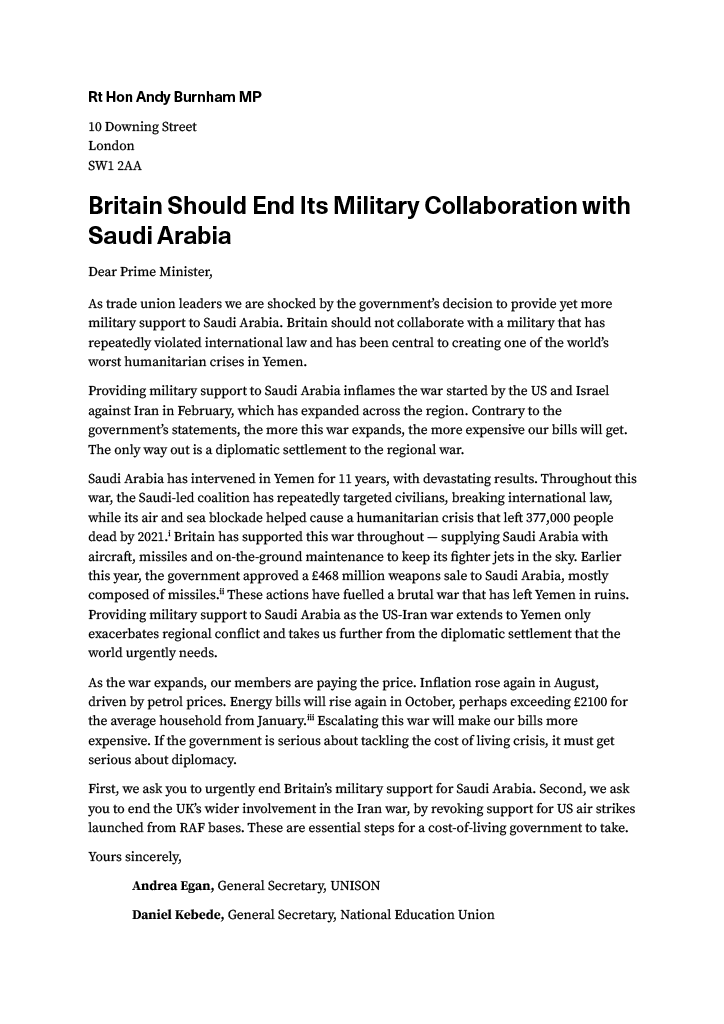
🚨NEW🚨: Ten unions call for Andy Burnham to end Britain’s military support for Saudi Arabia, due to the war crimes it has committed in Yemen.
The unions also argue that, contrary to government claims, “Escalating this war will make our bills more expensive”.

Lara Merling retweeted

🗣️ Our Global Research Director, C. P. Chandrasekhar, talks about capital mobility & domestic policy space.
📹This video was taken during conference "Towards new multilateralism: Cooperation for development in a world without hegemons", held last month in Beijing, China, in partnership w/ @Tsinghua_Uni's School of Marxism. More info: go.networkideas.org/4bY2cTD
Lara Merling retweeted

Few leaders explain economic policy to the public every morning. More governments could run their own mañaneras.
Thank you @Claudiashein for mentioning this week's meeting to discuss our report “State Transformation for Plan México” [link below], which sets out how public purchasing can build domestic capacity to deliver prosperidad compartida.

Lara Merling retweeted

En Palacio Nacional, recibimos a la economista Mariana Mazzucato; conversamos sobre el reciente informe "Transformación del Estado para el Plan México", elaborado junto con Lara Merling.


Lara Merling retweeted

Hoy me reuní con @MazzucatoM, quien me presentó su informe State Transformation for Plan México, coescrito con @LaraMerling. Agradezco mucho la oportunidad de conocer este trabajo y conversar sobre sus principales planteamientos en torno a la transformación del Estado y la construcción de una prosperidad compartida. Además, tuvo el detalle de obsequiarme su más reciente libro, Bien Común: Una nueva economía que funcione para todos.
El informe propone una arquitectura económica e institucional orientada a impulsar la inversión, ampliar la capacidad productiva nacional y promover un crecimiento más inclusivo y sostenible, cuyos beneficios alcancen a las personas, los sectores y los territorios.


Lara Merling retweeted
I’m excited to launch my new report, State Transformation for Plan México, co-authored with @LaraMerling , at @UNAM_MX next week.
At the heart of Plan México is a vision of prosperidad compartida — raising investment, expanding domestic productive capacity and ensuring that growth is shared across people, sectors and territories.
The report focuses on building the economic and institutional architecture needed to support the direction set by the Mexican government: turning this ambition into a new, more inclusive sustainable path to growth.
Hybrid | 22 Sept | 17:00 –18:30 CST | Register here ➡️ docs.google.com/forms/d/e/1F…
Read the report here ➡️ ucl.ac.uk/bartlett/publicati…

Lara Merling retweeted

The emerging elite consensus to bailout US AI companies is about preserving AI overcapacity and keeping the bubble from popping.
If elites were concerned about the fate of humanity, they'd be concerned about other things, like climate change, militarism, US foreign policy.
Lara Merling retweeted
Just in time for the latest oil price spike, we published our article urging the ECB not to hike rates to fight a supply shock. Europe needs a new inflation governance for shockflation. We need disaster preparedness for essentials instead of increasing investment costs.

Lara Merling retweeted
Wow — A new @Oxfam study finds that IMF programs today require FOUR TIMES the austerity cuts as a decade ago. The IMF also might bring back 1980s style "frontloaded" austerity demands, requiring mass cuts before lending even begins.
