“Let’s Explore The Night Sky Together”
- Tweets896
- Following8
- Followers244
- Likes191




ALT A highly-zoomed view of the crescent Moon, with Mars appearing as a bright reddish "star" near the edge of the Moon. Caption: "Moon occulting Mars" Image credit: Jeremy Stanley





ALT SLS and Orion traveling to Pad 39B atop the mobile launcher and crawler transporter

ALT NASA’s Space Launch System (SLS) rocket with the Orion spacecraft aboard atop the mobile launcher at Launch 39B at NASA’s Kennedy Space Center in Florida. Photo credit: NASA/Chad Siwik
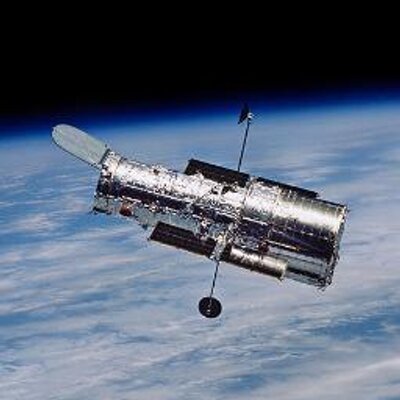

ALT Pale, nebulous clouds throng around a darker central area with a cluster of sparkling stars. These clouds are interspersed with darker filaments of deep brown and light blue. Orange stars peer through the clouds throughout the image.

ALT Fluffy tan-colored nebula clouds, with rust-colored highlights, surround a black central area. Within that area, the focal point of the image is one large yellow star with eight long thin points. To the right of this star is a bright star cluster in an oval shape. The stars within the cluster look like tiny pale blue sparkles. The cluster is more densely packed at its core and scatters outward. Towards the bottom of the image, multiple arms appear to spiral out of a cloudy tan knob. Taken together, the structures resemble a spider or a squid. Other blue and yellow eight-pointed stars, as well as distant galaxies, are dotted throughout the image. Credits: NASA, ESA, CSA, STScI, Webb ERO Production Team


ALT The Space Launch System rocket sits on the launch pad. In the background, the sun rises behind clouds. Green bushes sit in the foreground.


ALT NASA’s Artemis I Mission sits at launch pad 39B at NASA’s Kennedy Space Center.

ALT The star HIP 65426 & 4 views of its planet “b.” The background (Digitized Sky survey) image is black with white & blue stars. Star HIP 65426 is labeled at top center. It has 4 diffraction spikes (telescope artifacts) at the top, bottom, left, & right. Diagonal lines down from the star to the bottom of the image highlight 4 inset boxes. From L to R, 1st is Webb’s NIRCam view of the exoplanet. It's a purple dot with purple bars at 11 & 5 o’clock. The bars are telescope artifacts, not physically present. The planet & artifacts have been colored purple. The filter label says: F300M (3 micrometers). Next is a similar NIRCam view using filter F444W (4.44 micrometers), colored blue & with artifact bars. Next is a MIRI view, colored orange. No bars are present. The filter is F1140C (11.40 micrometers). Last, a MIRI view (a large red dot) with filter F1550C (15.50 micrometers). A white star icon on all 4 images represents the parent star.


ALT A group of five galaxies that appear close to each other in the sky: two in the middle, one toward the top, one to the upper left, and one toward the bottom. Four of the five appear to be touching. One is somewhat separated. In the image, the galaxies are large relative to the hundreds of much smaller (more distant) galaxies in the background. All five galaxies have bright white cores. Each has a slightly different size, shape, structure, and coloring. Scattered across the image, in front of the galaxies are number of foreground stars with diffraction spikes: bright white points, each with eight bright lines radiating out from the center.

ALT The background of space is black. Thousands of galaxies appear all across the view. Their shapes and colors vary. Some are various shades of orange, others are white. Most stars appear blue, and are sometimes as large as more distant galaxies that appear next to them. A very bright star is just above and left of center. It has eight bright blue, long diffraction spikes. Between 4 o’clock and 6 o’clock in its spikes are several very bright galaxies. A group of three are in the middle, and two are closer to 4 o’clock. These galaxies are part of the galaxy cluster SMACS 0723, and they are warping the appearances of galaxies seen around them. Long orange arcs appear at left and right toward the center.

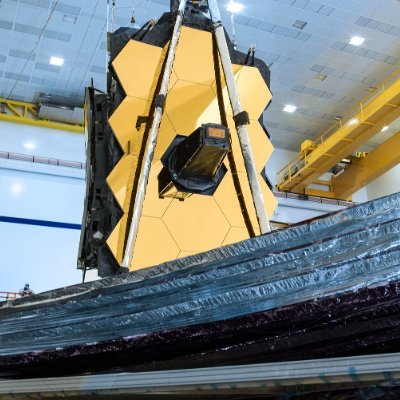
ALT Webb's golden mirror is reflecting the light in a dim room with a blue background. A person in a cleanroom suit stands on an orange lift in front of the mirror.