
Driving the development of a robust service & advocacy-oriented evidence base, enabling trans services & service users to have needs-based, impactful services.
- Tweets325
- Following725
- Followers1.5K
- Likes175

ALT Let's Talk about DATA What is data? Why do we collect it? How should it be stored and processed?


ALT We have already seen the negative effects of the media discussions of the report and want to reassure you that we will be taking time over the coming weeks to read and analyse the publications in full, and hope to share our fully-formed reflections with you, our community. All trans people, regardless of age, have the right to live as themselves, free from discrimination and violence, particularly from the institutions that should be there to protect them. It is vital that we preserve bodily autonomy for everyone. The continued attacks on trans people’s autonomy cause very real harm for trans people and all people fighting for the right to bodily autonomy. We will continue to fight for the care and dignity every trans person of every age deserves.

ALT We believe that the report recommendations will lead to further gatekeeping for trans children and young people, particularly around access to medical treatment. This Review will also have international implications that will cause direct and irreparable harm to young trans people. The Trans Learning Partnership knows the importance of centering lived experience and community expertise in creating impactful research. We have long been concerned that the Cass Review does not understand this importance, and we believe this is clearly reflected in the final publication.

ALT We are particularly concerned about the content discussing neurodiversity; social transition; and access to medications for children and young people. The report positions the fact that clinicians are unable to predict the future of children and young people’s gender expression as a critical failing of current practice. No service can or should aim to predict the future of children or young people’s lives and the idea that a clinician will know a young person better than they know themselves is in direct contradiction to the United Nations Convention on the Rights of the Child. The aim for clinicians should be to provide a safe, accessible and supportive service which provides individualised care to all children and young people it encounters. We also note that despite the review’s scope being limited to under 18 year olds, the report comments on adult care and makes recommendations which could be seen as threatening access to hormone medication for adults.

ALT The report is accompanied by several literature reviews prepared by the University of York. These reports determine that the evidence base in this area is generally of ‘low quality’. The report then dismisses this evidence, claiming that it cannot be considered in policy making. There is no acknowledgement that much of medicine, particularly for children and young people, uses evidence bases of similar quality to understand and direct developing policy. Additionally, the report makes multiple recommendations on the basis of other research without qualification to its quality. Some of these recommendations follow entirely spurious narratives and draw unfounded conclusions. The whole report is positioned in a way which considers continuation of current medication access as harmful, but removal of the current medication access as a neutral or beneficial act, despite no evidence to support this.

ALT On 10th April, the final report of the Cass Review was published. It is clear from the outset that this review has used a patriarchal, cisnormative view of society and questionable research etiquette to make claims and recommendations which will have outstanding and immediate negative implications for the care provided to children and young people. While there are some recommendations that we believe would be beneficial to children and young people and their healthcare access if appropriately implemented, these recommendations are delivered with a tone of cis-supremacy and transphobia which serves to undermine the rights of children and young people.


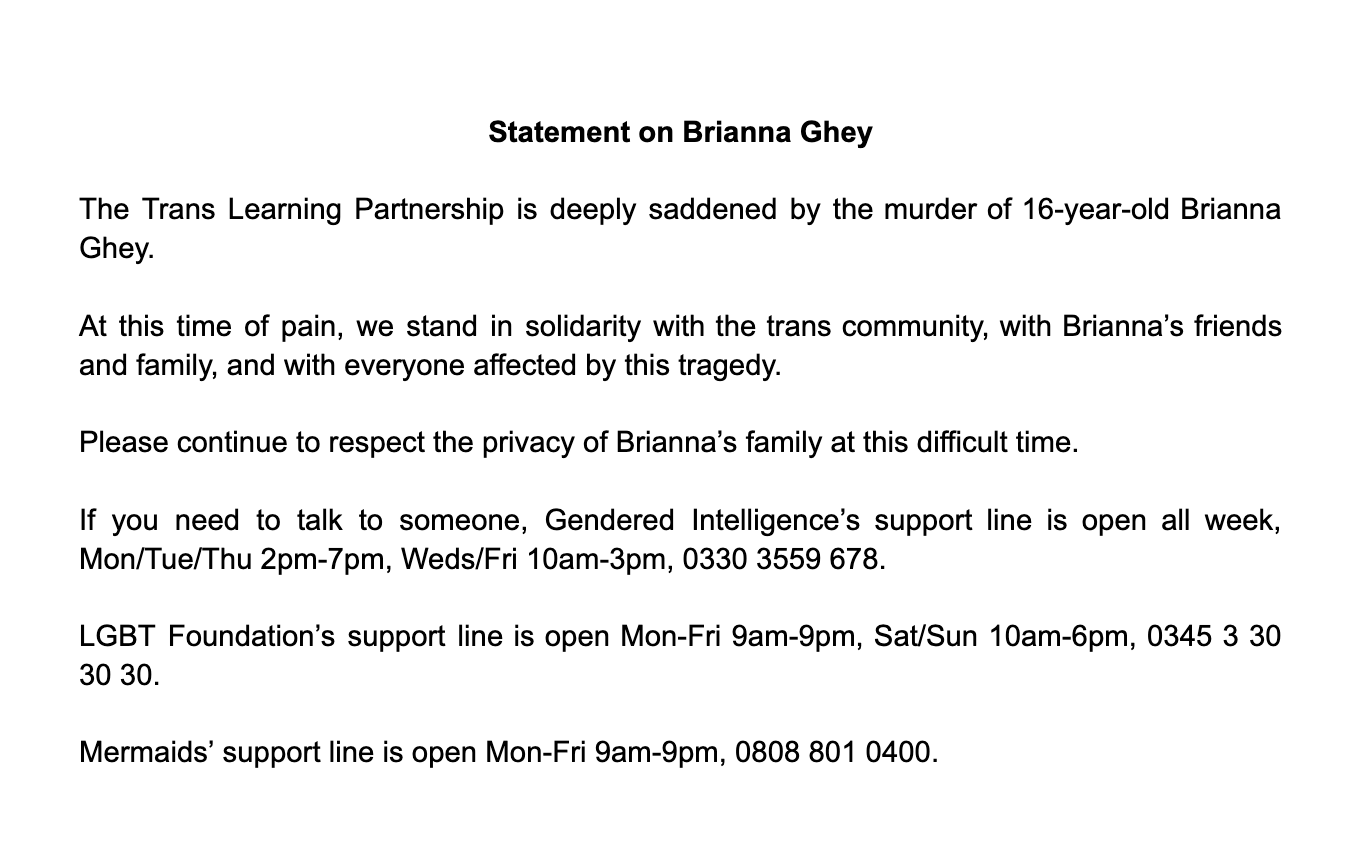
ALT Image reads: Statement on Brianna Ghey The Trans Learning Partnership is deeply saddened by the murder of 16-year-old Brianna Ghey. At this time of pain, we stand in solidarity with the trans community, with Brianna’s friends and family, and with everyone affected by this tragedy. Please continue to respect the privacy of Brianna’s family at this difficult time. If you need to talk to someone, Gendered Intelligence’s support line is open all week, Mon/Tue/Thu 2pm-7pm, Weds/Fri 10am-3pm, 0330 3559 678. LGBT Foundation’s support line is open Mon-Fri 9am-9pm, Sat/Sun 10am-6pm, 0345 3 30 30 30. Mermaids’ support line is open Mon-Fri 9am-9pm, 0808 801 0400.


ALT May 1968 graphic saying "la lutte continue"


ALT Logo of the Trans Learning Partnership. Three multi-coloured raised fists sit in the centre of a circle comprised of three arrows, labelled "trans", "learning", and "partnership".

ALT Poster with an image of two Black people. One is standing and smiling, showing off their pregnant belly - the other has their eyes closed and is pressing their head gently against their friend or partner's belly while holding their hand. The poster also features the colours of the trans and non-binary flags, logos for the LGBT Foundation and National LGB&T Partnership, and the following text: Are you a trans man or non-binary person who has given birth in England? We need your help to make NHS maternity services in England more inclusive. In particular we want to hear from trans men and non-binary people of colour (people from Black, Asian, and minority ethnic communities), as they are under-represented in this research project. We are a trans-led project running a survey to look at your experiences of birth. Please complete the survey at: https://www.surveymonkey.co.uk/r/itemsresearch.

ALT Since 2017, a moral panic over trans existence has been perpetuated by mainstream media outlets and politicians from across the political spectrum, plus a growing array of anti-trans campaign groups. Many of these groups will be responding to this Inquiry by calling for further restrictions to trans people’s access to healthcare services and single-sex spaces. Since 2015, trans people in the UK have also experienced a bewildering array of national consultations and inquiries. These include (but are not limited to): the Women and Equalities Committee Transgender Equality Inquiry (2015), an NHS England consultation on Specialist Gender Identity Services for Adults(2015), NHS England and NHS Scotland consultations on Specialised Gender Identity Services for Adults (2017), two consultations on Gender Recognition Reform in Scotland (2017-18 and 2019-20), a consultation on Reform of the Gender Recognition Act 2004 across the UK (2018)...

ALT Are legal reforms needed to better support the rights of gender-fluid and non-binary people? If so, how?Genderfluid and non-binary people are not currently either recognised or clearly protected within the binary legal conception of sex/gender. Nor are they protectedwithin the ‘permanence’ assumptions underpinning the GRA 2004. For example, the GRA 2004 requires trans people to affirm that they will remain in the gender identifiedin their GRA certificate ‘until death’, which does not take into account the possibility of genderfluidity. The Equality Act 2010 should explicitly protect all trans people, including those who are genderfluid and non-binary.

ALT Whilst future reform is necessary, we are deeply concerned that opportunities might betaken to water down the protections of the Equality Act 2010, should it be reformed. In June 2020, The Sunday Times reported that the Government was considering ‘newprotections’ to ‘safeguard female-only spaces’. In response, many women’s organisations and campaigners as well as trans and LGBT, party political and humangroups expressed concern. For example, representatives from LGBT groups in the Conservative, Labour, Liberal Democrat, Green, Scottish National, Plaid Cymru and Alliance parties issued a joint statement opposing the proposals.46 The CEO of Nottingham Women’s Centre wrote to the Prime Minister to report that herorganisation has ‘been a functioning trans-inclusive women’s space for over 22 years without any issues’, adding that: ‘Far from a protective measure, a move to further police women’s gender identity and presentation is a threat to all women, both cis and transgender’.