

We publish independent research on under-followed micro & small caps: business, industry, valuation, and what could change the thesis. Leo Frontier Research.
Atlanta, GA
Joined January 2018
- Tweets3.4K
- Following312
- Followers1K
- Likes2K




$LWLG is down 19% today, and the reason is one sentence on last night's call.
In August, Lightwave Logic said it was aiming for volume production in the second half of 2027. Now it expects 2028, after foundry delays and longer qualification.
The other 2028 date is cash. It had $87.8M at the end of September, down from $95.9M in June, and says that funds its plan "into 2028".
The good news was real. Foxconn demonstrated a transceiver built on Lightwave's polymer, running 200G per lane. Q3 sales were $38,000.
Our verdict: the technology moved forward this quarter and the calendar moved back. With production and the end of the funded plan now in the same year, any further slip likely means raising money before revenue arrives. Watch the early-2027 customer run on the final design.

2
216
$NXXT shows why growing revenue is not enough to make a small cap investable.
Nasdaq trading is due to be suspended at the open on the 11th of November. The company plans to seek a review, but says that will not delay suspension.
The warning signs were visible months ago.
1. April’s annual report showed just $384,000 of cash at the previous year-end, against $14.5m of operating cash burn during 2025. Additional capital was needed immediately.
2. August’s results showed revenue growing 41%, driven by mobile fuel delivery. Yet $1.96m of quarterly gross profit was smaller than $2.68m of interest expense. That is accounting expense, not cash interest paid.
3. July’s secured convertible financing raised about $1.8m against $2m of principal. Cash repayment at maturity carried a further 50% principal premium, plus interest. The lender also had conversion rights.
None of this made delisting inevitable. It made continued access to funding central to the investment case.
Our view: small-cap research must establish whether a company can fund its ambitions on terms that leave shareholders a worthwhile stake.
Before asking how large the business could become, ask what shareholders must give up to get it there.

1
1
758
$APPS fell roughly 37% today despite 27% revenue growth. We think the disappointment is understandable, but the recovery deserves a closer reading.
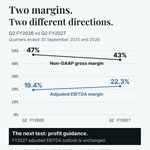
1. Gross margin weakened. Non-GAAP gross margin fell from 47% to 43% as revenue-sharing costs grew faster than sales. More advertising activity does not automatically mean better economics for Digital Turbine.
2. Yet adjusted EBITDA margin improved from 19.4% to 22.3%. Lower gross margin and better operating leverage happened in the same quarter. Treating every margin as the same number misses that distinction.
3. Cash generation improved too. Operating cash flow less capital spending was $10.0m, versus $6.7m a year earlier, by our maths.
The disappointment sits in the outlook. Management raised annual revenue guidance by $20m but left adjusted EBITDA guidance unchanged at $145m–$155m.
There is also a credibility issue: June revenue-sharing expenses were understated by $3.5m. The company says the correction did not change operating cash flow or covenant compliance.
Our view: the recovery is producing cash, but management has more to prove about how much of the growth shareholders will keep. The next convincing upgrade needs to reach profit.

1
237
$DSP’s $20m Waymark acquisition tackles a simple obstacle to TV advertising. Before a business can buy airtime, somebody has to make the advert.
We think making that step cheaper and faster could help Viant win more advertising budgets.
Three reasons this deal deserves attention:
Connected TV already represents more than half of advertiser spend on Viant’s platform. That spending grew nearly 40% year-on-year in Q3. Waymark strengthens a channel that is already working.
Waymark creates video ads from a company’s brand inputs. Viant wants to connect that creative production with its audience targeting and measurement, helping advertisers produce and test different versions more easily.
The deal closed on the 6th of November. It contributed nothing to the Q3 revenue growth of 29%. The existing business supplied that growth before this addition.
The competitive test matters. Amazon already offers AI-generated streaming-TV ads at no additional cost. Video generation alone will be difficult to defend.
Our view: the opportunity is to turn easier ad creation into more campaigns and repeat spending through Viant. We like the strategic fit. Customer spending and campaign performance will tell us whether the $20m was well spent.

1
134
$QUBT rose 8.4% Monday. In tonight’s results, interest and other income was roughly 30 times GAAP gross profit.
We think the real investment debate is what management can build with the money.
Revenue reached $9.5m, with growth primarily driven by acquisitions. That alone does not establish how quickly proprietary quantum products are scaling.
GAAP gross profit was $428,000. Interest and other income was $13.0m, mainly from cash and investments. Intangible amortization also depressed gross margins, so the reported 4.5% margin needs that qualification.
Roughly $1.3bn in cash and investments gives QUBT substantial staying power. It still lost $28.6m at the operating level this quarter.
The INmune Bio commercial agreement is a useful early customer milestone. Now we want repeat orders, better manufacturing utilization and stronger margins.
Our view: QUBT has financed the opportunity. Shareholders still need evidence that management can earn an attractive return on that capital.

299
$CECO is up about 23% today. We think the most demanding number in its new 2027 outlook is the profit margin.
At the guidance midpoints, revenue rises from $1.34bn this year to $2.2bn next year. Adjusted EBITDA rises from $212.5m to $500m.
That implies an adjusted EBITDA margin of roughly 23%, up from 16%.
Some growth comes from owning Thermon for a full year. These are not organic growth comparisons.
But the margin ambition deserves attention. Management says integration and synergies are ahead of schedule, and the vast majority of its $2.2bn backlog is permitted and underway.
Our view: the order book supports the growth case. Delivering those projects at the promised profitability is the harder test. Delays and cost overruns matter much more when expectations rise this sharply.
184
$APPS reports today at 4:30pm ET. We’re watching whether its recovery is producing enough cash to strengthen the balance sheet.
In the June quarter, revenue grew 27% and adjusted EBITDA grew 69%. Operating cash flow less capital spending rose from $1.2m to $11.2m year-on-year, by our maths.
That cash figure already includes interest paid. It is what remained after running the business and funding capital spending, before financing flows.
Our view: another quarter of stronger cash generation would make the recovery more convincing and give Digital Turbine more capacity to reduce debt.
The results were delayed from the 2nd of November to finish reviewing the unaudited accounts. Today we want clarity on that delay, continued growth and evidence that more of it is reaching cash.

1
517
$SVCO is on my radar for next week. Up 14.5% last week while the S&P 500 fell 2.7%. Strength against a weak market gets my attention, especially when there is a business reason behind it.
The shares jumped 15.6% on Thursday after Wednesday’s results. My read is that investors were looking ahead to a return to growth and profitability.
Three things stand out:
Bigger customers are buying. Silvaco won a major new customer for its chip-manufacturing simulation platform and four tier-1 customers for Jivaro Pro, which speeds up chip-design simulations. These tools help customers save engineering time and computing costs.
The Q4 outlook changes the earnings picture. At the midpoints, $22m revenue, roughly 88% adjusted gross margin and $16m adjusted operating costs imply about $3.4m of adjusted operating profit by my maths. Q3 recorded a $1m adjusted operating loss.
Management expects mid-to-high teens revenue growth in 2027. I like that Jivaro works alongside existing design software. Silvaco can win business without asking customers to replace their whole toolset.
The turnaround still needs proving. Q3 revenue fell 13%, total bookings fell 15%, and the company remained loss-making on a GAAP basis.
My view: there is enough commercial progress here to take the relative strength seriously. Next week I’m watching whether the post-results gains hold. Beyond that, the real test is whether those customer wins deliver the Q4 profit implied by the guidance.

1
286
$LMND grew revenue 73% in Q3. Gross earned premiums grew 33%. The gap matters: Lemonade is keeping more of the insurance it sells.
Passing less premium to reinsurers lifts revenue, while leaving Lemonade with more of the corresponding claims risk.
Gross profit rose 48% to $118.1m, so there is progress underneath. The net loss still widened to $43.7m.
Management guides to $5–9m of adjusted EBITDA in Q4. At the investor day on the 17th of November, I’d watch how it plans to turn that larger retained business into lasting profit without letting claims costs outrun premiums.

China’s $113bn lead over Taiwan as a supplier of goods to the US is down to $2.2bn.
Compare the first nine months of each year, adjusted for seasonality. US imports from China fell from $247.3bn to $218.1bn. Imports from Taiwan rose from $134.0bn to $216.0bn.
Taiwan’s own customs figures show what was in the boxes. Its exports to the US grew by $77bn. About $72bn of that came from one category that includes servers, computers and networking gear.
Taiwan reports October trade on Monday. The equipment shipments are the line to watch.

103
Two small caps sold a lot of stock this year at prices that look very good now.
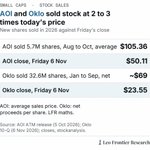
$AAOI sold 5.7M new shares between August and October at an average of $105.36. It closed Friday at $50.11.
$OKLO sold 32.6M new shares in the first nine months at about $69 each after fees. It closed Friday at $23.55.
For anyone looking at them today, that's the quiet upside of dilution done at the right time: AOI has $588M and Oklo $2.25bn from those sales, raised at 2 to 3 times today's price.
The flip side is why the price fell. AOI cut its year-end capacity target from about 650,000 to over 500,000 units a month. Oklo spends $400M to $500M on plant this year, before its first power plant runs.
Our verdict: a company that sells stock when it's expensive is doing its job. Whether it pays off from here depends on what that cash builds, and next quarter's capacity and spending numbers will show it.

289
$CLOV has lost money in the fourth quarter in each of the last three years, and its guide says it will again. That isn't the warning it looks like.
Clover earned $27.3M in Q1, $28.0M in Q2 and $6.4M in Q3 this year. The full-year guide of $25M to $35M implies a Q4 loss of about $27M to $37M.
Management calls it seasonal, and the pattern fits how Medicare Advantage works. The government pays plans a set amount each month, while costs climb through the year as members meet their deductibles and out-of-pocket limits. The selling season for next year, the 15th of October to the 7th of December, lands in Q4 too.
The fair comparison is last year. Q4 2025 lost $49.3M. This Q4 is guided to lose less, with about 46% more members.
Our verdict: judge Clover on the year, not the quarter. 2026 is guided to be its first full-year GAAP profit, and that's the number to check when Q4 reports.

7
492
Revenue is a story. Cash is a fact.
Three headlines this week, and the line underneath each:
$SOUN "raised" its 2026 guide. Take out the LivePerson deal and SoundHound alone is guided about $40M lower than in August.
$INOD beat by $12M and raised its year. On the call: its largest customer ended a program worth about $12M of Q4 revenue.
$AAOI posted a sixth straight record quarter. Its year-end capacity target fell from about 650,000 to over 500,000 units a month, after it raised $588M to build that capacity.
None of these is a disaster, and none of the headlines was false. Each was the company's chosen first sentence.
The habit we use: when you read "raised", "record" or "beat", go straight to the guide's fine print, the cash flow statement and the Q&A. That's where all three of this week's surprises were.
Our rule: read the company's first sentence, then go and find its second.

441
$INDI is up 32% today, and three analysts cut their targets this morning. Here's what the stock is reading that the targets aren't.
The business indie keeps after selling its China unit, Wuxi, did $40.7M in Q3, up about 14% on Q2. The Q4 guide has it at about $47M, another 15%, and management says gross margin moves to the low 50s once Wuxi is gone.
The Wuxi sale brings about $135M of gross cash, earmarked for the convertible debt. At Thursday's close the whole company was worth about $314M, so that one sale is about 43% of it.
The rest: non-GAAP profit targeted for Q2 2027, positive cash flow the quarter after, and humanoid robot design wins at AGIBOT, Unitree and Figure AI that aren't in its $6.2B backlog yet.
Our verdict: the market was pricing indie as a debt problem. Q3 showed a growing core and a way to pay the debt down. China's approval of the Wuxi sale is the thing to watch before year-end.

1
452
$FLY is up over 30% on the AST SpaceMobile engine deal, about $740M of new market value. The upfront payment is $800M. So far the market is pricing the cheque.
Half that cheque is stock. ASTS pays $400M in cash and 10 to 14M of its own shares, set by a forward average price. That band only adds up to $400M with ASTS between about $28.60 and $40. ASTS is near $31 and dipped to $27.58 this morning. Below $28.60, Firefly gets 14M shares and less than $400M.
The rest is $250M for the engines on the first three rockets and $250M of engineering over three years. After that, ASTS holds a perpetual licence to build Miranda and Vira engines itself.
Our verdict: the $400M of cash is real money for a company that had about $635M. The repeat business is the open question, because the licence lets ASTS build every engine after the first three without Firefly.

1
3
848
$REI is up about 5% today and hardly anyone is talking about it. The best number in the quarter wasn't in the income statement. It was a land swap.
In Q3, Ring sold 9,800 non-core net acres, carrying about 130 Boe/d, for $30.5M. It bought 16,500 net acres within and next to its own Central Basin Platform footprint for $18.8M. That's 68% more acreage for about 60% of the price, with $11.7M to spare. $10M of the proceeds went to debt, and another non-core sale, $13.4M, closed on the 30th of October.
On the call, the CEO put it plainly: the land it sold was "more valuable in the hands of somebody else."
The 2027 guide came down 500 Boe/d, to 21,000 to 23,000. Ring sold about 600 Boe/d along the way, so the plan for what it kept is roughly where it was in August.
The catch is cash. Ring spent ahead in Q3, with adjusted free cash flow of minus $13.8M, and says it will be positive for the full year. That needs more than $9.2M in Q4, on $43M to $48M of spending.
Our verdict: Ring is trading land it wasn't going to drill for land inside its own footprint, and getting paid to do it. Q4 free cash flow above $9.2M is the number that shows the spending ahead was worth it.

2
232
$SOUN is down 6% today, and most posts say its new 2026 guide beat the $238M analysts expected. That $238M was for SoundHound alone. The new guide includes LivePerson. Take LivePerson out and SoundHound is guided about $40M lower than in August.
The new range is $250M to $260M, up from $230M to $260M in August. But August's range didn't include LivePerson, which closed on the 4th of September.
On the call, the CFO laid out the bridge himself. Adding LivePerson to that $238M would make about $290M. The new midpoint is $255M, so about $35M is gone: roughly $8M from exiting loss-making contracts and $27M of licence revenue moving to hosted deals paid over time.
Strip out LivePerson's roughly $52M and SoundHound alone is guiding about $203M, against $245M at August's midpoint.
Our verdict: most of the cut is by choice, swapping up-front licence revenue for contracts that pay over years. The 2027 guide of $350M to $400M was held, and that's where the trade has to show up.

1
617
$INOD was up as much as 21% after hours. By 6:30pm it was up about 8%. One number from the call did it: $12M.
In mid-October, Innodata's "traditionally largest customer" ended one of its programs. Management says that costs about $12M of Q4 revenue, with new programs at that customer expected to replace it by Q1.
That explains most of the guide. The new 42%+ year implies a Q4 floor of about $79.6M. Q3 was $95.6M, or $83.6M without the lost program. The floor sits about $4M under that.
And the floor only counts booked work. On the call, management said large pipeline deals aren't included until they're awarded.
Two other things from the call: the $300M share sale program wasn't used in Q3, and the India layoffs reported on the 27th of October didn't come up.
Our verdict: the beat was real, and so is the hole. Q4 now comes down to how fast the largest customer refills it.

3
1,308
$AAOI fell 21% today and is down again after hours. The beat isn't the story. The capacity target is.
In August, AOI said it would be able to make around 650,000 800G and 1.6T transceivers a month by year end. Today that's over 500,000, and the 2027 US expansion is running late on power and construction.
In between, it sold 5.7M new shares at an average $105.36, raising $588M that it said would go into equipment and capacity. The stock closed at $46.84.
The Q4 guide is still $385M to $420M, up 43% to 56% on Q3's $269.9M.
Our verdict: the money arrived on time, the capacity didn't. Q4's step up now has to come from less capacity than promised in August, and 1 million a month by end-2027 still depends on a US build that's behind.
The question for the call: how much of Q4 needed the capacity that slipped.

441
$INOD is down about 13% today with no news, hours before it reports. The stock is already down 70% from its high. Here is what tonight has to clear.
The guide is 2026 revenue growth of 40% or more. On 2025's $251.7M that's at least $352M, so by our maths the second half only needs about $85M a quarter. Q2 was $92.1M. Innodata could shrink from Q2 and still meet its guide.
The real test is two customers. In Q2 the largest was 37% of revenue and a Big Tech customer 34%, together 71%. Innodata said its largest customer paid less in Q2 than in Q1 but would still grow for the full year.
Since then: about 550 layoffs in India reported by India Today on the 27th of October (not confirmed by the company), a new CEO since the 30th of September, and a $300M at-the-market share sale agreement signed the same day as Q2 results.
Our verdict: the guide is a low bar. The market isn't watching the guide, it's watching those two customers.
Watch two numbers after the close: Q3 revenue against Q2's $92.1M, and the top-two share of revenue.

1
945