
Postdoctoral fellow at @VectorInst. ML PhD at UBC. Mathematical and computational structures for ML. Geometric and algebraic methods.
Orlando Florida
Joined August 2020
- Tweets115
- Following40
- Followers328
- Likes106




Pinned Tweet
#ICML2024
Can We Remove the Square-Root in Adaptive Methods?
arxiv.org/abs/2402.03496
Root-free (RF) methods are better on CNNs and competitive on Transformers compared to root-based methods (AdamW)
Removing the root makes matrix methods faster: Root-free Shampoo in BFloat16 /1

I still remember the comparison between SGD and Adam a few years ago. Empirical results may not support that. So, wait and see just like the SGD vs Adam lesson.

Slow is Fast: Is Muon the end of Shampoo?
kexue.fm/archives/11917
Orthogonal Slowest Descent — from a convex optimization convergence bound — washes away any Kronecker preconditioner's eigenvectors, leaving only eigenvalues to balance the gradient's spectrum — leads to Muon.
On one hand, it is essential to tune baseline methods well on a model. On the other hand, it may be better to avoid using a model/architecture that has been modified and optimized for a single method for 1.5 years.

We will make Shampoo/SOAP, including KL-Shampoo/KL-SOAP, faster. Our goal is to match Muon's runtime while maintaining Shampoo/SOAP's strong per-step performance. Stay tuned for new updates.


Some initial steps to make Shampoo and SOAP faster arxiv.org/abs/2605.26327 We are working on further improvements.


Wu Lin retweeted
@weijie444 Looks like a KFAC-based method with modern clipping? G(ZZ^T)^{-1} is known as the FOOF update arxiv.org/abs/2201.12250 while msgn() can be interpreted as "generalized (preconditioned) gradient norm clipping" arxiv.org/abs/2506.01913 .


We released "The Newton--Muon Optimizer" . We show that Muon is secretly an implicit Newton method, and use this insight to build a better one. 1/n
Paper: arxiv.org/abs/2604.01472
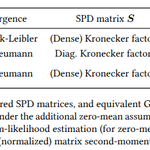
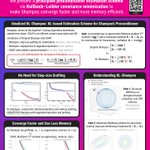
Within an information-geometric framework, we reconnect Shampoo/SOAP with both classical quasi-Newton ideas and Gaussian whitening, and develop practical methods that naturally handle tensor-valued weights in language model pre-training. arxiv.org/abs/2509.03378 opt-ml workshop

This work builds on my ICML 2019 paper (with @MarkSchmidtUBC and @EmtiyazKhan), extending a variational Bayes-based geometric framework to modern NN optimization. It can be used to design methods for Bayesian inference, numerical optimization, and gradient-free optimization.
This work is a joint effort with Scott C. Lowe, @f_dangel, @runame_, Zikun Xu, and @RogerGrosse.
Stay tuned for more updates coming soon.
Wu Lin retweeted

1/9 In practice, the Shampoo optimizer crucially relies on several heuristics.
In our NeurIPS 2025 spotlight paper, we investigate the role of learning rate grafting and infrequent preconditioner updates in Shampoo by decomposing its preconditioner.
arxiv.org/abs/2506.03595

Wu Lin retweeted

Huge thanks to my amazing collaborators. This project was led by @juhanbae along with @LinYorker and @RogerGrosse.
Supported (indirectly) by @Anthropic, @NVIDIA, @VectorInst, @UofTCompSci/@UofTArtSci/@UofT

Wu Lin retweeted

Are you LoRA fine-tuning LLMs and looking for easy ways to get improvements in accuracy? And also Bayesian uncertainty on top for free?
Then check our recent work, accepted @neurips24fitml workshop!
arxiv.org/abs/2411.04421

Natural gradient descent: (steepest) gradient descent under a norm induced by the Fisher matrix yorkerlin.github.io/posts/20…
Riemannian gradient descent (with geodesic retraction) : gradient descent in Riemannian normal coordinate

